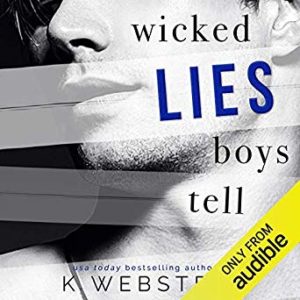
Wicked Lies Boys Tell
Narrated by Teddy Hamilton and Jacob Morgan
That right there, those names listed in the “narrated by” part of the header tell you precisely why I picked up Wicked Lies Boys Tell. And as expected, Teddy Hamilton and Jacob Morgan aced the narration in this New Adult GFY story about two long-term friends who fall out and then fall in love, their terrific performances helping to paper over the cracks in the story – of which there are quite a few; tempering the predictability and softening the sharp edges of some of the more obvious stereotyping.
Penn McAlister and Copeland (Cope) Justice
have lived next-door to each other all their lives and have been best friends
ever since they can remember. But that all changed one night when they were
sixteen and Penn, who had known for quite some time that he liked boys and not
girls, and liked his best friend the best of all, kissed Cope and Cope punched
him in the face.
For the past two years Cope has iced Penn
out and hardly spoken to him (and when he has, it’s to say something hurtful),
and has been dating the gorgeous, “tall,
blonde and vicious” Ivy while Penn looks on and blames himself continually
for the end of their friendship. He’s trying to concentrate on the future and
college and how wonderful it will be to be, at last, away from home and out
from under the thumb of his controlling, abusive father. But when Penn gets
into a drunken fight at a party (pulling a guy away from a girl who was clearly
not interested in him), it’s Cope who wades in to help break up the fight and then
takes Penn to the hospital to have his broken hand seen to. Somehow, that
starts to break down the barriers that Cope has erected between them and they
start spending time together again like they used to… except that now Cope
knows what Penn wants, and that he’s not – and never will – be able to give it
to him, because he is Absolutely and Definitively Not. Gay. (Or bi.)
Yeah. You keep telling yourself that, Cope.
As the two guys reconnect and start to
realise just how much they’ve missed each other and their friendship, Penn owns
up to not being quite sure of his sexuality. He’s only kissed one girl – an old
friend named Leah – by way of an experiment, and that didn’t really do much for
him, but he’s never kissed a guy (other than Cope) either, so how can he really
be sure? Cope thinks Penn should date some guys and maybe fool around a bit so
he can gain some experience and figure things out, and then they’ll be able to
get back to the way they were before, right? Best buds. He decides to help Penn
find someone… except that when he finds Penn making out with a guy from school,
Cope is furious – although naturally, it’s not because he’s jealous. Nope. Not
one bit. The other guy is just not good enough for Penn.
As the saying goes, “denial ain’t just a
river in Egypt”, and Cope continues to fight what is obviously a strong sexual
attraction to his best friend, feeling aggrieved at Penn for “making him feel this way”. Another
drink-fuelled exchange during which Penn accuses Cope of ruining his chances of
getting any sexual experience, leads to Penn saying that perhaps he should be
practicing his “skills” on Cope – a BJ is a BJ regardless of who gives it,
right?
We all know where this is headed, and one
of the best things about the story is the way in which Penn and Cope’s
emotional connection comes through, but the whole story is fraught with So.
Much. Drama that it often felt ridiculously overblown. And sometimes, the
language made it worse. For example, near the beginning, Penn is gazing at Cope
and remembering the kiss that did all the damage:
Penn:
“One passion-driven, alcohol induced kiss by a sixteen-year-old boy in love
with his best friend.”
Caz’s brain: :(
Penn:
“A killer kiss.”
Caz’s brain: Yeah.
Penn: “The
kiss of death.”
Caz’s brain: Okay, I get it.
Penn: “The
kiss that killed our friendship and gave birth to a hate monster.”
Caz’s brain: Jeez ! I said I get it!
And then there’s the drama-o-rama of the
sub-plot straight out of an historical romance wherein Penn’s arsehole of a
father wants Penn to marry Leah because he wants some land (or something) owned
by her father. They appear to agree to the idea while fully intending to get
out of it as soon as possible. Leah knows about Penn and Cope, who by this
time, are eagerly and frequently having sex with each other – but Penn and Leah
have to play the part of an engaged couple in public, which gets more and more
difficult for Penn to do and Cope to watch.
Cope is kind of a dickhead for the first
part of the book. He keeps throwing Penn’s attraction to him in his face, insisting
that Penn should admit he’s gay (because he hasn’t said it yet) and then
reminding him that he (Cope) isn’t. Yes, Cope is obviously hella confused, but
he’s still a dick. Fortunately, he does redeem himself once he admits the truth
about his feelings for Penn, and they’re a solid couple in the face of the
oncoming storm (and yet more drama) of their fathers’ disapproval.
Teddy Hamilton and Jacob Morgan are, hands
down, the best thing about this audiobook, both of them tackling the
purple-tinged prose with aplomb and managing to alleviate the overly dramatic
mood of parts of the story and bring some degree of reality to them simply by
virtue of their skill as vocal actors. They’re both extremely experienced and
accomplished performers and do a great job with their assigned characters –
Teddy Hamilton narrates Penn’s PoV and Jacob Morgan Cope’s – as well as each
other’s characters and the rest of the cast. Mr. Morgan is especially good in
Cope’s more assholic scenes, covering his vulnerability with a veneer of scorn
and snark, while Mr. Hamilton is great at conveying the hurt and longing Penn
feels towards his best friend.
I had quite a few issues with the story in Wicked Lies Boys Tell; not only is it clichéd
and ridiculously soapy, but many of the characters are painfully stereotypical.
Cope’s “I’m not gay but you can blow me” followed by his “I’m not gay, but I’ll
blow you” happens way too quickly,
and although Penn is supposed to be following a football scholarship, he hardly
plays any football (even after his hand is fixed). The ending is abrupt and
just plain… odd (Cope’s Dad steps up simply to piss off Penn’s Dad), and being
completely honest, I was a little uncomfortable with the fact that Penn and
Cope were just eighteen. That’s on me – I’m not the target audience for this
book in any case – but that doesn’t mean that the other issues get a pass. Wicked Lies Boys Tell is superbly
narrated, but if you do pick it up, be prepared to feel as though you’ve been
dropped into an English-speaking telenovela!
Recent Comments