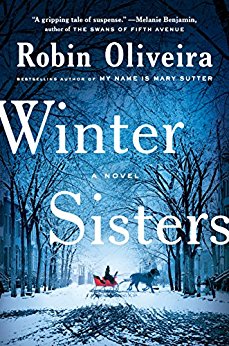
Winter Sisters
Winter Sisters is the follow-up novel to Robin Oliveira’s bestselling My Name Is Mary Sutter. It picks up some fifteen years after the end of the previous book, and can be read perfectly well as a standalone. However, if you, like me, haven’t gotten around to reading My Name Is Mary Sutter quite yet, it’s important for you to know that Winter Sisters does give a few things about the first book away.
In the winter of 1879, an enormous winter storm falls upon Albany. Roads are impassable, and the everyday business of life is brought to a jarring stand-still. Mary Sutter, Albany’s first female physician, does her best to see to the medical needs of her patients, but finds it nearly impossible to manage in the wake of the storm. When her neighbors come to her with the news that Emma and Claire, their two young daughters, have gone missing, Mary is understandably concerned for their well-being and sets about trying to locate them. At first, local law enforcement figures the girls just got turned around in the snow, but it soon becomes clear that something far more sinister has happened.
It isn’t until the spring thaw that the fate of Emma and Claire is discovered. They are returned to their family, but it’s obvious they’ve endured unspeakable things. Both girls seem unable to identify their captors, so Mary, against the wishes of several of the town’s most powerful residents, begins an investigation of her own.
Her efforts to uncover the truth behind the girls’ disappearance are met with quite a bit of resistance. No one, especially the chief of police, thinks Mary has any business poking her nose into a criminal investigation, but Mary will not be deterred. She knows something terrible happened to Emma and Claire, and she’s determined to see the party responsible brought to justice.
Winter Sisters is not an easy story to read. There are several passages that describe child molestation in a very detailed way, and I found myself having to step away from the book on several occasions just to give my heart and mind a break from the depravity on the page. We’re also privy to the horrible ways law enforcement officials treated sexual assault victims back then. It seems that the age of consent for girls was ten back in 1879, and, much to my disgust, several police officers seemed to blame the sisters for their ordeal. Obviously, these things still happen today, but something about the stark way Ms. Oliveira recreates them here made them especially hard for me to read.
In many ways, this is the story of how one crime can affect an entire town. So many people are affected by what happened to Emma and Claire, and the author lets us see things from many of their perspectives. I usually enjoy seeing things from several different points of view, but I found it kind of confusing here. It was hard to keep track of exactly who was who and how they were connected to the central characters. I wish the author had chosen a few characters to tell the story, rather than including so many sudden switches from person to person.
Mary is a wonderful character, and I definitely plan to go back and read the first book, which focuses on her struggle to be a female doctor in a time when such a thing was pretty much unheard of. By 1879, she is running a clinic with her husband, providing treatment to many of Albany’s prostitutes. She’s exactly the kind of hard-working, tenacious heroine I love, and I’m so glad I got to know her. I imagine readers who are already familiar with her backstory will be pleased to catch up with her again as well.
Winter Sisters is a dark and atmospheric historical mystery. The beginning is a little slow, but things pick up nicely about a quarter of the way through. However, it’s important to point out that this is not an action-packed novel by any stretch of the imagination, and for the most part, it relies on the setting and the characters to keep it moving forward. There are a few moments of high drama near the end of the story, but those are more the exception than the rule. Even so, I found myself riveted, and I read the final half of the book in a single sitting.
Due to some of its content, Winter Sisters isn’t a book that will appeal to every reader, but I urge fans of historical mysteries to give it a shot. It’s an unflinching look at a dark period in women’s history, and I’m glad I was able to stick with it. I came away from it feeling a little more gratitude for the rights I have as a woman living in modern times.
Buy it at: Amazon/Barnes and Noble/iBooks/Kobo
Recent Comments