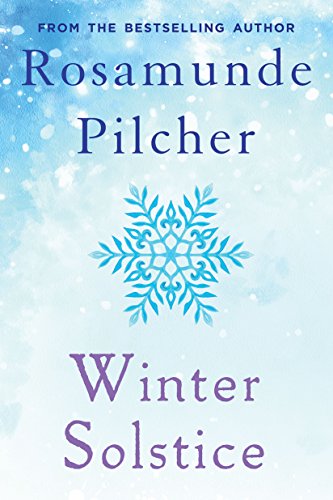
Winter Solstice
I’m not usually a big fan of women’s fiction, but I always read Rosamunde Pilcher. Sinead O’Connor may tell us that “England’s not the mythical land of Madame George and roses,” but when you read Pilcher’s books, you can’t help thinking that England is something of a mythical land after all. A beautiful place, where everyone’s house has a charming name and people always have delightful conversations over tea. Since Pilcher is not a particularly fast writer, fans must wait years between books. Winter Solstice is much anticipated, but unfortunately it is somewhat disappointing.
Winter Solstice mostly takes place over a few weeks around Christmastime, as an unlikely group of people find themselves sharing a home in Scotland. There’s Elfrieda Phipps, a retired actress, and Oscar Blundell, a man who recently lost his family in a car crash (or smash, as they say over there). They are first to arrive at the Estate House, of which Oscar is part owner. Later they are joined by Elfrieda’s cousin Carrie, who is recovering from a disappointing love affair, and Carrie’s niece Lucy, who has been left behind in England while her mother vacations in Florida with a new boyfriend. Last to join the group is Sam Howard, a man who has been living in New York for the last six years but has come home to the UK after separating from his wife.
This is a book about family, friendship, love and healing. For the most part, the characters are easy to like. They are all nice people who enjoy homey pursuits like making scones and walking the dog through the frosty countryside. Indeed, the frosty countryside is probably the best part of the book; Pilcher does an excellent job with the setting. It’s all described in such loving detail that the reader can almost smell the snow and the peat fires (although I’ve never actually smelled a peat fire, I can tell from reading this that they smell heavenly).
Although many Pilcher fans will find this worth reading for the setting alone, the rest of the book is disappointingly average. The problem is that not much really happens. The characters prepare meals, sit around, walk the dog, and talk – in exactly that order. There is much speculation about what will be eaten for breakfast and supper, and what visiting guests might like for tea. Admittedly, the food they eat is a whole lot more interesting than anything I’ve had lately, but I still didn’t want to read a whole book about it. And if there’s anything they do more than eat, it’s drink. I’m a teetotaler myself, so this didn’t bother me terribly, but I would think the characters repetitive indulgence in mid-day brandies and whiskey would send any recovering alcoholic straight to the liquor cabinet.
Pilcher’s books have always been a little slow at the start. I remember reading a passage at the beginning of Coming Home where the heroine combs her hair and unpacks her belongings into a bureau. The whole scene seemed completely unnecessary, and I couldn’t imagine why the author thought anyone would care about such things. But the book eventually moved on from that point to become a fascinating character study with a World War II backdrop. Unfortunately, Winter Solstice never quite moves past the hair-combing and food-shopping stage, which is really too bad. If you’ve never read Pilcher before, pass this one up in favor of Coming Home or The Shell Seekers.
Recent Comments