
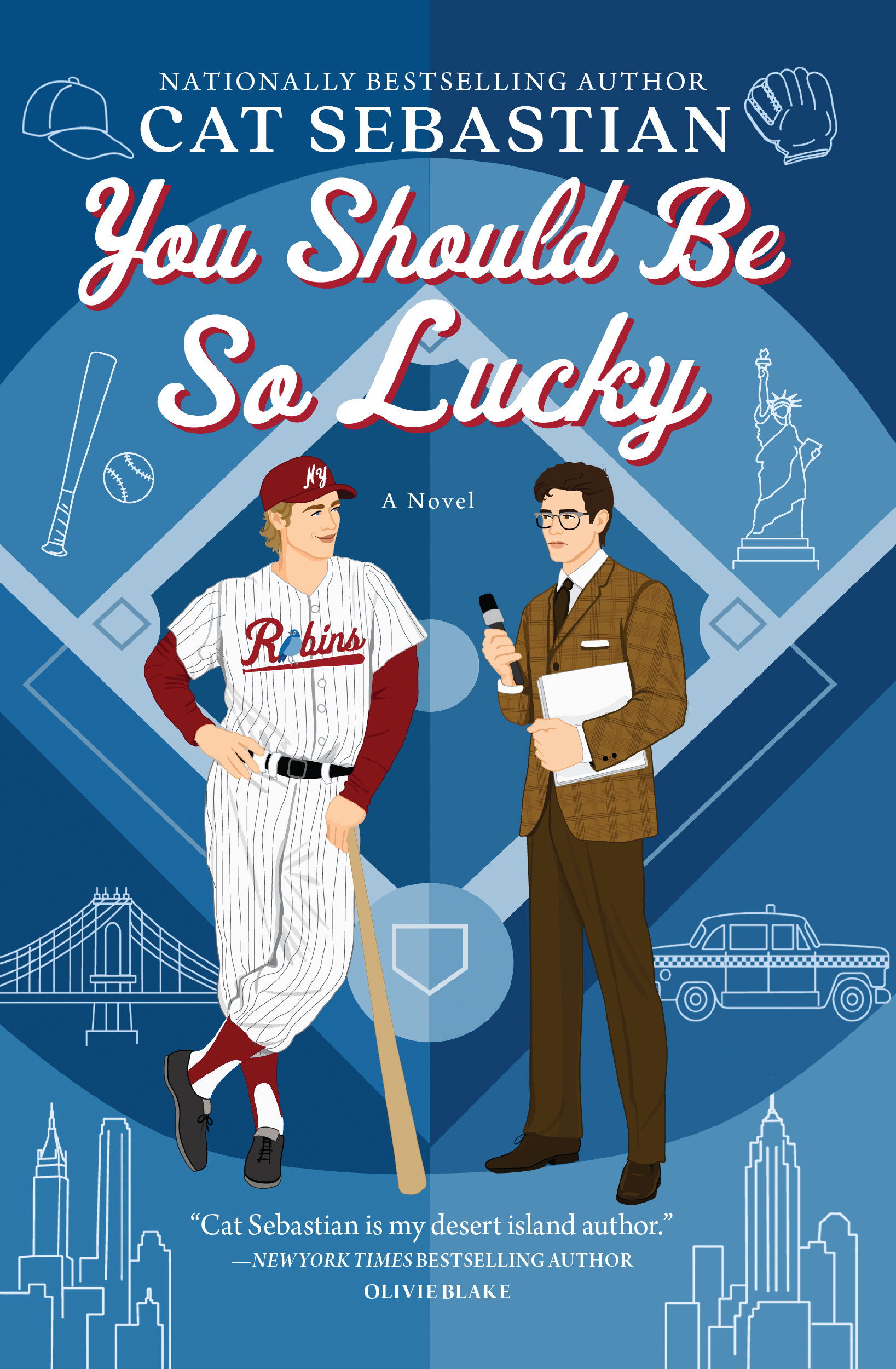
You Should be So Lucky
Set in the same world as We Could Be So Good, Cat Sebastian’s You Should Be So Lucky is another gorgeously romantic and tender story that, while dealing with some heavy topics, manages to be warm, funny, honest and uplifting – and reminds us that although life might suck at times, it can also be wonderful, especially when you find that one special person who can lighten the load.
It’s 1960, and rising baseball star Eddie O’Leary was having a great season with the Kansas City Athletics when he found out, on live television no less, that he was being traded to the New York Robins, a brand new team languishing at or near the bottom of the league. Not surprisingly, his reaction wasn’t the best, and his invective-filled outburst – also relayed live – made for big news up and down the country. To make things worse, he hasn’t played a decent game since and is experiencing a slump that might well be career-ending, his team-mates are ignoring him, and he’s still living in a crappy hotel room, mostly because he doesn’t think he’ll be sticking around long enough to get himself a place of his own.
When Andy Fleming, editor of the Chronicle, approaches arts writer Mark Bailey and asks him to consider penning a high-brow sports-based feature for the paper’s new weekend magazine, Mark is sceptical, to say the least. Andy wants to publish a weekly diary following one of the city’s ball players over the course of the season, but Mark isn’t particularly interested ghostwriting for a ball player, and when Andy tells him that the player he has in mind is Eddie O’Leary, Mark is even less so; he can’t think of anything more likely to get someone to throw their paper directly into the nearest trash can. But Andy is tenacious. He reckons there’s more to Eddie than the headlines suggest, and is sure that Mark is absolutely the man for the job. Mark still isn’t convinced until, at home, he watches the Robins’ game on television and realises that whatever is going on with Eddie O’Leary is a disaster – and that maybe here is something he can write about after all.
The last thing Eddie expects, when he’s summoned to the manager’s office, is to be told he’s to take part in a series of interviews for the Chronicle. He can’t do anything but agree to it, of course, but he can’t help hoping, when the reporter doesn’t show up in the locker-room after the next game, that the plan has fallen through. And then he notices the man standing apart from all the other sportswriters, leaning gracefully against the end of stall and turning the pages of a book, seemingly untroubled by the surrounding chaos. Eddie is completely blindsided by the other man’s casual poise and handsome face – even though Eddie has turned not noticing handsome men (especially in locker rooms) into an art form – but manages to get through the introductions without babbling something ridiculous. But when Bailey suggests they should get dinner, Eddie blurts out a ‘no’ so fast as to be rude – his teammates have enough reasons to hate him without thinking he’s cosying up to a sports reporter. Realising he’s put his foot in it, he quickly suggests he and Bailey meet the next morning instead – although he doesn’t stick around long enough to actually arrange a place and time. When morning arrives, and feeling embarrassed at having behaved like such a dick the previous day, Eddie decides the stadium is where he’ll most likely find the reporter – and is surprised when he steps from the elevator into the lobby of his hotel to find Mark there waiting for him.
As was the case with We Could Be So Good, there’s not a lot of plot here, and the focus is entirely on the characters and their developing slow-burn romance.The story that follows those awkward initial interactions as Mark and Eddie spend the next few months getting to know each other and falling in love, is full of incredible chemistry and gentleness and understanding while at the same time dealing with themes of grief and loss and loneliness, and about what it means to be queer at this point in time. The author does a fantastic job of showcasing the challenges faced by these characters in trying to balance their desire to live authentically while not opening themselves – and those they associate with – up to bigotry, discrimination and, possibly, physical harm.
At first glance, Mark and Eddie are very different men. Mark is prickly and elegant and precise where Eddie is sunshiny, big-hearted and garrulous (and apt to put his foot in his mouth), but scratch just a little beneath the surface, and they have more in common than even they realise at first; they’re both terribly lonely and are dealing with different kinds of grief. Mark lost his long-term partner very suddenly a year earlier and has been somewhat adrift ever since, and Eddie is grieving the loss of the life he knew and, potentially, his entire career – and yet somehow, all their ragged edges just fit together in ways that help them both to begin to heal and start living again. Mark isn’t good at opening up (understatement!) but Eddie is surprisingly perceptive and sees him as no-one ever has before, and Mark does the same for Eddie. Watching them enjoy a kind of quiet domesticity while slowly learning to lean on each other and let themselves love one another is just so very satisfying and lovely.
There’s a strong cast of secondary characters here, too, including George Allen, the much older, grizzled sports reporter who befriends Mark, and Eddie’s teammates and team manager – a former player who was dragged out of retirement to manage the team between benders. The author builds a strong sense of camaraderie between the members of the team and shows them learning to work together to improve their game and their chances. I know nothing about baseball, but I really liked the sense of this group of disparate players gradually becoming a cohesive unit that the author evokes.
I also liked the subtle exploration of the complexities of what it means to be out or closeted at a time when being openly queer was not only illegal but could be dangerous. Mark’s partner was headed for high public office so Mark had to be very careful almost all the time not to do or say anything that might cause suspicion, while Eddie knows queerness and professional sports don’t mix even as he longs for that part of him to be somehow recognised. As with Nick and Andy, neither man can be properly ‘out’, but what they can be is open with a select group of people who know what they are to each other – which I imagine must have been how many queer people were able to live and love as they chose at this time. It feels very realistic and period appropriate.
I can’t put my finger on why, but You Should Be So Lucky doesn’t quite reach the heights of We Could Be So Good, even though it’s a fantastic read and thoroughly deserving of DIK status. The writing is excellent, the character development is superb, and the slow-burn romance is full of genuine emotion, caring and decency. It’s one of those books you’ll finish reading with a heartfelt sigh and a smile on your face, and I heartily recommend it.
Recent Comments



I loved the romance, and it’s so well written, but felt the MCs needed more time growing on page. At the end I still didn’t feel I “knew” them? (And it’s a testament to how wonderful WCBSG is as well as the skill of this author that I expect to deeply know her characters!) However, there was an awful lot about baseball and fixing Eddie’s swing which was just pages where the MCs weren’t interacting. And I ended up really disliking the manager – like, it’s ok to sanction not talking to your star player for weeks, to be a womanizer, do drugs and then encourage your players to also drink, drug, cheat on their wives but, hey, that’s all ok because at least he isn’t a racist. So I fluctuated between loving the MCs and hating everything about baseball subplot.
I agree about the baseball (it’s one of the reasons I struggled with KD Casey’s books – too much baseball in too much detail) – although I suppose that given the problems with Eddie’s game are a key part of why he’s where he is, there had to be at least some page time devoted to it. The problem is that I know absolutely nothing about baseball, which makes it impossible for me to understand why whatever Eddie was doing and changing would make such a difference. I get authors who love a particular sport wanting to write about it and wanting to get into nitty gritty detail – but they need to realise that by doing so, they are going to automatically exclude some of their readers some of the time. Quite honestly, I dislike all sports equally – I just skim the sporty bits in sports romances to get to the bits I AM interested in!
I ended up wondering if there might be a story for the manager in there somewhere – he certainly does seem to have something of a troubled past.
I don’t want to undersell how much I did enjoy this! Especially the 2nd read where I could skim the parts that weren’t essential e and enjoy the meat of the romance! I’m sure Ardolino’s “redemption” -especially his attempts to overcome his alcoholism – is part of the whole ‘second chances / rally from adversity’ theme but I was unreasonably annoyed by his character. More Mark-Eddie interactions! Less the rest of the team being unlikeable.
It’s definitely different if baseball interests you, or you at least know something about it. Years ago I followed MLB and I enjoy the game more than other major league sports. It takes finesse and a lot more thinking on your feet than one might think. Anyway, I really enjoyed the sports parts. But even if I hadn’t known much about the game, I loved the interactions, like when they were trying to help Eddie correct his swing. It gave more depth to the seconday characters and their relationships to each other and Eddie.
To me the manager was a great character because he’s flawed, complex, and struggling. No, I wouldn’t want to be his friend, but I thought he was a pretty savvy manager and just a larger than life individual. I’m really tired of so many sports, or other romances where everyone is just too perfect and PC and boring. This book has interesting characters and complex situations without a bunch of angst, which I don’t generally enjoy. The baseball background is realistic for the time period (and not that far off from today unfortunalty) being a good ole boys network. Anything else would have felt very unrealistic. Of course, I realize I know it still might not be everyone’s cup of tea and that’s fine, but I found I really liked the grittiness here.
I needed the baseball parts (of which I know nothing, but the tricks to get Eddie working again I know from other settings) and I needed the team development for a full experience. The trainer worked perfectly as a warning sign of who Eddie might become, if he did not live his truth, and I really liked his (just signaled, not told) redemption arc. The precarious situation of the two leads felt so much less so because the people around them were giving them a bit of cover, of acceptance, of protection.
More page time for our two heroes: if I like them, I always want that.
But to me, all the subtle not explicit things between them were beautiful, and fit their precarious times.
I like the discussion, but the book felt different to me. I needed thos things that irritated others for a well rounded book and for my deep satisfaction with it.
Potential spoilers:
The casual cruelty (not talking to him for a month) was very much of those times. I liked how it made the times real to me, also the drinking and the women – it just was like that, and I prefer that to a fictional 1960-ies. And I appreciated how much underlying kindness there was, from many of the characters, such as respecting, taking care with the women despite it not being the norm.
I deeply appreciated the very quiet hints at resisting racism, and how the trainer got his reputation for casual violence because of it. Well written without overwhelming the main story.
The scene where the trainer takes Eddie to Greenwich village, which I took for protecting him while he looked for a quick encounter (in the trainer’s mind) showed me how far people were willing to go for the main couple.
Finding a nearly hidden entrance so as to have a joint apartment was the best possible, not the good, solution, and showed Eddie’s commitment to living together (I understood that Mark’s former partner must have had an official apartment too, otherwise Mark only finding out about his death by chance would not have worked).
I’ve been looking forward to this one, since I absolutely loved WCBSG. My hubby is away this weekend, so I am saving it. I think it’s hard for any author to “knock it out of the park” with back to back books, so I will be more than happy if this one is an “inside the park home run” or even a triple. Sorry for the baseball lingo, I know it’s cheesy, but I couldn’t resist.
Finally finished my review of the audiobook, so I could read your review now! :-) I do love the way you phrase things.
Anyway, I really enjoyed this and because I was struggling to write a worthy review, I listened to it a second time just a couple of days after finishing it. I enjoyed i tjust as much the second time, maybe more because I could just relax and enjoy the prose, which is really good. I loved the descriptions and the sense of time and place, plus the emotioanl parts hit a perfect balance for me, not minimized, but not pitched to overwhelm, either. It’s just a lovely lovely story. My only complaint is that I didn’t 100% like the way it ended, sort of?
That’s what made this an A- While We Could Be So Good was a solid A.
I wonder if Eddie is OK with it? With the point being, unlike William, he is CHOOSING Mark over everything, including his supposed dream. Eddie says ” The fact that he even has to worry about being found out is a knife to his throat – it’s frightening and wrong and not even remotely fair – and if one day the price he has to pay to make it go away is his career, he’ll pay it with no regrets.”
Have heard mixed things so far about this one, but it’s definitely on my TBR!
Really? I haven’t seen anything negative… but then I’m not online all that much tbh!
It’s been getting some B- to C+’s around in my reading circles. I sense I’ll probably like it!
I just finished it last night and totally agree with your review, although for me I liked both books equally. I know nothing about baseball but quite liked that the author did not treat it too seriously given that it is basically an adaptation of rounders but for grown men (although I’m sure American readers will disagree). I thought she evoked the era and the difficulties the protagonists faced at that time well. I grew up in Scotland in the 50sand 60s and looking back I remember my grandmother had two single male friends who were always together and on reflection I very much suspect they were gay. Although things have thankfully progressed in the last 60 years it is unfortunate that it is still not easy for professional sportspeople to admit their sexuality but hopefully things will become easier as time goes on.
I kind of zone out whenever baseball (or any sport, really) gets too much page-time in romances!
I totally agree with your review.
I read it in practically one go, as soon as I had it.
I feel warmed and hopeful despite the realistic hard times surrounding our heroes. This reminded me that we can create our areas of contentment and well-being even in hard times in the wider world. And that bad times pass.
I felt that the two books are nearly the same kind of beautiful and happiness-inducing, but, for no specific reason, this was just a tick less overwhelmingly beautiful.
Maybe the first book felt so special because she found her beautiful voice for this time and group so well, and this time, she did it again? It was not so surprising.
Maybe her portrait of New York in all its details was so much part of the first book, it was so vivid ? I I just reread the first few pages and really smelled the old fashioned subway smell…
Maybe Nick was a grittier character and so his journey was more intense to read?
Or it was base ball which I do not understand and so I connected to it less?
Maybe a reread will change this ranking, my love of both books is nearly the same.
As I said, I can’t put my finger on why, but this one was just a >< below a flat out A. It’s still a wonderful book, though.