
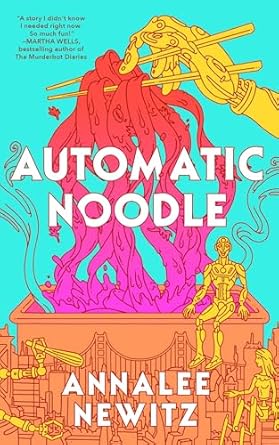
Automatic Noodle
Acclaimed author Annalee Newitz has a swing and a miss with Automatic Noodle. A short story with multiple heavy themes, the work’s failure to adequately explore many (if any) of the points it makes has it falling far short of first base.
The war has ended with California being independent of America. Staybehind, a former bot soldier who is an HEEI (AI/Sentient Robot), suddenly awakens one morning to find that he has been offline for months and is currently standing still in a restaurant which is about to flood. He checks on his friends/co-workers, Sweetie, Hands, and Cayene, and finds them frozen in place. After a few moments of web surfing to figure out what has happened, he manages to get them up and running again. Once they’ve dealt with the flooding issue, they discover that the original owners of the café where they work and live have absconded and essentially closed the company. The robots are on their own.
Hands has always dreamed of making biang biang noodles, and with the help of Cayene, he convinces the others to use their existing location to go into business for themselves. After some negotiations regarding building ownership and contracts, they rebrand as a quality lunch spot named Authentic Noodle and quickly gain popularity, with their initial reviews ranking them as among the best lunch places in San Francisco. Then SuzyQ, a starred reviewer on the prime food platform, outs the restaurant as a robot-run institution. Soon, they are dealing with robophobes and a plummeting rating that threatens to put them out of business. If the restaurant goes under, they will be repossessed. All robots must reimburse their manufacturers to be free, and the debt tends to be astronomical, resulting in a lifetime of payments or enslavement. Will they be able to figure out how to stop SuzyQ and her cohort of haters before it is too late?
This is a short story billed as ‘cozy science fiction’, but the endless discussions of social issues – slavery to debt, the thinly disguised “robophobia”, homelessness, immigration, AI – keep it so firmly mired in twenty-first-century political problems that it is in no way the warm, fuzzy escapist read a cozy is meant to be. What makes things worse is that the work’s short page count prevents these issues from being intelligently addressed. For example, Robbles, a human friend of the droids, says that he had lived in California before the war, but still wasn’t a legal citizen and could be deported back to America. This sent my mind into a loop about just how citizenship would work in a liberated California. Would you have to have been born there? Fought in the war? What if you couldn’t fight for some reason? So many people who live in California have moved there, so if they had stayed during the bombings, why wouldn’t they be legal residents? It is clear that the character of Robbles is meant to be a statement on illegal immigration, but my confusion surrounding his status made it irritating rather than thought-provoking. Fortunately, I knew what I should think, not because of how Robbles’ story is rendered, but because the author uses Cayene and Staybehind as mouthpieces to tell me.
That’s one of the main problems with the book. The writer must have known that none of their points made sense based on the text and needed further explanation, because there is a lot of spelling things out for the reader. No issue seems to be brought up without the feelings, thoughts, or statements of one of the characters telling us just what the right way to process it is. Which is hella awkward when it comes to the most significant issue underlying the narrative – AI rights. To be fair, I am reasonably certain that the robots are intended to be representative of marginalized communities. That might have worked forty or fifty years ago, but in a world where machines are increasingly thrusting humans out of jobs and even taking over doing racist rants for us, it simply doesn’t compute. The probability that humans and automatons will become equally sentient at some point is far greater than it has ever been before, and as we grapple with the loss of writing positions, accounting positions, translators, travel/booking agents, and manufacturing jobs, it is not easy to sit down to a chronicle using robots as stand-ins for humans that argues in their (the robots’) favor. Especially when that tale juxtaposes the realities of homelessness with the rise of robotic rights. I needed there to have been a much deeper and more nuanced approach taken to something that encapsulates this huge current issue than what is offered here. Add in that it feels like cultural appropriation for the droids to produce a handmade, specialized product associated with a specific human culture, and I just couldn’t with this text. I couldn’t accept the underlying but unaddressed message regarding AI, couldn’t deal with the endless preaching against “robophobes” who would have decidedly different points than the homophobes I am ninety percent sure they are meant to represent, couldn’t understand how the heck the world this tale takes place in actually works, couldn’t accept that sometimes people are just homeless and throwing some compassion at them is enough – and couldn’t give this a good grade.
Beneath all its problems, Automatic Noodle has an extremely interesting premise and some decent prose. They aren’t, unfortunately, enough to pull it out of the mire it eventually devolves into, but they do keep the story from being completely unreadable. It might work, perhaps, for someone willing to simply accept the surface story, but if you think about your reads at all, this one doesn’t bear up under any kind of scrutiny.
Recent Comments


I feel like a lot of novels are trying hard to be the next Tomorrow and Tomorrow and Tomorrow, but it’s just not working.
I feel like a lot of novels are trying hard to be the next. . . . which is a real problem. Publishers want a next and i think that channels creativity into some predetermined tracks that actually stifle it.
YEP