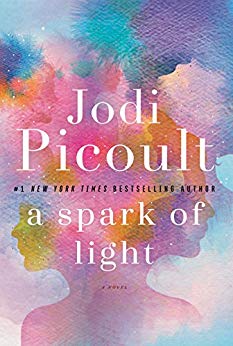
A Spark of Light
A Spark of Light is the latest novel from bestselling author Jodi Picoult. In it, the author explores the timely issue of women’s reproductive health, and the way the pro-choice vs. pro-life debate impacts the lives of people everywhere.
When a gunman bursts into a women’s reproductive health center on a sunny autumn morning, ready to get even with those he holds responsible for providing an abortion to his teenaged daughter, a group of people’s lives are changed in unimaginable ways. For hostage negotiator Hugh McElroy, it starts out like any other case. He’s hopeful he can defuse the situation before too many people are hurt or killed, but when he learns that his own young daughter is one of the people the gunman has taken hostage inside the clinic, the stakes get a whole lot higher. Knowing he’ll be removed from the case if his connection to one of the hostages is revealed, Hugh keeps it a secret from his superiors as he struggles to make a connection with the angry man who could be responsible for the death of the person Hugh loves more than life itself.
Fifteen-year-old Wren can’t imagine how things went so terribly wrong so quickly. All she did was go to the clinic to gain access to birth control, and now she’s hiding in a storage closet, hoping to escape the notice of the gunman. The only thing keeping her sane is the thought of her father working desperately to keep her safe.
AAR reviewers Shannon and Lisa got together to discuss this complex tale.
Shannon: I’ve loved so many of Ms. Picoult’s previous novels, and I was really excited to give this one a try. The synopsis intrigued me, and I figured someone as talented as she is would create a fascinating story. Unfortunately, this one didn’t end up working for me nearly as well as I hoped it would. How was it for you?
Lisa: I’ve had a lot of mixed opinions on Picoult over the years; her last two books absolutely didn’t do it for me, and this followed a lot of the narrative mistakes she’s been making lately – teenage protagonists wise beyond their years, court cases that don’t mean much to the overall scheme of the story because they’re too broadly told, tons of PoV characters; in fact I think this book broke the land-speed record when it comes to the highest number of central PoV characters she’s ever portrayed – but I found it much, much more compelling than I have found her other recent novels. It kept me reading all the way to the conclusion, even though I found that conclusion narratively unsatisfying.
Shannon: For me, the thing that sets this book apart from others I’ve read by this author is the narrative structure. We first meet the characters at five pm, and the story progresses backwards from there. Personally, I don’t care for this style, as I find it difficult to invest in the story when I already know the outcome. What are your thoughts on that?
Lisa: It absolutely made the narrative harder to track; even worse, the style in which the story is told frequently pulled me away from an important narrative moment just as it was unfolding. Picoult’s usual cast of thousands detracted from the urgency of the book; I’d be getting into the drama of the moment and suddenly we’d be back in Louie’s childhood again.
Shannon: It was also really weird for me to read about how a character had died, but then see them alive as the story progressed. And I totally agree with you; there were way too many supposedly central characters. Did any of them resonate with you more than others? I think Wren was my personal favorite, and I was surprised by how much I ended up liking Hugh. Father-daughter relationships are fascinating to me, and I loved how the author depicted this one.
Lisa: The answer to that one’s easy for me; as always, Picoult’s way of capturing teenage voices made Wren my favorite. I did like Peg as well as Hugh and his sister, and the Wren and Hugh relationship was absolutely the best part of the novel.
On the other end of the spectrum, I found the heavy-handed symbolism with Janine and Joy annoying – did you?
Shannon: The plot involving Joy and Janine was too clichéd. Like you, I’m guessing it was supposed to be symbolic, but I couldn’t bring myself to care very much about either of the women.
What did you think of the shooter? Were you able to identify with him at all? I obviously didn’t agree with his actions, but I could understand a bit of what he was going through. I love the way Ms. Picoult is able to make me see all sides of an issue, even when one side is the complete opposite of my own beliefs and opinions.
Lisa: I had a very hard time relating to him. While it was clear that at one point George had moral fiber and a backbone, and I could understand his feeling devastated that his daughter was slowly pulling away from him, he became a stereotypical cardboard cut-out evangelical Christian character somewhere in the middle of it all – and I especially stopped trying to understand him once he ceased to be able to relate to his daughter because she stopped being the little girl who symbolized his worth as a human being. Their relationship honestly was borderline creepy and I couldn’t blame Lil for struggling against the bonds that held them together. The choice he made to do what he did would’ve made a lot more sense if Lil had died thanks to the procedure, or if somehow the Plot Spoiler I Won’t Reveal had been tilted against her by the Center’s existence.
Moving on: until the Necessary Revelation that tied it into the rest of the story, I felt like Beth and Mandy’s part of the story was pointless. While an attempt at shedding light on the punitive state laws that have been chipping steadily away at Rowe v Wade, it ended up feeling more like Picoult was trying to wedge her typical court plot into the narrative, resulting in an uneven picture. It did make me like Mandy – but made the actions of another character make little sense. What did you think?
Shannon: I was puzzled by the author’s choice to include Beth and Mandy in the story. I wholeheartedly agree that this particular subplot gave the story an uneven, choppy feel, and I honestly think A Spark of Light would have been far more enjoyable without it.
However, I was really drawn in by the way the various hostages related to one another. It was very clear many of them disliked one particular woman, but they were still able to work together in an attempt to keep each other safe. Did you think this was realistic?
Lisa: Oh, definitely; one of my favorite parts was how all of the women and doctors worked together; how they communicated via the bathroom and rolls of toilet paper, how they weren’t afraid to get their hands dirty to survive. THAT was the sort of symbolism that actually worked for me.
Lisa: To a heavier topic: the book tries to shed a little bit of light on the fact that women’s health clinics do so much more than provide abortions. They help with mammograms, provide birth control, help with ultrasounds and women’s natal health – and Ms. Picoult also used some honest but very graphic depictions of what an abortion actually entails for the person who has it to try to destigmatize that activity. In general, do you think Picoult succeeded in portraying the complex reality of abortion in America, especially by giving George, Janine and even Lil voices? I found her attempt at trying to be even-handed sometimes transcendent, sometimes unworkable, at worse hyperbolic (“We’re all drowning slowly in a tide of our opinions”, she has a character say, which might well be her mantra as an author). The evenhandedness is typical of her sees-all-side-of-things ways as a writer, but omniscience doesn’t work when you’re trying to balance action with emotion and a large canvas.
Shannon: Abortion is such a complex issue, and I think it would be hard for anyone to accurately capture all the various nuances. Ms. Picoult succeeded as well as anyone can with something like this, but the whole issue feels too big and broad to be handled in novel form. Still, I applaud her for trying. She’s an author many respect, so she’s sure to reach a wide audience.
Lisa: Indeed, it’s a hard thing to try to pull together a novel like this with a fair, neutral voice, and at that much she succeeds.
Shannon: What is your final grade? I’m going to have to give this a C. It had so much potential, but the way it was structured made it really difficult for me to read and enjoy. I felt like I would have related so much better to the characters if I could have learned their stories in a way that made chronological sense to me.
Lisa: It gets a C from me as well. This is much, much better than most of Picoult’s latest work, but the narrative as a whole absolutely suffers both from a lack of a proper concrete ending for most of its characters, some stock character choices, and its overly-complex framing device. Next time she should stick to maybe four main PoV characters and work from there; eleven is frankly too many for a barely 300 page novel.
Buy it at: Amazon/Barnes & Noble/iBooks/Kobo
Recent Comments