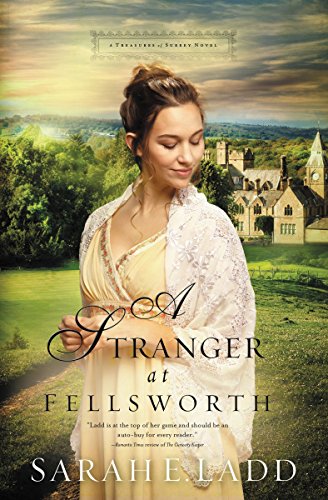
A Stranger at Fellsworth
Reading historical romance presents history fans with a conundrum. I’ve heard it said that much of the history presented in these novels is “Heyer” history or “Austen” history, meaning that the facts placed in historical romances are influenced more by what these fiction authors wrote than by actual historical events. It’s hard to know then what is anachronistic. Do I find something odd simply because the event/factoid is actually untrue to the period or because it is untrue to how Heyer or Austen would have presented it? Either way, A Stranger at Fellsworth presented me with some historical hiccups which kept a good book from being stellar.
Miss Annabelle Thorley has fallen on hard times. Or more specifically, her family is in dire financial straits, a fact which has affected Miss Thorley’s fortunes. Her engagement has ended. Her mother’s beloved belongings have been sold off to pay creditors. And now an attempt to rob her has been made by a young woman who was the belle of the ball in their circle not two years earlier. If not for the timely intervention of Mr. Owen Locke, Annabelle would have lost her reticule along with the few precious coins she had left within.
This is an important moment in the book, the scene where the hero and heroine first meet – but I’ll admit to being completely distracted by what was happening with what the text described as the young “beggar woman.” I couldn’t understand how a young woman of quality could fall to thieving in the streets. I would have presumed some position would have been open to her – whether it was shop girl, governess, lady’s maid, companion for an elderly relative or even the mistress of one of her many admirers. The social circle Annabelle moves in is comprised of a rather hedonistic group of young men, so if this girl had indeed been the beautiful diamond of their group, offers such as that should have been forthcoming. I filed this away in my mind for later and tried to get back to the story.
Later that evening at a party Annabelle attends, we see her erstwhile fiancé. Once more, I got mired in confusion as it seems he was the one to end their betrothal. My understanding, from numerous romances and a bit of internet digging, was that this was not the done thing. A lady could cry off but not a gentleman. While I pondered that bit of information, Annabelle’s brother got drunk, and then created a scene when he advised her to marry one of his friends – an older man who is portly, bad-tempered, ill-mannered and a slovenly dresser besides.
Annabelle, of course, has no intention of doing that. She is forced to share the carriage home with the man along with other of her brother’s drunken friends, but when it’s time to disembark she ignores her suitor’s proffered hand and exits the carriage on her own. Her plan is to lock herself in her room but before she can escape, the rejected Romeo demands an answer to her rudeness. They have a minor altercation which Annabelle hopes is private but when she manages to disengage from the scene she realizes they have a witness; the same man who came to her rescue earlier that day is standing in the shadows, watching her.
Naturally, she demands to know why he is there and is surprised when her gentlemanly rescuer explains he is the servant of one of her brother’s guests. The reader already knows that he is actually a close friend of that gentleman as well as a servant. We also know he has accrued some savings and soon hopes to be a land owner. Annabelle, however, will only learn of this later. For the moment, the two have a barely civil exchange in which he offers to come to her aid should she ever need it again, after which she finally retires to her room and its locking door.
There is no comfort there, since her maid essentially tells her she needs to think through rejecting her only chance at marriage and the two wrestle with the possibility of Annabelle finding herself on the street begging. Again, really? Just when all hope seems lost Annabelle remembers something; she has an uncle at Fellsworth who once told her she would always have a place of refuge as long as he lived. She contacts Owen to ask for help arranging a carriage ride there and makes her escape, her maid in tow.
Once at Fellsworth, Annabelle discovers that her safe haven is not a place in her uncle’s home but as a teacher at his school. Feeling she has no real recourse, she accepts his offer and moves into a small attic room to begin her career as a teacher. As chance would have it, Owen Locke is the gamekeeper at a neighboring estate and the two develop a steady friendship. But their quiet country life soon contains some surprises, for trouble has followed Annabelle from London and it’s about to land on Owen’s doorstep.
One of the many things I liked about this tale was the pacing, which has a life-like cadence of fast and slow which gives both Annabelle and the reader time to reflect on all that is happening. I also really appreciated the way the author captures some of the struggles Annabelle faces as she moves from one style of life to another. Learning to dress and undress herself is a challenge that I think a lady of that time would have faced as she moved down in the world. I liked that Annabelle’s faith journey was a personal and private one, and I loved the moment she had towards the end of the novel where she shared her discovery of faith with someone of significance to her. I also enjoyed the development of Annabelle’s relationship with Owen’s daughter. Normally, those types of encounters in romance novels feel forced to me, with the child loving her future new mother on sight. In this case it feels like a much more natural progression.
I also enjoyed getting to know about Owen’s job as gamekeeper and I appreciated his kindly, steady personality. And I just loved having a working class, blue collar hero in a Regency romance!
While the romance between our leads didn’t shine, I thought the author did a good job of presenting us with two amiable characters who admired each other and would likely make a very solid marriage. That whole endeavor felt very true to the time, place and social station of the people involved.
A Stranger at Fellsworth is a story that I really wanted to love. In the end, I found it one that was very readable and enjoyable but not without difficulties. Historical errors/inconsistencies seemed to plague the text and bog down the tale the author was trying to tell us. I would recommend it to fans of the author and those who enjoy Inspirationals but readers new to the author or genre might prefer to start elsewhere.
Recent Comments