
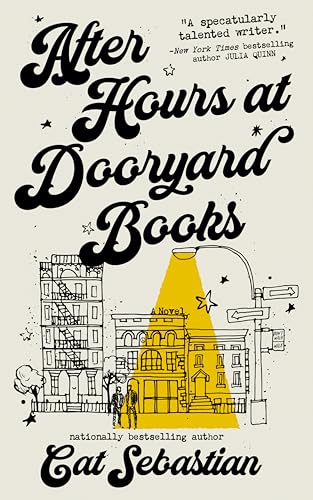
After Hours at Dooryard Books
Cat Sebastian has cornered the market in queer twentieth century historical romances, moving from the 1940s-set Page & Sommers mysteries to the Cabot stories of the sixties and seventies and then to late fifties for We Could be So Good and You Should Be So Lucky. I’ve thoroughly enjoyed all of them and am delighted to be able to add After Hours at Dooryard Books to their number. It’s a gentle, low(ish)-angst story for all that it’s set during a time of great unrest and upheaval; the central slow-burn romance is tender and lovely, and I loved the focus on community, on people coming together, learning how to take care of each other and allowing themselves to be cared for in return.
February, 1968: the war in Vietnam shows no signs of ending anytime soon, public disaffection is growing, and in New York City, the garbage is piling up in the streets because of a strike by sanitation workers. Patrick Fitzgerald is contentedly working on fixing the binding on a first edition he recently picked up at an estate sale, when Mrs. Kaplan, the owner of Dooryard Books (where Patrick is the manager) breezes in accompanied by a stranger, a man several years older than Patrick’s twenty-seven, and whom he immediately realises is her latest ‘project’. Patrick should know what that looks like; a decade ago he was one of her projects himself, and in the intervening time, he’s been there to help lots of Mrs. Kaplan’s other waifs and strays to get back on their feet before making plans of their own and moving on.
Mrs. Kaplan introduces Patrick to Nathaniel Smith (Smith? Yeah, sure) who is even more dubious looking than her usual strays – tall, thin, pale, with too-long brown hair and eyes that keep darting around as though he’s expecting to be arrested any minute. But Patrick knows better than to judge. He welcomes Nathaniel, shows him where he’s to sleep and returns downstairs to the shop to ask Mrs. Kaplan what he should know about his new guest – but she’s surprisingly cagey, saying only that he may be a bit skittish but that he’s getting better – before she heads out.
A day or so later, Patrick and Nathaniel are sharing a somewhat dismal dinner of badly cooked eggs when the shop doorbell rings; expecting a late delivery or something Patrick runs downstairs and opens the door, shocked to see not a delivery man, but his best friend and sister-in-law Susan, carrying a single suitcase – and a very young baby. Patrick is trying to make sense of it all – Susan and his brother live in California, although Michael was drafted and is currently serving in Vietnam – when she holds out a crumpled piece of paper and Patrick’s brain stalls as his heart sinks. It’s from the Department of Defence; Susan must got it that morning, packed a suitcase, grabbed her guitar and the baby and gone straight to the airport. And now they’re here – which means there are now three people counting on Patrick to know what to do. In a way, he’s glad to have so many things to think about; it will at least stop him dwelling on the fact that his brother is dead.
After Hours at Dooryard Books is divided into five sections of several chapters each (plus an epilogue), which relate the unfolding events from Patrick’s and Nathaniel’s perspectives. It’s very much a character driven, slice-of-life story as these three very different people form strong bonds and become a chosen family, working through grief, guilt, anger and shame against a meticulously researched historical background that encompasses political protests, civil unrest, music, literature and a city that is changing around them.
Patrick’s backstory emerges slowly as the story progresses, and we learn that he was taken in by Mrs. Kaplan when his family disowned him after he was beaten up and arrested during a raid at a gay club when he’d just turned eighteen. She gave him a place to stay and eventually employed him to be the manager of the second-hand bookshop she and her husband had opened in 1920, and Patrick loves what he does. He spends his days selling books in the gayest neighbourhood on the East Coast, checking the classifieds and scouring estate sales for rare books, and his nights happily sleeping his way through the local network of “homosexual literati”. He’s kind, generous and funny – he’s clearly taken the lesson about paying it forward to heart and does what he can whenever he can, whether it’s looking after Mrs. Kaplan’s strays or making sure a working girl can afford a cup of coffee and a cab fare.
Nathaniel is a mess when he arrives at the shop. He’s nervy and obviously hiding from something, waiting for whatever that is to catch up with him; but he’s also in need of help and sympathy and companionship, and the warmth and unconditional generosity of spirit he encounters from Patrick is impossible to resist. Dooryard Books isn’t the sort of place he’d have thought he’d go to in a million years – it’s a den of political agitators and subversives – but because of that it’s also a really good place to hide out while he takes stock and works out what’s next. And as his already changing perspectives continue to shift, he comes to see that these are good, decent people doing the best they can in difficult circumstances, and he can’t do anything but admire them for that. As he slowly begins to find himself again and to realise that he can choose who he wants to be and how he wants to live, he also discovers that perhaps the hardest, most important kind of forgiveness is the one you afford to yourself.
The romance between Patrick and Nathaniel is beautifully developed, a lovely slow-burn full of chemistry, mutual caring, support and gentle humour. Patrick is delighted to discover the caustic wit that lurks just beneath Nathaniel’s surface – an irritable bastard with a pretty face is his catnip – and for Nathaniel, being around Patrick, who is so open about his sexuality, is something of an eye-opener, especially when he’s tried to stuff the truth about himself into a locked box and throw away the key. Despite very different backgrounds and life experiences, Patrick and Nathaniel are perfect for each other; they’re both lonely (Patrick’s revolving bedroom door notwithstanding) and grieving, struggling to process the anger, the sadness, and the helplessness that accompany loss at the same time as they’re working out how to support others going through the same thing.
The secondary cast is superbly drawn and adds considerable depth and vibrancy to the story, notably the bright, brilliant Valdez twins, Hector and Iris – who often do their homework in the back of the shop after school and have the makings of a pair of real radicals – and Susan, a well-known recording artist who has made a career of singing angry protest songs. The platonic friendship that develops between Susan and Nathaniel is one of the best-written male-female friendships I’ve ever read in an m/m romance; I loved the way they find common ground through music and how music plays such an important part of helping Nathaniel to work out who he wants to be.
After Hours at Dooryard Books is a compelling read, a beautiful story about finding family and finding love, about shared grief, forgiveness, the importance of community and finding the good where you can, of making space for happiness and peace for yourself and your loved ones, even when things seem hopeless. It’s undoubtedly one of Cat Sebastian’s best books and I recommend it without hesitation.
Recent Comments




What a truly wonderful book! I loved the development of the romance between Patrick and Nathaniel but also watching them build a family and a larger surrounding community. What I did not expect was how the book mirrored many of the issues of the current U.S. sociopolitical climate. The author must have done it deliberately and I am impressed. The book was also a beautiful ode to New York City. I am really happy to have read it.
I’m so glad you enjoyed it – it really is a wonderful book.
So good. Totally want to hang out at the bookstore.
It made my Best of 2025 list. I love how it’s so quiet and intimate and yet the world is changing so much so fast.
I can’t wait to read it. Is there any word on an audio version? I know you’re not a big fan of American-English speaking Joel Leslie, but I love him. I hope he’s narrating this one.
I’ve wondered the same. This one is self-published and I don’t think CS does her own audio so it’s probably a case of waiting for an audio publisher to pick it up. I haven’t seen anything so far, but I’ll keep an eye out.
One of the anticipated books on my pre-order list! I very much look forward to reading that. Your review confirms my high expectations.
I hope you enjoy it – it really is excellent. CS really has a fabulous way of writing a story in which “nothing much happens” – and still making it compelling!
On my TBR!
It’s SO good! I hope you love it.
Definitely on my TBR!!
It’s a real treat of a read – I hope you enjoy it when you get round to it!