
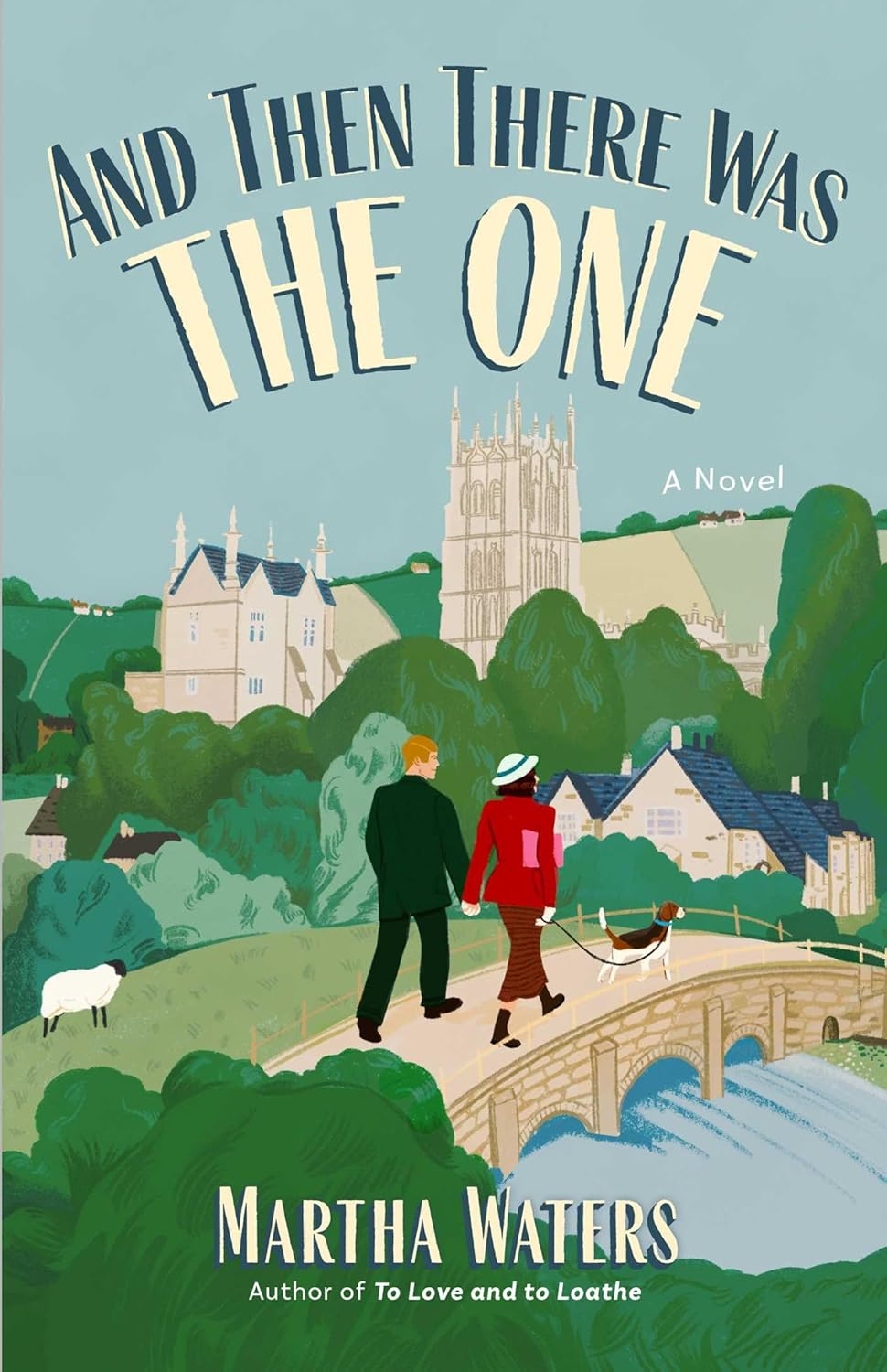
And Then There Was the One
It’s 1934, and the normally idyllic village of Buncome-upon-Woolly has been the site of four homicides in the past year—an unprecedented crime wave. As a result, the village is overrun with Murder Tourists hoping to emulate the plots of their favorite detective novels and do a bit of amateur sleuthing. This irritates Georgiana Radcliffe, the elder daughter of the village’s most prominent family, to no end. It was her knowledge of botany that actually solved three of the murders, and she doesn’t need any help from bumbling outsiders, thank you very much.
But she’s worried that, in the case of the fourth murder, the police arrested the wrong person. And now a fifth member of the village has died, supposedly of natural causes, but could it be yet another case of foul play? Georgie is determined to investigate. But with the local constabulary opposing her involvement in police affairs, she decides to seek outside help from a famous London detective. Unfortunately, the detective is too busy to help in person and sends his secretary instead. Even more unfortunately, the secretary—worldly, flirtatious, impossibly handsome Sebastian Fletcher-Ford—seems worse than no help at all. But as he works with Georgie to investigate the possibly nefarious goings-on in Buncombe-upon-Woolly, she discovers that Sebastian just might have hidden depths.
I was sold on this novel from the title alone, and I was eager to discover how much this book would adhere to the conventions of Golden Age mystery novels like those of Agatha Christie and Dorothy L. Sayers, which I love. In fact, this book doesn’t feel like those novels at all (which is not necessarily a criticism); instead it presents a lighthearted version of English Detective Novel Land, with the requisite picturesque village and its impossibly peaceful, prosperous, and contented residents. I very much enjoyed the setting, especially the overenthusiastic Murder Tourists, and I appreciated that the mystery actually addresses how this particular English Murder Village came to be. It’s not a particularly strong mystery plot otherwise, though, so I wouldn’t recommend this book to those looking for a Golden Age mystery read-alike.
That said, the mystery in this novel is definitely secondary to the romance between Georgie and Sebastian. It really just provides the backdrop for their love story to develop as they run around the village interviewing suspects, finding clues, and (in Sebastian’s case) eating absurd quantities of food. (Side note: I know his ridiculous appetite is supposed to be a funny bit, but it actually did get on my nerves after a while—no one could eat as much as he does, without exercising at all, and maintain his perfect godlike physique.)
By and large, though, the love story really did work for me, largely because both Georgie and Sebastian are such sympathetic characters. I love a seemingly vapid hero who’s more than he seems, and while Sebastian’s reasons for adopting his rakish persona aren’t examined in depth here—I assume we’ll get more of his backstory in the sequels—we learn enough to realize that people have always underestimated him, and he has a deep desire to prove them wrong.
Meanwhile, Georgie is a heroine after my own heart: competent, practical, a bit grumpy, and determined not to lose her head over Sebastian’s flirtatious nonsense. She also feels a weight of responsibility, not just for her vague father and melodramatic younger sister, but for the entire village; she views solving the murders as her duty to her community. She dreams of studying botany in London but won’t entertain the thought of leaving Buncome-upon-Woolly—even when it becomes evident that her family and friends can survive without her and are all too happy to support her goals.
Together, Georgie and Sebastian have fun chemistry and great banter, and it’s clear what each of them sees in the other. She’s drawn to his cheerful, laid-back demeanor, as well as the intelligence he tries but fails to hide from her, and he’s completely smitten with her competence and drive. I love a romance where love changes both partners for the better, and that’s definitely the case here. I was a little surprised by the sex scene—most historical mysteries I’ve read have been closed-door—but I’ll take it as more evidence that this novel is a romance first and a mystery second.
Overall, this book isn’t particularly life-changing or deep, but it is a cheeky, fun time, and I’d definitely consider reading more about Georgie and Sebastian. While the mystery plot and other big storylines are resolved, the door is definitely open for a continuing series. Meanwhile, I know Martha Waters has also written some Regency romances; I haven’t read them yet, but this book has convinced me to check them out!
Reviewed by Christina Behe
Recent Comments



Getting B’s all around; I’ve enjoyed her historicals, so this is exciting to see.
I’m excited to try some of her historicals now!
I’ve read all but one, and they were all pretty solid – I’ve given B/B+ to them here.
I gave a few of them a’s to Bs. She’s very fun!
Sounds like fun! I haven’t read any of Martha’s book so this might be a nice one to start with.
I definitely found it to be a fun entry point!