
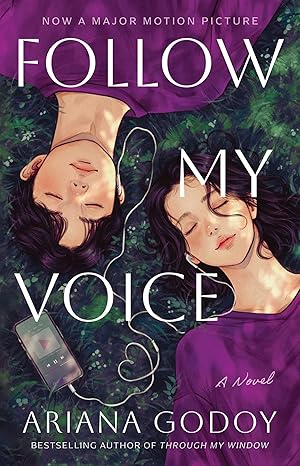
Follow My Voice
Smooth prose and excellent pacing make Follow My Voice, a Booktok and Wattpad viral sensation that will soon be an Amazon Prime Video, an easy to read YA love story/coming-of-age story. A hopeful look at a young woman rebuilding after everything has been broken, this gentle tale covers some harsh subjects, including fat shaming, suicide, death, cancer, mental illness, and depictions of bullying.
There is only one bright spot in Klara Rodríguez’s life – the college radio program DJed by Kang every other night. Klara’s agoraphobia and anxiety have kept her a prisoner in her sister’s home for the past eight months, and Kang’s soothing voice, interesting take on the world, and killer song selections are her lifeline to the universe outside her windows. She has never reached out to him, despite the numerous invitations he gives listeners to send requests or comments via text. It’s enough for her to be the silent partner in this relationship, to let his voice lead her into a happier, healthier space.
All that changes on the day her sister Kamila and brother-in-law Andy get her to visit the park down the street. It’s a triumphant moment for Klara. Giddy from her own success and all that vitamin D from some direct sunlight, she shoots off a text to Kang.
“Dear Kang, your voice is a comfort for people who are having a hard time like me; you brighten my day and calm my nights. I will always follow your voice. With gratitude, K.”
Kang uses that text as his closer for the evening, thanking her and all his listeners for making him a part of their lives. He’s the only person outside of Kamila and Andy Klara has talked to in months. The fact that he’s willing to engage with her, even in this remote manner, gives her the added impetus to try new things. Slowly and cautiously, she starts puppy sitting for a neighbor and signs up for classes at the local community college. She’s nowhere near being the outgoing, vivacious person she was before tragedy sucked all the life and joy out of her, but she feels like she is starting to come back to herself. She continues to reach out to Kang at his radio program, connecting over the music and books they both know and love. And then he reaches out to her.
I have to begin by saying that Klara must have had really lousy taste in friends before her life imploded, because they apparently abandoned and mocked her when she developed mental health issues. This seemed odd to me since the novel takes place post-COVID, which places it at a time when many people have an awareness of these issues and some compassion for them. Also, we’re so connected through social media and texts that it seemed unnatural to me that no one kept in touch with her at all. I was also surprised that Klara doesn’t belong to any support groups. As we dive deeper into the story, we learn the triggers for Klara’s anxiety, and both of those things would have typically included being encouraged to participate in groups where she would meet people her age who are experiencing similar problems.
Fortunately, Andy and Kamila are glimmers of hope in Klara’s bleak, lonely landscape. Kamila, a psychologist, and her lawyer husband are both unbelievably kind and understanding about what is happening to Klara. Roughly a decade older than she is, they devote a lot of time and energy to taking care of her and making sure she is healing. However, we don’t get to know them very well aside from being told they are overachievers who excel at pretty much everything. A weakness of first-person narration is that secondary characters often lack substance, and that is certainly true for Andy and Kamila.
Klara’s new college friends fare much better. Diego, Perla, and Ellie are somewhat clichéd, but they have some depth. We get a lot of backstory for each of them and they are all very likable people.
Unfortunately, their arrival heralds the book becoming very paint-by-numbers YA. The plot is filled with moments that help delineate the hard line between good and bad people, a distinction that many novels use in place of nuanced characters these days. We also experience some character-voiced expositions on “manmade beauty standards”, the importance of acknowledging mental health as being as important as physical health, of being an ally, and how all feelings are valid. If you’re over ten, you’ve probably heard it all before.
Since this novel contains so many staples of Young/New Adult fiction, I couldn’t help but compare it to other popular YA works. These kids are so much better behaved than those in The Breakfast Club or The Fault in Our Stars. Everyone in this tale, despite experiencing some truly horrifying things, is a poster child for recovery.
The romance between Kang and Klara also pulls in all the requisite YA tropes. Kang is the school’s star soccer player, one of the best-looking guys on campus, and a talented and popular DJ. He has legions of fans who send gifts to the school’s studio and lots of pretty girls who follow him around, letting him know how awesome he is. He falls for Klara because her texts connect them in a way the book never quite makes clear. We do know he’s got exactly the kind of energy Klara considers ideal. Someone who “is always a sweet, tender guy who treats (you) well from the beginning.” He’s completely understanding of Klara’s many foibles and is as much a safe space for her in real life, willing to put her needs ahead of his own, as he was on the radio.
In fairness, Klara is needy but fairly perfect as well. She’s sweet, considerate, and thoughtful as well as funny, smart, earnest, and good.
I’ve encountered that character-type a lot lately in contemporary romance, and I have mixed feelings about it. I enjoyed spending time with decent, well-adjusted characters, but this level of saccharine feels very disconnected from real life. People recover messily, not perfectly. Kids push limits and do stupid things, but that doesn’t make them bad people. Romance has, for too long, celebrated toxic males who can count on the heroine to fall in love with them even after he has literally beaten her, but I can’t say I’m any fonder of a story where a hero is so loving, kind, and supportive that he is less human lover and more perfect saint. In fairness, Kang is more fully depicted than most of these men and he does at least at have a personality and a life outside of his interactions with the heroine.
Grade-wise, Follow My Voice presented me with a conundrum. The author hits all the notes perfectly for the kind of story she is telling. However, the fact that she is playing a sugar-coated version of a familiar tune means the narrative doesn’t offer anything but a well-done, expected version to the reader. My suggestion is to read it if you love angsty, sweet teen/new adult drama; skip it if that isn’t your personal catnip.
Recent Comments




This sounds nice!
If you enjoy YA, it is a lovely little book.