
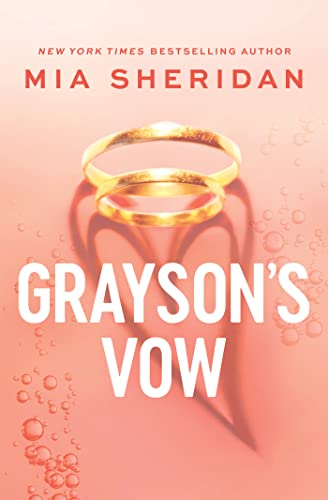
Grayson’s Vow
I’m usually not a big fan of marriage of convenience stories. Unless there is a very, very good reason given as to why the two participants in the scheme can’t be together for real, I end up shaking my head much of the time, over the drama that plays out when the couple falls in love – of course – and then torment themselves over not being able to be together forever. Grayson’s Vow by Mia Sheridan offers some of that eye-roll inducing manufactured angst, but that’s not really the reason for my middling grade.
Kira Dollaire, the daughter of a rich and powerful political player, has determined to fully break away from her cruel, manipulative father. Her beloved Gram has left her a decently-sized trust, but in order to gain access to it, Kira must marry. Enter Grayson Hawthorne, the owner of a local vineyard in dire need of funds to get it back up and running again. Before talking herself out of her crazy scheme, Kira approaches Grayson with a deal. If he agrees to marry her – in name only – she will give him half of her inheritance. After a year of marriage, they can divorce and go about their individual lives, no harm, no foul.
At first, Grayson thinks Kira is some kind of schemer. From his limited research, she appears to be just another spoiled socialite who’s been kicked off her daddy’s money supply, possibly because of involvement with drugs. No doubt she plans to marry him to get access to her trust fund and then she’ll disappear with the entire amount, leaving him high and dry. But Grayson can’t harvest this season’s crops without repairing equipment and hiring a crew, something he needs money to do. With no other options, he agrees to marry Kira, but he certainly doesn’t trust her and barely manages to conceal his open contempt.
The two arrange to get married, Kira moves to the Hawthorne estate, and they manage to suss each other out over their first few weeks as husband and wife. Both quickly learn that they’ve each suffered greatly at the hands of cruel parents, and both see themselves as unworthy of love. But they can’t deny their growing attraction to each other, and before long, they wonder if they can turn this sham marriage into a real one.
Up until this point, my issues with Grayson’s Vow were minor. As I’d expected, the usual amount of built-in-end-date causing unnecessary angst made me shake my head. There is absolutely no reason given that Kira and Grayson can’t be together forever if/when they find themselves in love and desiring an authentic relationship. I wasn’t a big fan of the cutesy personas they’d foisted on each other – him labeling her a witch and her calling him a dragon – but I could have dealt with it.
But then comes the Big Misunderstanding. Before Kira enters his life, Grayson had spent time in prison after accidentally killing a man during a fight. The details of his incarceration come out eventually, but they aren’t as crucial as the fact that Kira’s father and her no-good-fiancé played a part in Grayson’s prison sentence, which was somewhat extreme given the nature of his crime. Naturally, when this information eventually reaches Grayson, his reaction is not only over the top, it’s absurd. The way he treats Kira is borderline unforgivable. For some inexplicable reason, Kira feels responsible for things that had nothing to do with her and accepts the blame that Grayson heaps on her.
Then again, as a character, Kira is a bit of a Mary Sue. Despite her dreadful upbringing, she wants only to help others less fortunate than herself. She plans to give most of her half of her inheritance to a homeless shelter. When she ran away from home, it was to build hospitals in Africa. Even her plan to access her trust via a sham marriage is extremely generous, given that Grayson will get half of the money she could definitely use herself. And she put up with Grayson’s cruelty then risked everything in order to help rectify the damage her father and fiancé had wrought as if it were her fault. It wasn’t that I didn’t like her. It was simply that I didn’t believe that she could exist.
One thing I didn’t understand is the hand wringing that Grayson and Kira endure over the prospect of marrying for money. They make it clear up front that this is a business arrangement with a built-in end date. Both of them will benefit equally, and no one is being exploited in any way. They aren’t betraying partners that they truly love and are emotionally unencumbered. For some reason, however, they each fret over making a mockery of the sanctity of marriage and think poorly of themselves for marrying without love. I wanted to point out to them that for centuries, marriages were business, political, and/or military alliances having little to do with love. And it isn’t as if this is a forever deal. Perhaps I’m a cynic, but Kira’s plan made very logical sense to me.
I’ve always loved Mia Sheridan as a writer (see my reviews for Archer’s Voice and Most of All You), and Grayson’s Vow contains her trademark damaged hero and heroine. But where the other two books do a great job of showing how the couple help heal each other and teach each other to love and to trust, this one misses the mark a bit.
Too, while the cruelties that Kira and Gray suffer at the hands of their parents aren’t nearly as dark as some of those Sheridan’s other characters have endured, this is clearly a hallmark of hers. You need to be prepared from some stomach-churning actions perpetrated against Grayson especially.
Grayson’s Vow is well written but, in the end, a bit frustrating. Not my favorite of Mia Sheridan’s, to be sure.
Recent Comments



My question links to the basic premise of the will: Is it legal to insist that a beneficiary marry to receive a bequest?
And if “beloved Gram” really did place such a condition on the use of the money, wasn’t it actually Gram who was making a mockery of the sanctity of marriage? This also makes me wonder to whom the money would have gone if Kira didn’t manage to get married.
Will stipulations of this kind usually make me think that the dead person must secretly have disliked or resented the beneficiary, hence the from-beyond-the-grave attempt to force them to do something they don’t want to do. I once critiqued a romance manuscript with the same premise, except the beloved dead relative’s will required the heroine to quit her job and live in a fixer-upper cottage for a year. The purpose was to jar the heroine out of a rut and make her appreciate the simpler things in life, and of course she met a smoking-hot handyman. But the beloved dead relative came off as so controlling that I just couldn’t understand the heroine’s devotion (or obedience to the stipulation).
I keep reading books with this sort of stipulation, too; it has to be very well done for me to like it. In one instance, a grandmother stipulated her granddaughters live together in her house so they’d get over their feud; that’s much more understandable to me.
In Kate Canterbary’s IN A JAM, the heroine’s grandmother has a similar stipulation in her will. The hero (a lawyer) tells the heroine that the will’s marriage requirement can be easily overturned. The heroine, for…reasons, doesn’t challenge that part of the will. I liked the book, but why have a character saying, hey, you can easily get out of this thing, if you’re not going to have your heroine get out of it?
I reviewed a book – Perfect Kind of Trouble by Chelsea Fine – in which the couple had to endure a scavenger hunt while handcuffed together in order to get their hands on money left to them in a will! The book was actually good, but a lot of the logistics made no sense. I couldn’t imagine how you would be able to get dressed while handcuffed to someone. You’d have to cut all your shirts up one side. :)
I’m not sure about the legality of requiring a beneficiary to marry to receive a bequest, but the book gives a fairly mundane excuse.
Kira explains it to Grayson this way:
“Well, yes. Mr. Hawthorn, you see, my grandmother, my father’s mother, lived modestly, but thanks to some fortuitous investments my grandfather made, she died with quite a bit of money. She left it to her two grandchildren, me being one, the other a cousin I don’t know well.”
“However, she stipulated in the trust that we only get the ‘money either when we turn thirty or get married, which-ever comes first.'”
Kira’s lawyer explains further:
“You know,” Mr. Hartmann continued, “your grandmother believed that if age and maturity didn’t make a person more aware of the needs of others, or at least one other, marriage certainly would. It’s why she put the conditions on the trust money. She wanted it to be used well and ideally in partnership with someone you chose to share a life with.” He winked at Kira. “I’m so glad that’s the case with you.”
There is some fear of Kira’s father learning that the marriage happened for the money and then contesting the will, which is used as justification for Kira and Grayson living together.
The real irony, IMO, is that Kira laments to herself that her Gram would “roll over in her grave” if she knew Kira was marrying for money and not love!
Also, the amount of money left to Kira in the trust is actually not that much – $700,000. After splitting it in half, Kira and Grayson each stood to get only $350,000, which didn’t seem worth it for such drama.
I’ve liked a number of Sheridan’s books—DANE’S STORM is one of my keeper shelf favorites—but there’s no doubt she often rides the very thin line that separates angst (where character drives plot) from melodrama (where plot drives character). Since the ascendancy of Colleen Hoover and the popularity of the “put-upon heroine forced to endure every level of misunderstanding, pain, and emotional manipulation to achieve her HEA”, I think we’re seeing writers whose work already tended that way (see also, Aly Martinez) really lean into the style, taking their work from engagingly angsty to over-the-top melodramatic. Imho, BookTok has much to answer for.
BookTok, IMO, is very fandom-trained, which means they trend so hard toward certain tropes without any leavening.
To me, this seems a return to bad old days of downtrodden heroines enduring all…pity
We’re not even getting good grovels anymore!
I think it’s all about Colleen Hoover. As they write in today’s NYT:
In 2022 alone, Hoover’s novels sold 14.3 million copies and in total, more than 24 million copies to date. Time magazine named Hoover one of the most influential people of 2023…..
Yes indeed. That sums it up pretty accurately. When Hoover was the answer in the Authors category on a recent episode of “Jeopardy” (I was yelling “Colleen Hoover” from my couch, but none of the contestants got it), I knew her pop culture moment (and the masochistic heroines she favors) had arrived. As Brian Wilson once sang, “I just wasn’t made for these times.”
I think I could endure the heroine going through the wringer if it were at all worthwhile for them. 90 percent of the time it’s not, and the plot is painfully bad along the way.