
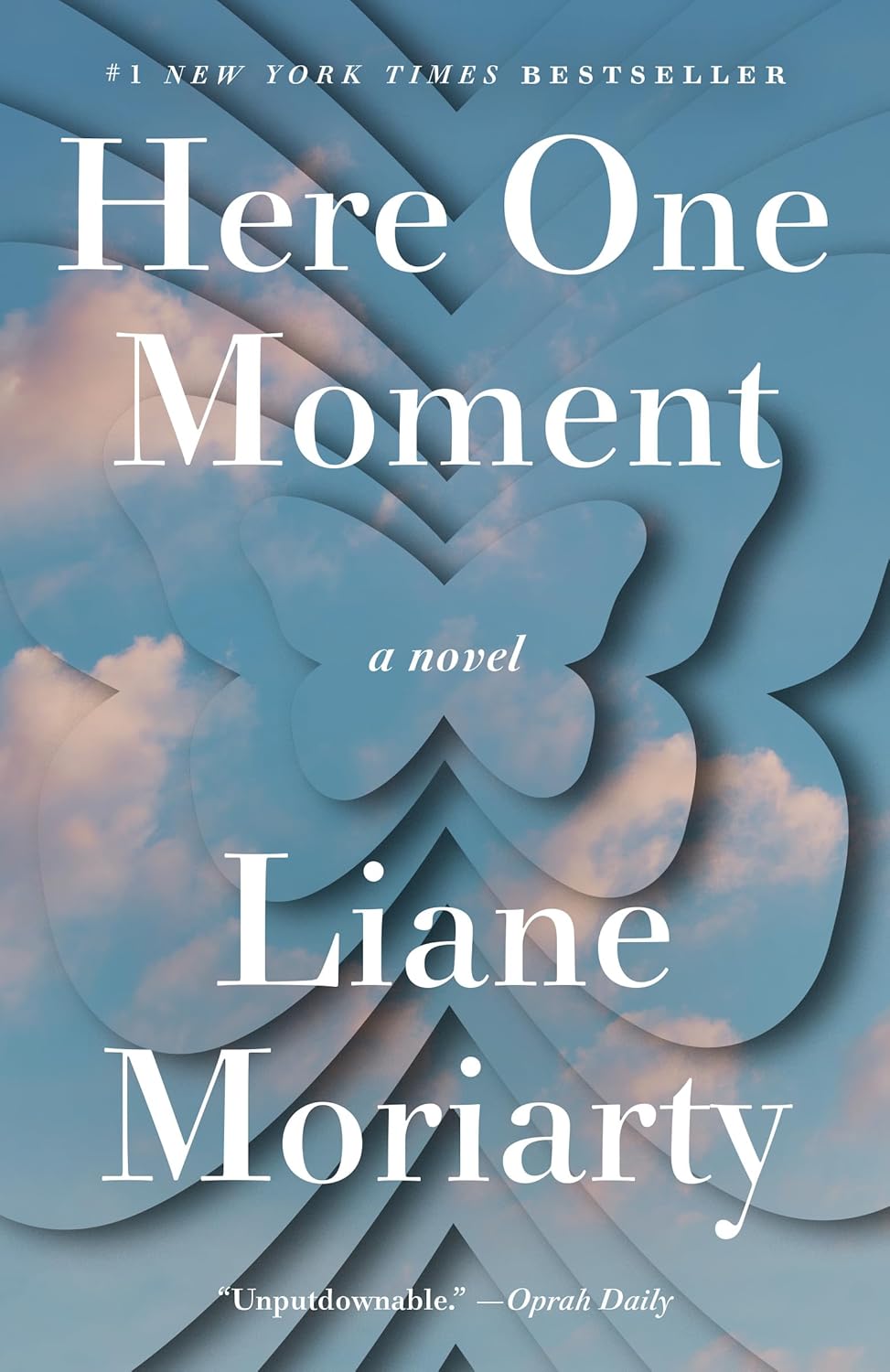
Here One Moment
Liane Moriarty’s Here One Moment opens with a terrific premise. After an irksome delay on a flight from Hobart to Sydney, a middle-aged woman rises from her seat, walks the aisle, and starts pointing at passengers, calmly announcing the age at which each will die—and the cause.
Allegra, a 27-year-old flight attendant, is told she will die at 28 by suicide. Paula, an exhausted mom traveling with her kids, is told her six-month-old son will drown at seven. Leo, a 47-year-old harried engineer, will die at 48 in a workplace accident. Ethan, now 29, will be killed in an assault at 30. Eve, 20, newly married—she’s literally still wearing her wedding dress—will die in five years, at the hands of her husband, at 25. Every passenger in coach—if there’s a metaphor in why business class was spared, I couldn’t find it—receives a literal death sentence.
When she’s finished, the woman returns to her seat and falls deeply asleep. The plane lands. People collect their bags. Most decide she’s unstable and try to file the whole bizarre episode away. But then, weeks later, one of the predicted deaths comes true. Then two more. What seemed like either a prank or a mental health crisis begins to look—impossibly—prophetic. Those the Death Lady, as the internet names her, pointed at now wonder whether the future she handed them is fixed.
Should Leo abandon his job? Should Allegra stay away from cliffs and pill bottles? Should Paula, who promptly signs her son Timmy up for infant swimming lessons, trust he’ll be OK? Should Ethan change the way he lives, knowing that somewhere out there is a person who may—or may not—pose a threat? Should Eve and her husband divorce now, before he, although it seems impossible to imagine, takes her life? What do you do, really, when you find yourself living—thank you Tim McGraw—as though you were dying?
The book moves between its many narrators, moving among the passengers and the woman who made the predictions: Cherry Lockwood, the daughter of a famous psychic. Cherry—and if you don’t like her, you won’t like the book—tells us about her life, and slowly, very slowly, Moriarty lets us see how she became the Death Lady.
Here One Moment has big questions threaded through the stories Moriarty weaves together. What, really, do psychics offer? Can anyone predict the future? And once a fate is predicted, is it malleable? Doesn’t just knowing what is to come change that very thing? And if fate can be felled—or at least altered—by free will, what choices should one make?
Moriarty excels at character. Here, as in Apples Never Fall and her other bestsellers, the men and women she creates are recognizable, believable, and, most importantly, interesting. And though this isn’t really a thriller, it’s tense because you care about the people whose lives are limned. We’re kept guessing, until almost the book’s end, what becomes of Ethan, Timmy, Eve, Leo, and the others. They deserve full lives. Will they get them?
Even that, though, is a trick question. All of us live with the possibility of imminent death, and all of us have to decide how to live in the face of it. Mortality is a bitch who can’t be mastered—tech bros be damned. Can it be tamed? Maybe. But even if we take reasonable precautions—exercise, eat right, get enough sleep, pay attention, drive safe cars, learn to swim, take self-defense classes, pop supplements, do all the other bazillion things humans do to bargain with time—we’re still all going to die.
I couldn’t put down Here One Moment—I’m a sucker for books that put love at the forefront—but I can see it won’t be for everyone. Some will find it too sentimental. Others will fret that Moriarty doesn’t pin down the metaphysics. If you have no patience for feel-good novels, don’t bother; go read the latest Ishiguro instead. This novel is for readers who believe life, love, family, and joy are worth the pain they bring. The book isn’t about dying; it’s about what matters once you stop pretending you won’t.
Recent Comments


Read and enjoyed this. It’s not a spoiler to say that not everyone’s future plays out exactly as Cherry, the Death Lady, predicted. A small criticism: wasn’t really sure why it was considered a confirmation of her predictions when two very old people died. They were very old – it wouldn’t take a psychic to predict that they would die sooner rather than later. OTOH, I liked how Moriarty focused on only a few people from the flight, their friends and families and actual and potential loves, and how they responded. We all know we will die (other than, perhaps, the tech bro Dabney links to), but when faced with an imminent death it does tend to concentrate the mind wonderfully.
I think it was considered a confirmation because, deep down, the internet desperately wants her to be right because it’s INTERESTING. Part of what I think the novel tries to address is how much social media has become the court of public interest.
Probably true. The first death was certainly more shocking and concentrated the public’s interest. One of the many things I liked about the book was that it made some of the characters more open and aware.
This sounds fascinating. I’ll have to pick it up.
I am still thinking about it!!!
I love books that linger. Those are the best kind.
Oh, this sounds good!