
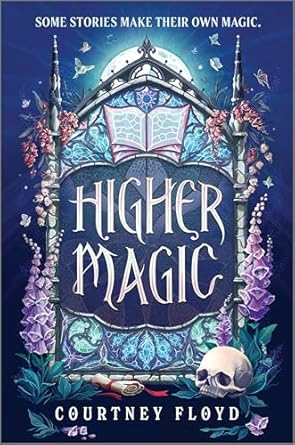
Higher Magic
Higher Magic exemplifies the problem of desperately wanting to make a point and forgetting that you are writing a novel. The end product is less a cohesive story and more a jumbled lecture.
Ever since Bartleby’s parents took her to have her fortune read in a cupcake shop, she’s suffered from anxiety waiting for the catastrophic (or not, the fortune wasn’t perfectly clear) event that will happen when she combines technology and magic. Which is a real bummer, given that she bungled her first attempt at passing the university’s Magic program qualifying exam and has only one more try – and she has just been advised that she must use Digimancy. Since that requires combining computers and magic, Bartleby is convinced that complete failure is imminent. The last time she attempted to use Digimancy, she destroyed several machines.
The worst does, of course, happen. Her spell (called “workings” in this narrative, which grew redundant and confusing) results in a talking skull. It was meant to narrate “long eighteenth-century texts to create fiction about a Christmas village,” which would then effect a sample Christmas village of the type people display on their mantles. This would prove Barleby’s dissertation thesis that “early novels shaped new social realities.” Instead, the skull (named Anne) narrates Bartleby’s (and others’) inner thoughts – some quite embarrassing – along with glitching by spouting nonsense and randomly throwing out quotes from various (non-Christmas) novels.
Not sure just what went wrong, Bartleby turns to her roommates Cy and Darya, as well as outrageously attractive grad student James, for help. She’s hoping they can figure out the error in the coding and spell work combo she used that caused this massive mess. Only, rather than discovering what’s wrong with Anne, they find that Anne is actually alerting them to a sinister plot within the university. “Magic students who seek disability accommodations are disappearing—quite literally.” After much deliberation, the group takes its issue to the proper authorities – whose response is underwhelming and not very reassuring. The administration initially claims a particularly virulent flu has caused the missing student situation, and also offer the excuse that it is normal to lose students at the start of the semester, as many simply drop out. However, when parents also start demanding answers, Barteby determines to take matters into her own hands. Adding Lora, a Yatiri with a coterie of natitas to aid her in speaking to the dead/disappeared, Bartleby and her merry band of sleuths search for the missing. What they find just might change higher magical education forever.
I liked a few things about Higher Magic. The idea of a magical university intrigued me, and I was intrigued by the subject of Bartleby’s thesis: Narration reshapes consensus reality by giving us access to the interiority of others, allowing us to know people in a way, and from a unique perspective, that’s not supposed to be possible. That knowing carries beyond the page, into the way we are with each other. Person by person, reader by reader, reality shifts.
Unfortunately, the novel doesn’t explore either of the premises it offers. Instead, the ideas are floated out there and then buried beneath the weight of a plot that pointed us to what the author was really getting at: Universities don’t offer enough accommodation to be thoroughly inclusive. That might make an interesting topic for an essay in a periodical or a dissertation; it could even be developed into a decent non-fiction book. It isn’t a good premise for a riveting novel, though.
Among the many things sacrificed to the author’s objective is characterization. Bartleby is the politically correct version of a hot mess, who fumbles her way about in her quest to prove that, despite her foibles and difficulties, she belongs in higher education. It is clear that she is determined, quick-thinking, and deeply devoted to her liberal principles, but I didn’t get a feel for her outside those factors. This made her romance with James a complete fizzle. I couldn’t see what he was attracted to in her beyond the fact that she met the criteria of being a cute girl with progressive ideals.
James’ characterization consists solely of the fact that he stood up to his powerful family so that he could pursue his own academic interests, and that he follows Bartleby around like an obedient and helpful puppy. He is also the whipping boy/poster boy for white males. At one point, he tells us:
When . . . Rue agreed to be my advisor, they had conditions. A whole lecture full of them, really, but one of them was that I needed to use my privilege in the program to include people, “especially the ones the academy does its best to keep silent and make invisible”. Otherwise, they didn’t want to spend their time mentoring another well-to-do white boy.
Clearly, James passed this test, making him worthy to continue at the school. I found the way the text addresses privilege, colonization, and diversity disturbing, though. At one point, the term “white boy” is muttered as a slur. The evils of “white men” are presented with no subtlety or discussion. I felt strongly that since this issue is addressed, it needed more than the simplistic, poor-quality throwaway statements that litter this book.
The world-building here is practically nonexistent. There are some fun aspects, such as fortune cookies containing real (but obscure) fortunes; IGOR standing for Icantation, Gesture, Object, and Ritual, which are the building blocks of all workings/spells; helpful ghosts absorbing “fragmentary bits of weird alternative realities”, and cupcake wrappers being read like tea leaves (yummy). However, the author sets her tale in the contemporary world, but fails to explain how magic impacts that world or what it means for our universe to be physically influenced by the narration of stories, given the numerous conflicting narratives that exist. The dangers of a spell that can read minds and share that information with everyone are also not discussed. I’ve heard this called a form of mental rape before, and indeed, a scene where this power is used against someone towards the end of the novel indicates the risks of such power in the hands of those willing to do whatever it takes to win.
Ultimately, the failure to delve into its premise, poor characterization, shoddy world-building, utter lack of nuance, and political pontificating makes Higher Magic a difficult, unenjoyable read. I don’t recommend it.
Recent Comments



I noped out of this one as soon as I saw that the heroine’s name was Bartleby. I would prefer not to!
Yes, thinking of Bartleby the Scrivener is a definite turn off for a romance.
In fairness, that’s a much deeper story than this :-)
Too bad! The description to this one made it sound fun.
I loved the premise. I wish the author had delivered on that rather than taking the route she took.