
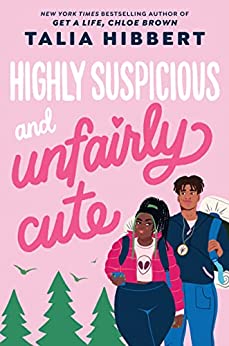
Highly Suspicious and Unfairly Cute
In Talia Hibbert’s Highly Suspicious and Unfairly Cute, we get a relatable, friends-to-enemies-back-to-friends-to-maybe-more young adult story that, while well written, somewhat missed the mark for me. Granted, I had high expectations given the buzz Hibbert has received for her contemporary romance titles.
Celine Bangura may be an outsider, but she definitely owns it. She knows who she is and what she wants, and she’s on a straight-line path to accomplish her goals. She’s going to finish her final year at school with top marks, be admitted to Cambridge where she will study law, and then become England’s greatest corporate lawyer. She certainly isn’t going to let perfect, popular, former best-friend Bradley Graeme derail her. After Brad ditched her to be a part of the in-crowd, she added defeating him in all ways possible to the top of her goals list.
Bradley Graeme is popular and successful at football (soccer in the US) and gets top marks, but most people don’t know that coping with his OCD is a constant challenge. Like Celine, he plans on attending university to study law so that he can make his family proud, albeit somewhere less lofty than Oxford or Cambridge. He keeps his dream of writing a novel a secret from everyone, convinced that he doesn’t have the talent to ever make it as a professional author. And while he knows that he had hurt Celine in the past, he doesn’t understand her determination to see him as her greatest enemy. All he did was explore new interests and try to make some new friends, but she can’t seem to get over it.
When Celine gets the opportunity to attend a special program sponsored by her idol, civil rights attorney Katharine Breakspeare, she’s thrilled. Not only will participating in the prestigious Breakspeare Enrichment Program (BEP) provide stellar content for her uni application, but she could win a full-ride scholarship. Brad has no interest in the program’s outdoor setting and wilderness challenges, but he would love to win a scholarship that would allow him to secure single-accommodations when he goes to university. It certainly would help his mental health if he doesn’t have to share living space with other people.
When they are both accepted to the BEP, Celine and Brad find it impossible to ignore each other. They are paired together during their first challenge, and it doesn’t take long for all of their past hurts to bubble to the surface. At long last, Celine is able to confront Brad over his betrayal of not only their friendship but of her personally. For his part, Brad expresses his frustrations over Celine’s unwillingness to accept his apologies or explanations. With all of their grievances out in the open, the two are able to move into a tentative friendship. And it doesn’t take long for the strength of that friendship to morph into stronger, romantic feelings.
But Celine is reluctant to commit herself fully to a relationship with Brad because she can’t bear the thought of losing him again, something she is convinced will happen when they must separate to attend their individual universities. Too, she begins to question all of her goals and decisions, fearful that she has based her entire life and future on obtaining some sort of revenge against the father who abandoned her for a new family. Brad begins to second guess his decision to go to study law but fears disappointing his parents by telling them that he wants to study English instead. The two turn to each other for support and understanding, but is it enough to remain just friends?
Talia Hibbert has a flair for creating well-rounded characters who come complete with relatable flaws. Their level of self-awareness is refreshing, and the self-deprecating humor, especially on Bradley’s part, is laugh-out-loud funny. The dialogue between Celine and Brad is realistic and honest, and I did like how they support each other as they navigate their uncertain futures. I don’t have personal experience with OCD, but Hibbert has done an excellent job presenting the challenges and solutions I can only imagine would come with this mental illness.
But I did have a few problems with this book. First of all, it is mentioned more than once that Bradley is bisexual. However, this is never addressed, nor is it a plot point or important to his character in any way. I had to wonder why this was included other than for the sake of representation.
Too, as a main character, Celine is very shrill and mean, especially at the beginning of the story. She clearly has reasons to resent Bradley, and we do learn more about what caused the break in their close friendship. However, she is so nasty to him that you had to wonder why he would ever warm to her again. Bradley is a much more likable character in every way.
My last quibble is that the book’s main premise ends up being a non-factor. The wilderness survival competition is never fleshed out, serving only as a vague background for some relationship development. Indeed, once they reconcile near the book’s half-way mark, any sense of competition between Celine and Brad comes to an end and the BEP becomes not much more than an afterthought.
In the end, Highly Suspicious and Unfairly Cute is well written and the characters are quirky and real. While I haven’t read any of Hibbert’s other books, I’m definitely willing to check them out despite being a bit disappointed in this one.
Recent Comments



I loved this book. I was very upset when I finished it.
About to finish this one! I do enjoy, although I do agree with you about wanting things to be more fleshed out. I’ve previously read the Brown Sister series and would definitely recommend! They’re a bit more mature in terms of language and cultural refernces. I wrote a review about those on my blog if you wanted to check it out :)
https://amixedperspective.wixsite.com/web1
Aww, I’ve been looking forward to this one. Still gonna give this a read, I loved the Brown family series.
Mundane information about characters abound in fiction. Mentioning that the MC is bisexual might simply be to show representation, but that’s important. Writing a character who has red hair, or has a wonderful singing voice, is short or tall, all give readers a place to connect with and/or understand them. Casual representation is important and doesn’t have to have anything to do with the plot other than to give insights into the character’s experiences.
I liked how JayHogan, in Foxed, showed one MC who was bi, mentally comparing men‘s and woman‘s shape, and noting differences and why he liked each. It was not belabored, not insistent, but it was real.
For me, in a romance, where love and sex, being comfortable in your body, and sharing it with another, are a central part of the book, a casual mention of bisexuality is not satisfying – not like red hair, or liking big earrings.
As Jenna writes for this book, I have seen a mention of a character being bi in a few books, where it looked like an easy way of representation without actually having to flesh out what it means, since falling in love with the other MC just took care of it all.
That said, I have not read the book, so this is a general comment. Jay Hogan‘s was the first book outside ménage/erotica books where I truly „felt“ the bi and could relate to it. I liked that a lot.
I get what you’re saying, but I think just knowing the character is bi is going to have an impact on how readers perceive the character. It’s like mentioning they ran track in high school, even if it has nothing to do with the story. We’re going to have an idea, and image of this person’s life experience: athletic, hard working, good with time management? I think it matters because I, for one, would have a different perception if the person was a thespian. In my mind being a thespian means you’ve had these experiences that a runner might not. So if I read that a person is bi, then I have more information about their experiences, with both male and female lovers, and that’s a different than if the person is straight.
And also, I want to point out that a person identifying as Bi is Bi whether or not they ever have sex with more than one gender. I think Foxed is a good example of that. 55 and never having had sex with a man doesn’t mean he wasn’t bi his entire life. the character in this book is with a woman now, but he’s still bisexual and it’s a big part of a person’s identity. Maybe this author didn’t flesh it out, but I don’t think we necessarily have to have that, especially since this story isn’t about him being bi.
And lastly, I’m ok with an author just throwing it out there because, as Marian said, otherwise we just keep going back to the default and that’s really not representative of the spectrum of sexuality out there, from straight, to gay, to bi, to pan, to ace, etc. We kind of erase alternate sexualities when we always flip to the default.
That’s a good point!
This is a bit tricky for me. I understand what I think you are saying – that mentioning a person’s sexuality in a casual manner, the way you might mention hair or eye color or that they love dogs and like to go bike riding, is a way to normalize all different kinds of sexuality that hopefully leads to more acceptance. That a person’s sexuality is just one of many facets of their personality and is worthy of no more or less attention than any other facet. The thing, for me, is that sexuality does affect the way a person/character interacts with the world. Physical traits are mentioned because they help a reader form a picture of the character. And personality traits are expressed either through action or observation so that we can somewhat predict behavior. So what are we to make when a writer chooses to mention a character’s sexuality? I think you are saying that we aren’t meant to make anything of it, just that this is what he is. And I totally get that.
But this reminds me of a recent book I reviewed “That Summer In Berlin”, in which the heroine had a limp. The thing was, the limp was mentioned often, but it didn’t affect the story in any way. So why bring it up at all? Or, as another example, the whole “Dumbledore is/was gay” deal. His sexuality played no part in any of the Harry Potter books, so why clarify in any way what he is/was?
I guess I’m looking at this from the opposite side. If a person’s sexuality isn’t important to the story or their character (as demonstrated within the parameters of the story), then it really isn’t anyone else’s business. By not specifying either way, aren’t we also normalizing?
Great discussion!
I think one result of not specifying a character’s orientation is that most readers will assume the default – straight. Just like when a character’s skin color isn’t mentioned, many people will imagine a white character.
That said, I understand readers would expect a main character’s bisexuality is going to play a role in the story somehow, or be developed beyond a mention, so it seems odd when this doesn’t happen. But it’s possible that this reaction will lessen as diversity (and the casual inclusion of diversity) becomes more widespread in fiction.
This is such a good point and kind of supports my thinking. I agree with the assertion that if a character’s sexuality is not mentioned specifically, then most people will default to “character is straight”. And I see that this is something that, as a society, we are trying to change. However, if a character is specified as being bi-sexual but everything he/she does in the story tracks as a straight character, then what was the point? If being bi didn’t change anything from the “straight=default” setting, then isn’t it just some form of performative representation?
What if the author mentioned a character was from a large Italian family, but then didn’t say anything more about it? Would the information have any impact on how you think about the character, even if we never see them interact with their family? It would me. I don’t see information about a person’s sexuality as different. It tells us something about them we didn’t know, and then we don’t just default to “straight.” Our sexuality is a key component of who we are. I don’t think that’s performative, I think it’s giving us a clearer picture of who they are.
Would it be nice if the author showed how it impacts the person? Maybe. But it’s okay (imo) that it simply be part of them.
I think the point is to let bisexual people know that here is a connection, even if the connection isn’t developed.
If I may use myself as an example, I’m an atheist. Nothing about my weekday routine differs from what I might do were I a religious person, except that I don’t pray. However, if a character in a book says they’re an atheist, I’m pleased to find a fellow nonbeliever.* The character doesn’t need to read Bertrand Russell or put an Evolve fish on their car. The character can go about their day as usual, but I will feel an extra little connection to them because they think the same way I do.
So being an atheist doesn’t need to change anything to be meaningful to this reader, just like being bi doesn’t need to change anything to be meaningful to readers who might like to see more representation of themselves.
*Though I’ll also hope that the author doesn’t have the character’s atheism come about because they lost a loved one, dropped to their knees, screamed “Noooooo!” at the uncaring sky, and stopped believing in God from that moment on.
Yes, great discussion. thanks for responding! You have some good points.
I kind of answered this above, but mainly I think we can unintentionally “erase” other sexualities by simply defaulting to “straight.” Maybe being bi wasn’t important to this story, but it’s important to this character. And I will view him differently after reading he’s bisexual, even if it’s not germane to this plotline because it’s part of his life experience. Being bisexual is different than being straight and it has an impact on who a person is. to me, that’s important.
And as far as “what does it matter?” It often matters a hell of a lot to those who are not part of the default group. Every time I read a m/f book I’m seeing me, even if it’s in a small way, and that’s a privilege. Too many readers do not see themselves. Representation, or even just acknowledgement, matters.
Great discussion!!
I get what you are saying.
I still believe that in a romance, being bi would matter, in how our character perceives love interests and looks at persons around them differently, just like being gay or het. And should be shown, not just mentioned. But if that is not happening , them I agree, mention is better than nothing. I will, however, find it a bit disappointing that the author does not show, only tell.