
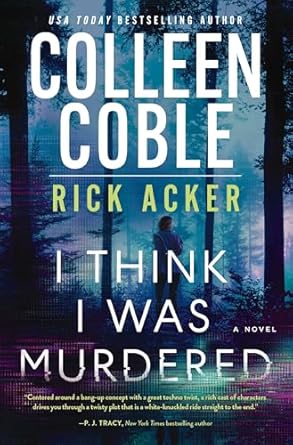
I Think I Was Murdered
Can AI bring back to us those who have died? Will the facsimile relationship be healthy or dangerous? Those are the questions at the heart of I Think I Was Murdered.
Katrina Berg had a perfect life – a brilliant career at a hot tech company, a handsome husband, wealth, and a loving family. That all ended the night her spouse Jason was killed in a fiery car crash. It was an event that caused a domino effect; shortly after, the CEO of her firm disappeared with a large chunk of change, the FBI is now questioning her ethics and competence since she is legal counsel for the company, and then her beloved grandmother passes away.
Katrina’s main support through all this is the beta prototype for a new, ultra-sophisticated chatbot created by her firm. All the contents of Jason’s email, social media, pictures, and every other bit of digital data Katrina could find had been loaded onto the AI platform, with the result that she can talk to her phone and have it respond to her just the way Jason would have. She questions how healthy it is to use the app as frequently as she does, but she can’t stop. Every day, she seeks advice from this digital Jason. Every day, she gets answers using the syntax and words her husband would have used. Until one afternoon, when she begins to receive responses she doesn’t expect. Phrases in Japanese, a language she didn’t know Jason was familiar with. And then, after an innocuous question, the answer I think I was murdered.
Even as she is processing this, another shoe drops. Her best friend Liv, the head programmer at Katrina’s company, tells her the CEO was involved with Chinese gangsters. And those gangsters are now after Liv, his ex-girlfriend, and Katrina, his attorney. Feeling insecure in Silicon Valley, the two head to Katrina’s hometown of North Haven. The kitschy tourist community provides a picturesque stop for those visiting the Redwoods area but is sufficiently isolated that the gangsters will hopefully be unfamiliar with it. This seemed like a stretch to me. The gangsters are involved with a tech company, so I assume they’ve heard of internet research and could probably find out Katrina’s background. It didn’t make sense to me to visit the family with potential killers on her tail, but whatever.
Speaking of her relatives, Katrina’s family is pretty irked with her. Her grandmother left her restaurant, Bestemor’s, to Katrina, and Katrina plans to sell it. Her mother and brother both want it to stay in the family, but Katrina feels Seb Wallace is, in a way, part of the family. The popular and talented restaurant mogul got his start working at Bestemor’s and has a great deal of affection for it. He’s assured Katrina he will keep the staff her nana had trained and will not make any major changes to the decor or menu. While Katrina and Seb weren’t close growing up, the two bond over their mutual love and knowledge of Norweigan food when they discuss the sale, and Kartina is confident she has made the right decision. As an added bonus, Seb also knows Japanese and might be able to help her gain some insight into what the AI on her phone is telling her.
I was drawn to this book because of the main question posited in the text – could an AI version of you figure out you had been murdered and why, based on your digital footprint? The portions dealing with that and how the use of AI both hinders and helps Katrina in her grief are fascinating. Technology has had a profound impact on us in the last hundred years, and I enjoy narratives that explore that.
The descriptions of the setting are good as well; the huge trees, hundreds of years old, and rugged terrain, with homes at the end of rocky, muddy unpaved paths and steep drops off on the roads that are paved. Most people in North Haven have guns because mountain lions and other beasties abound in the area. All of this contrasts nicely with the very modern issues the heroine is dealing with.
That said, I struggled with other aspects of the story. The writing tends to be too much tell and not enough show. Once the heroine meets (or reunites) with Seb, she seems to begin a very rapid climb out of grief; I found this unbelievable because Jason has only been dead for a year, and she has just learned he was murdered. Additionally, she’s addicted to the AI version of him. I appreciated that the authors don’t resort to turning Jason evil just to make Katrina hate him, but I would have preferred them to have put more time between Jason’s death and Katrina falling for Seb.
This kept me from rooting for them as a couple, although I liked Seb well enough as an individual. He’s kind, thoughtful, generous and caring. There are moments in the tale when he is almost too perfect, but he has just enough flaws to make him down-to-earth and realistic. I did find the depiction of his wealth unlikely, but I accepted that as part of romancelandia culture.
I liked Katrina a bit less. She can be thoughtless of others’ feelings and too self-focused. She definitely lacks communication skills; the mess with her family could have been easily resolved with a few heart-to-heart conversations. Moreover, the mystery’s resolution and her inability to recognize what has been happening right under her nose left me questioning her intelligence.
I also felt the story had a bit too much going on. Both Seb and Katrina have family issues that constantly intrude upon the text, and the mystery itself winds up being needlessly complex.
I’ll add that the book also brought up nationalities too often for my taste. From the Japanese chef who works at Seb’s restaurant to the Chinese gangsters chasing them and the endless talk of Katrina’s Norweign heritage, the tale feels unnecessarily race-conscious. To be clear, there is no overt racism, but I found the focus on the gangsters’ nationality distracting and unnecessary. I would label anyone who was shooting at me a villain and wouldn’t much care where they came from!
Fortunately, not all the baddies are of one race (some are white Americans), and not all the good people are white. Conversely, for a book labelled as Inspirational/Christian, the story has very few faith aspects. God is mentioned half a dozen times, Jesus never, and the characters pray a total of three times, the contents of said petitions being of the sort that an agnostic might use in a foxhole. I’ll add that while there is no on-page sex, it’s made clear a lot of sexual activity is occurring off-page. None of it features the hero/heroine, but their siblings and friends are active.
The mix of positives and negatives results in a mid-level grade. I think fans of the author may enjoy I Think I Was Murdered, and those intrigued by the premise, as I was, might be able to overlook its flaws, but I would recommend it to only those specific audiences.
Recent Comments



In my opinion, falling in love a year after the death of a loved spouse seems fine.
It would have been fine if Katrina hadn’t been speaking to the AI Jason so regularly but since she was it felt a bit more awkward to me.
I hear you. It sounds like a weird romance.