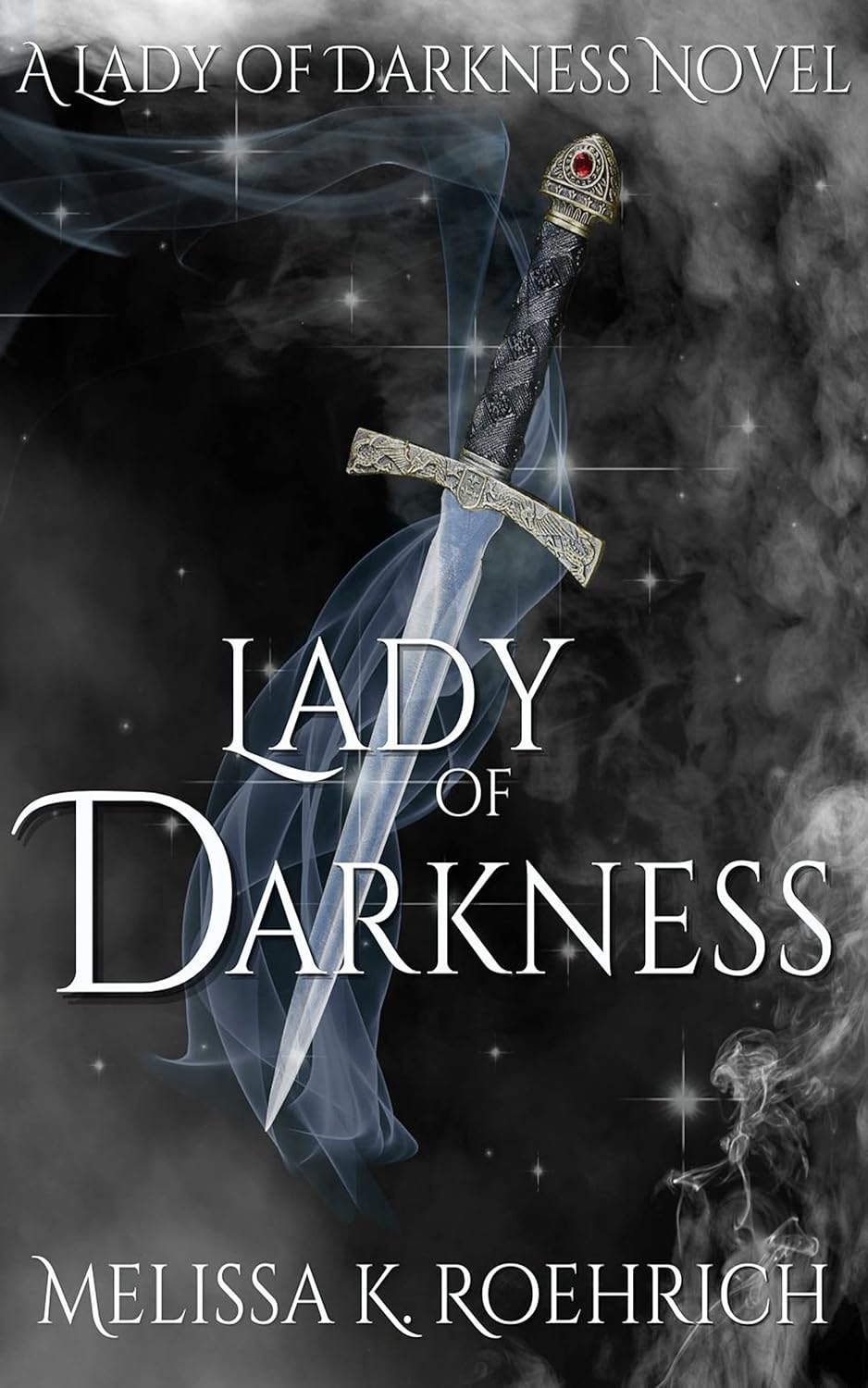
Lady of Darkness
Melissa K. Roehrich’s Lady of Darkness is a new adult fantasy that combines familiar tropes into a character-driven narrative filled with assassins, romance, and secrets. Despite its intriguing premise, the book struggles to deliver an interesting story, often feeling like an attempt to mimic popular romantasy series such as Throne of Glass and A Court of Thorns and Roses without fully capturing the qualities that made them so addicting.
The story centers around Scarlett Monrhoe, a deadly assassin trained by the ruthless Assassin Lord, who has spent her life seeking vengeance for her mother’s murder by the Fae Fire Prince. As one of the continent’s most feared killers, Scarlett is bound to a life of servitude until a high-stakes mission offers her the chance at long-awaited vengeance. But when children begin vanishing from the city, her pursuit of revenge is interrupted, forcing her to confront a deeper threat. Teaming up with Sorin, a mysterious captain of the guard, Scarlett dives into an investigation to uncover the truth.
Despite the promising setup, Scarlett’s characterization falls flat. Although the narrative repeatedly assures readers of her toughness and capability, her actions rarely align with these claims. Instead, Scarlett comes across as a caricature of a strong, independent heroine rather than a fleshed-out, complex protagonist. For much of the book, she is caught in an emotional cycle of angst, particularly over her relationships with the men around her. Ultimately, it’s hard to feel invested in a protagonist who spends so much time crying out for someone to rescue her, especially when the book insists she’s a deadly assassin.
In terms of romance, the relationship between Scarlett and Sorin follows the tried-and-true enemies-to-lovers formula. As expected, it features a push-and-pull dynamic, trust issues, and heated moments. However, while their chemistry is solid, the emotional stakes never feel as high as they should. Even though the tension builds steadily throughout the story, the romance lacks the freshness or originality that might have elevated it. It’s a slow burn, but one that ultimately fails to deliver the payoff readers might hope for, especially given the book’s considerable length.
One of the most significant issues with the book is its pacing. The plot feels sluggish, dragging in the middle with little forward momentum. At 604 pages, it’s a hefty read, and the slow buildup doesn’t justify the length. Several mysteries are introduced but left unresolved, prolonging the story unnecessarily. While the first half succeeds in maintaining suspense, it’s hard to ignore how little happens by the time the book reaches its conclusion. Unfortunately, the ending feels more like a setup for the next installment than a satisfying conclusion to the current book, which is frustrating given the book’s lengthy runtime.
That being said, there are some bright spots. The worldbuilding, particularly the magic system, is well-thought-out and engaging. The setting is rich with potential, and Roehrich’s descriptions of the world keep things interesting enough to pull readers through the slower sections of the book. The various supernatural elements—Fae, witches, shifters, and vampires—create an interesting backdrop, even if the plot itself doesn’t fully capitalize on the potential of this world. Additionally, the side characters, like Nuri and Cassius, add some much-needed depth, offering a sense of complexity that Scarlett herself lacks.
Overall, Lady of Darkness feels like the beginning of a series that it is rather than a fully realized book in its own right. While it’s definitely not for everyone, it’s the kind of book that will find its audience—namely fans of fantasy romance who are willing to overlook a predictable plot and a shallow protagonist in exchange for an atmospheric setting and steamy, if conventional, romance. If you’re a reader who loves a dramatic, trope-filled fantasy with a dash of magic and mystery, this book might just be your guilty pleasure. For me, though, it ultimately fell short of the hype, leaving me wishing it had lived up to its potential.
–by Megan Brown
Recent Comments