
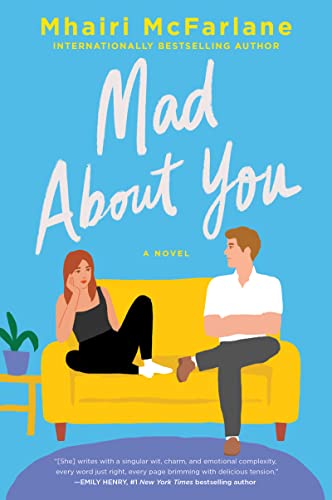
Mad About You
Mad About You is a typical Mhairi McFarlane novel – funny, sweet, filled with fanciful characters handling their fairly heavy problems with a light heart, lots of wit, and more than a little bit of humor.
When we first meet Harriet Hatley, the most in-demand wedding photographer in Leeds, the groom has just done a runner at the wedding she is shooting. Harriet offers emotional support to best-man Sam as he musters up the courage to meet the bride at the limo and watches as he gets punched in the face for being the bearer of bad news. Harriet never met the husband (not)-to-be, but she knows one thing for sure – the man is a real jerk not only for destroying what should have been one of the happiest days of the bride’s life but for leaving his friend to face the music alone.
Moments like this – as well as the high divorce rate and her own past – are why Harriet “doesn’t believe in romance, loathes the idea of marriage, and thinks chocolate fountains are an abomination”. Facts she has made abundantly clear to her boyfriend Jon, with whom she has been in a relationship for two years. So when he proposes at his obnoxious parents’ fortieth wedding anniversary celebration, she is livid. She goes through with the charade, not wanting to embarrass him in front of his loved ones, but breaks up with him once they return to their hotel room. After an awkward night sharing a bed with a man with whom she wishes she had never shared anything at all, and several even more awkward interminable days living in his house, she moves into a stranger’s home, sight unseen. Literally. She doesn’t meet with the man and does nothing more than glance through the pictures of the room he has for rent.
Cal Clarke, for reasons I never quite understood, is desperate for a decent roommate after his last renter treated their home like a nudist colony. When Harriet moves in with her four small bags of stuff he is relieved to find her almost normal. Until his best friend Sam shows up. That’s when the three of them put two and two together and realize a few things. One, Cal is the groom who absconded from his upscale nuptials, and two, there is no way that Cal and Harriet will ever be comfortable living together.
Only they are. After a few cumbersome moments, Cal and Harriet discover they make not just decent roommates but fairly good companions. They have a shared sense of humor. They like each other’s friends. They enjoy each other’s company. Bonhomie flows easily between them, which isn’t surprising since they are both easy-going, laid-back people who prefer a comfortable but low-key lifestyle that lets them concentrate on their jobs, friends, and family while minimizing the drama in their lives.
But both of them also have pasts that are determined to stay in the present. Cal’s ex keeps making visits to their home, determined to win him back. Jon continues to pursue Harriet. And then the monster Harriet has been trying to forget for years waltzes back into her life and she has to decide if she is willing to put everything she has built on the line to handle him in a permanent manner or if she’s going to chuck it all and run from her problems once again.
This story is very much women’s fiction, and rather than dealing with finding Mr./Ms. Right, it primarily deals with what happens when you find Mr./Ms. Wrong. It’s obvious from the get-go that neither Cal nor Harriet are good at romantic relationships. Cal has a type called Hot Thatcher – “Margaret Thatcher’s personality in the body of a babe” – which seems to mean he falls for girls who are caustic, overly assertive, domineering, lying, cheating beauties. Harriet is drawn to men who are extreme emotional dependents (Jon) or abusers.
Adding to the difficulty is that neither of these two seems to have a clue as to how to deal effectively with problems in a relationship. This means their problem people tend to stick around longer than necessary, adding (hilarious) hardships to their lives. While the author uses her usual charm and humor to tell us of their foibles and difficulties I will admit that the laughter didn’t keep me from realizing Ms.McFarlane was building a relationship between two people who should probably see a therapist for a few years before being with anyone again.
Fortunately, even if they can’t pick great partners, Cal and Harriet do have wonderful taste in friends. They not only have a terrific #budmance with each other, they have other solid pals in their lives. Lorna, Harriet’s bestie, is a delightfully droll, slightly looney, and often laugh-out-loud funny sidekick, and Sam, Cal’s close buddy, is sweet and charming. All four characters have a sunny-side-up take on life which makes the book a fun and easy read. Even as the narrative deals with some hard issues, it remains a jolly tale because most everyone in it is a delightfully light-hearted comical individual.
Which is surprising given that a good third of the story is about a manipulative emotional abuser and the women who fall for him. The author does a terrific job of laying out the mind games these individuals play with their victims and how gaslighting is such a subtle form of torture that those experiencing it are often utterly miserable without being able to explain why. This part is handled extremely well – it is funny enough that it doesn’t weigh the book down and serious enough that it tackles the issue with the sobriety it deserves. However, if this is a trigger issue for you at all, this might not be the novel for you. There is an excellent resolution, but to get there we have to do a bit of a deep dive into the problem.
The ‘romance’ in the story reads more like a friends-with-benefits scenario and doesn’t move even that far until the last twenty percent or so of the book. I suppose, if one were inclined to be generous, they could take the friendship buildup as the foreplay for the relationship but it’s so clearly them just bonding as pals, with no real undercurrent of sexual tension, that it doesn’t feel like the groundwork for a courtship. Maybe it’s all the emphasis on the failed relationships that make this feel like a no-go as a love story, but whatever the cause I didn’t ship Harriet and Cal.
I love Mhairi McFarlane’s work and am always happy to read anything she writes. However if you enter Mad About You looking for a romance – which the cover and title would seem to indicate – you are probably destined for disappointment. If you’re in the mood for some amusing woman’s fiction, though, definitely pick it up.
Buy it at: Amazon, Audible or your local independent retailer
Visit our Amazon Storefront
Recent Comments

On the TBR pile!
Curious to hear what you think of it. :-)
I would be very curious about what others thought regarding two issues: the “emotionally-dependent” – but also well-to-do – Jon with whom the heroine spent TWO YEARS, giving him no clue about her reservations. Hmmm. And Jon’s “obnoxious” parents, whose obnoxiousness consists at least in part of their class! and their failure to appreciate the heroine’s “cool” identity (her eyeglasses, her shoes, etc.). I was trying to lose myself in the story but couldn’t avoid being smacked in the face by the heroine’s lack of moral agency – and cool glasses do not make up for a smug sense of social superiority. Am I overreading here?
Are they parents obnoxious because they’re rich?
That depends on how you define obnoxious because they are rich. In the sense that the heroine simply blames them for being rich, the answer is no. However, they’re richer than average and like to look down on others for that reason. And the son (Jon) is actually a lot wealthier than they are, so they sorta added an unearned pretentiousness to their social standing based on his wealth rather than their own. Or at least, that’s the way I read it.
I don’t know that you are overreading but I definitely saw things differently. At the 79% point of the book, Harriet admits she wasn’t fair in her relationship with Jon, and let it stretch out too long. She had planned to bow out on their first date (16% mark) but events had her feeling the polite thing to do would be to stick it out and she kept sticking it out for two years. She acknowledges that was wrong and I would argue his behaviors post-breakup showed that he wasn’t perfect either. I called him emotionally dependent because of how clingy he was not just with her but with his family. Jon struck me as a regular guy (if a bit of a mama’s boy) and the kind of man who could definitely be someone’s mister perfect, just not hers. He also admits that he manipulated her to get her to stay with him. And she was clear on the marriage thing, which is why he proposed in public. He counted on her not wanting to embarrass him by saying no in front of his family.
Regarding the parents, they were passive-aggressive in their insults to Harriet. It was clear they thought she wasn’t good enough for their son. I get thinking someone isn’t right for your kid but thinking someone isn’t “good enough” is another thing entirely. It was clear they had an issue with her class, finding her beneath them and I don’t blame her for finding that insulting.
Harriet did seem smug at times in how she dealt with people and I felt she could have used a dose of compassion in certain situations. I enjoyed the story a lot despite that glitch but if you’re not loving it, I can understand that. Humor is a delicate thing and what one person finds funny can fall flat for another.
I’ve really enjoyed everything I’ve read by this writer so far. Thanks for the review and the heads up about it not being a romance – or even a love story really.
To be fair, it ends with an HEA epilogue and the h/h do get together in the last 20% or so of the novel. I just think readers should know it is more WF than romance.
I am so happy that you clarified this issue about ‘is it a romance’. The ending was definitely a HEA. I thought that the book was very good. For me, it read as a mashup of women’s fiction and romance. I thought that it was important that the personal growth that Harriet experienced (women’s fiction) was what allowed her to find her agency to open up to love (romance).