
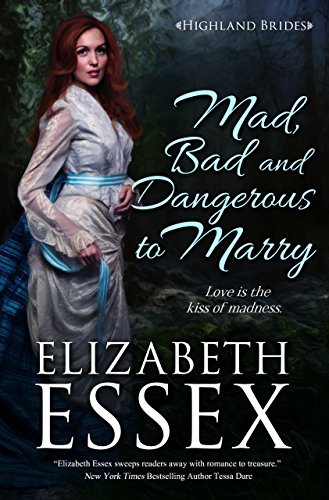
Mad, Bad and Dangerous to Marry
Lady Greer Douglas has been corresponding with Lord Ewan Cameron, Duke of Crieff, since their betrothal as young teens, but she’s never met him. On her way to their wedding, Greer and her parents encounter a badly beaten man in the road, and turn him over to a gamekeeper for care. Upon arrival at Crieff, Ewan’s cousin Malcom greets Greer with the sad news that Ewan is dead… but there’s no body! If you have never read a romance in your life, you might feel some suspense here, but otherwise, brace yourself. The rest of this book simply follows cliché with cliché, compounding it with dubious prose.
Obviously, the injured man is Ewan, which is revealed relatively early on, but not before we’ve endured chapters of irrational behavior in service of a Big Reveal that is neither big nor a reveal. Ewan has amnesia! Greer and Ewan never met, despite being engaged for a decade and living on estates that are hours apart! Greer’s miniature of Ewan is out of date! The gameskeeper who recognizes Ewan won’t tell Ewan who he is, for no good reason! It’s eyeroll-inducing.
The feeling of being bogged down is exacerbated by the never-ending and pointless epistolary flashbacks from Greer and Ewan’s courtship. Rather than supplying character details and backstory, most of these letters read like boring voice-overs from travel documentaries:
Our first sojourn finds us in Florence, a city where the Renaissance is alive at every turn. Art and sculpture and architecture come together in such a harmonious way as to be entirely seamless – one cannot imagine the great cathedral without its immense, astonishingly powerful baldachin over the altar, or the Baptistry of San Giovanni – St. John the Baptist to us – without the impressively beautiful bronze doors called the Gates of Paradise.
That sounds like exactly the sort of thing a twenty-something writes to his girlfriend! And that’s not as annoying as the letter where Greer reports the death of her grandmother, expressing great sorrow because… traveling to the funeral means she’s not going to meet Ewan as planned. No grief, no loss, no sympathy for her mother, just disappointment about her own situation. To be fair, that’s not completely unrealistic for a teen letter writer, but it did not incline me fondly towards Greer.
After Greer and Ewan realize who Ewan is, there’s a brief stretch where the book seemed likely to pick up. Was Malcolm the villain? Was he being manipulated by a different villain? Was he a bystander? Unfortunately, those questions didn’t last long, and other issues arose. Greer becomes very upset with Ewan for not remembering her, seeing it as evidence that he does not love her enough. Yes, Greer, that’s how brain injuries work. Badly timed sex is had. Characters impulsively split up to investigate things, and villains are confronted alone (although one character does take along a butler, who mysteriously disappears partway through the scene before reappearing later).
Also, twice, Ewan mistreats his horse, once riding him when he needs to be cooled and once needing a stableman to pointedly encourage him to get down because the horse is lathered. This is neither a selling point for Ewan’s character nor a credible character detail for a man who is supposed to be beloved by the horse and at home in the Highlands.
The author tries to transcend the typical Scots “lassies” and “Dinna fash,” as when Greer’s skirts are “clarty.” However, these words feel intrusive in otherwise modern writing. At one point a woman says – and I kid you not – “Holy stolen dukedoms.” If you don’t hear the word “Batman” after that phrase, congratulations, you’ve been living in a cave. And not a bat-cave, either.
I’ve read and loved Elizabeth Essex before, but this book seems almost as though it’s been written by a different author. While I can still recommend some of her backlist, I cannot honestly recommend this novel.
Buy it at: Amazon/Barnes & Noble/iBooks/Kobo
Recent Comments


Oof, I’ve read a few of the author’s other books; disappointing that this one isn’t up to snuff.
Does the hero-abuses-his-horses through overriding them come as part and parcel of my least favorite romance novel trope, “hero is so horny for heroine he must ride like a wild man to forget her’?
I was also disappointed in this book because Essex has written some of my favorite romances of all time, especially the naval ones like Almost a Scandal or Scandal to Remember. I keep hoping her next book will have the same qualities as those earlier ones.
I agree! I gave both Almost a Scandal and After the Scandal DIKs here.
Lord Ewan Cameron, Duke of Crieff??? When will writers spend 30 seconds on the net checking out the proper use and expression of titles? I also was curious about the use of Greer for a woman’s first name. Apparently it really only came into fashion in the 20th century but, hey, it’s fiction, so who cares? Actually, I expect our reviewer here has been generous with a “C” grade. Nothing here that would tempt me to read this mess.
Agreed. And it’s worse when it’s an author who has been writing in the genre for a number of years. Like Caroline, I’ve enjoyed some of this author’s books, but gave up on this series after the first two were so disappointing.