
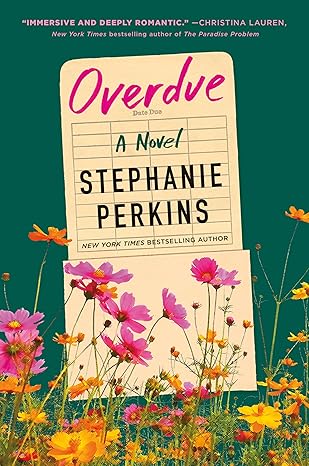
Overdue
Are you interested in a different kind of coming-of-age novel? I enjoyed how Stephanie Perkins’ Overdue made me think about what adulthood means, and the different markers of it. I remember when New Adult launched as a genre marking that period of transition out of high school and the childhood home; this book truthfully depicts a transition I see less often: from New Adult to Adult.
Librarian Ingrid Dahl has been with her boyfriend for eleven years without putting a ring on it. When her sister announces her engagement, Ingrid wonders if she and Cory should marry after all. Cory responds with a bombshell: actually, perhaps they should take a break. Dating since college means they haven’t dated or slept with other people, and how can they commit to each other without that experience? Ingrid and Cory agree to a one-month break, which everyone but them knows will be longer than a month. Everyone except Ingrid’s coworker, Magnus Nowakowski, who doesn’t dare hope.
It should be obvious that Ingrid is willfully clueless here. Anybody with two brain cells knows that this is a soft break-up, and frankly, that it should be. I give the author credit that her supporting cast recognizes this and side-eyes Ingrid, and that Ingrid is very chagrined and embarrassed about missing it in retrospect. I read enough advice columns to know that people do make mistakes this stupid and obvious, and I know I’m someone who preaches the ‘let heroines have flaws’ gospel, so it’s ironic for me to find this particular flaw so annoying and contrived. But I did, and you are as free to judge me for it as I did Ingrid. Also, please note that Ingrid’s initial boyfriend Cory and her eventual love match Magnus will not be her only partners in this book.
Overdue posits that in early adulthood, everything, from furniture to apartments to partners, is a placeholder or a trial run. Full adulthood is marked by commitments to people, places, and activities. The clock has run out on Ingrid’s starter job, and she has to choose between safe career advancement at the library (stable but not her passion), and chasing the dream of owning a bookstore. The lease on her and Cory’s shabby apartment, where she hates the wall color but isn’t allowed to repaint, is up for renewal, but she can’t afford it without Cory. But isn’t going to a smaller place as a single person a step backwards? Is Cory a starter partner, someone who was right for Ingrid’s twenties, or should he make the transition to permanent? (Obviously we know Cory’s on the way out, but Ingrid doesn’t.)
I liked Ingrid’s coworker Magnus a lot, and I love the oblivious heroine trope. When Ingrid kisses Magnus and he puts her off, she’s convinced he doesn’t like her, but it’s clear to us that Magnus has done it because he can’t face having her and then giving her up when her relationship with Cory resumes. There’s an age gap between Ingrid and Magnus, but it worked for me because one of the themes in the book is the concept of maturity levels – that once Ingrid moves out of New Adult and into Adult, the ages within Adult matter very little.
The prose has its ups and downs. There are a few moments where the author seems to be expressing political opinions at the reader instead of speaking in the character’s voice, and even though I share these opinions (for instance, acceptance of poly relationships and frustration at public mistreatment of library staff), the way it’s incorporated feels soapbox-y and inorganic. At another point, the author’s first-person narration is deeply confusing:
“I still didn’t understand that breaking up had always been the inevitable and only possible way this could end.”
When is this narrator Ingrid located in time? How can she be narrating a lack of understanding of the thing she’s narrating? The way she talks in a sex scene (“Our hunger was desperate and ravenous”) had me eye-rolling.
On the other hand, sometimes the writing is quite entertaining. For Ingrid’s sister’s Christmas wedding, they debate red poinsettias or red roses. Ingrid reports,
“My mother believed poinsettias were too obvious, which had prompted my sister to retort, ‘TELL THAT TO THE ROSES.’”
When she holds a friend’s baby, Ingrid thinks,
“Amira was beautiful and hungry and sleepy and good, but I was still grateful that she was theirs and not mine.”
(By the way, this is a childless by choice heroine, which at least in my reading remains underrepresented, so if you’re looking for one of those, this may be your book).
On the whole, while I won’t push Overdue on people, I had a pleasant time with it. If the concept of exploring transitions within adulthood intrigues you, with romance as part of that growth process instead of as the main focus of the story, then this is definitely worth picking up.
Recent Comments




On my TBR!
Seeing your review reminded me of Perkin’s fabulous book Anna and the French Kiss and when I looked up the review on Power Search, I saw your name as the reviewer, so thank you!
That was a wonderful book. Unfortunately, the sequels were disappointing. I guess Stephanie was a one-hit wonder for me.