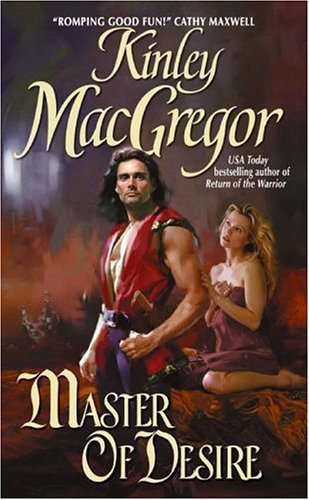
Master of Desire
Master of Desire is a book that really grew on me as I read it. I opened it expecting an ultra-cheesy medieval (I mean, come on, look at the title) and it is pretty cheesy, especially at first. But while no one is going to confuse it with a Madeline Hunter medieval, it’s not a bad read at all. Underneath all that over-the-top bawdiness there are some winsome characters and a good plot.
King Henry II has one solution to the dispute between Draven, Earl of Ravenswood, and Lord Hugh. Henry trusts Draven’s word of honor, and he knows Hugh loves his daughters, so he orders Hugh to send his youngest daughter to live with Draven for a year. Draven gives his word of honor that Hugh’s daughter will remain completely untouched.
When Draven comes to Hugh’s castle to claim Hugh’s daughter Emily, he finds that she is fairly eager to go. She loves her father, but he has forbidden her to marry because her mother and two of her sisters died in childbirth. Emily longs for a family of her own, and even though she is a little afraid of Draven, she sees this as her one chance for freedom. Her father holds Draven responsible for raiding several of his villages, but Emily quickly decides for herself that Draven is not the monster that her father and many others believe him to be, so she begins to pursue Draven in earnest.
Draven is very attracted to the beautiful Lady Emily, but several factors prevent him from courting her. First of all, he has given his word to the king that he will not harm her, or take her virginity. But he is even more influenced by his traumatic childhood. His father was a cruel man who killed his mother, and Draven believes that he possesses the same rage inside of him. He is terrified that he could end up harming or even killing Emily. Draven will have to face his own demons, and settle matters with both Hugh and King Henry, before he and Emily can be together.
Master of Desire is very lush and melodramatic and is more a romance with medieval flavoring than a hyper-realistic medieval romance. I found the language somewhat off-putting at first, because it reads like a cross between Friends and Shakespeare. A sentence like, “Could he possibly be any more embarrassed?” is followed by, “Nay, not even if it were the pope himself who awakened him.” The melodrama is helped along by poor Draven’s constant state of lust. I kept mentally comparing the poor guy to Priapus, and wanting him to take a cold bath in a stream. I had to laugh when late in the book the author called him Priapus too.
However, once I got into the spirit of the book I really started to enjoy it. Emily has a Garwood-esque innocence that is appealing, and her light-hearted nature makes her a good match for the too-solemn Draven. Their first love scene is both touching and uncommon in that everything isn’t perfect right off the bat.
Although the villain of the book is so obvious you can’t help wondering why the characters don’t see his true colors, in other ways the plot is inventive, and the conflict between Draven and Emily’s father Hugh is handled quite well. At the end of the book Draven and Emily are reunited after a brief separation, and this reunion scene is fabulous, funny, and romantic – this is what finally pushed the book firmly into B territory for me.
This is not a book for everyone. If you insist on historical accuracy or very plain prose you may find this one too over the top to enjoy. However, there are likable characters to be found here, and a nice plot to boot. Medieval fans, particularly those who like Garwood’s books, might well find this worth a look.
Recent Comments