
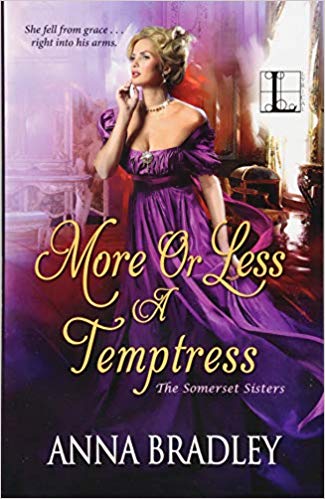
More or Less a Temptress
Anna Bradley’s More or Less a Temptress is an opposites-attract romance that wraps up her Somerset Sisters series. While the hero and heroine have their original sides, this potential is lost in a story that was too implausible for me to suspend disbelief.
Hyacinth Somerset, the youngest of five sisters, is treated like a helpless, fragile wisp by her family. This is something of a self-fulfilling prophecy, so when Hyacinth is at social occasions, she hides, and if she has to speak to anyone, she stammers. But one night, when she and her grandmother are traveling, she witnesses what she believes is a murder—two men fighting, which results in one punching the other into a limp heap and then dragging the body off.
Hyacinth doesn’t tell anyone, since her family considers her overwrought already. Then, in a ballroom, her brother-in-law introduces her to his newly discovered brother from Scotland, Lachlan Ramsay, and it’s the victor of the fight. Hyacinth gasps that Lachlan is a murderer, then faints dead away.
As it turns out, the “victim” is fine, naturally, and he’s Lachlan’s brother Ciaran. They have the sort of relationship where they regularly hit each other, but this time Lachlan went too far and beat his brother into unconsciousness (don’t worry, it’s the kind of knockout that has no long-term effects). However, Hyacinth’s misinterpretation means the ton believes the worst of Lachlan. And since he has a younger sister who needs a Season, this is bad news all around.
Lachlan comes up with a solution. To make amends, Hyacinth will stay in London to complete the Season and support his sister. Meanwhile, he will keep an eye on this terrified mouse and protect her. But he’s hiding a dark secret, which is why he and his siblings fled Scotland.
So. Let’s start with Hyacinth. A fearful heroine could be interesting, and one reason I loved Lorraine Heath’s Texas Glory was because of its browbeaten heroine learning to stand up for herself. But Hyacinth comes off like a heroine being clumsy; her flaw is there to make her endearing, rather than causing any actual problems for her.
Plus, towards the end she does something unbelievable. Spoilers ahead, because this was so ridiculous I can’t be vague about it. Some lord tries to blackmail her with Lachlan’s secret, but when the lord pulls her into a clinch, she takes a lump of wax from his pocket without his realizing it. She believes he cheats at cards by marking them with wax. So during a ball, she decides to get him alone somewhere, make him take his waistcoat off, slip the wax into his pocket, be discovered by someone he cheated, and then hand his waistcoat back in such a way that the wax falls out.
Not only is this plan convoluted, it’s incredibly foolhardy. At one point, Hyacinth reflects that “she must be mad to consider embarking on such a risky scheme”, and I could only agree. Her brainless idea only succeeds because failure would torpedo the HEA.
As for Lachlan, I’m going to spoil his dark secret too. He saved his sister by punching a man trying to rape her, but the man fell, hit his head, and died. So Lachlan believes he’s a murderer. This is the fourth time I’ve come across the plot where a main character stops an assault, but the assailant falls, hits his head, and either dies or is presumed dead, after which the main character spends the rest of the book blaming themselves for being a murderer.
Of course, this changes nothing for Lachlan’s new family, but it seemed all the weirder that despite his being convinced that he’s a murderer, he continues to be physically aggressive with everyone from the blackmailer to his brother. And the romance is unremarkable. Hyacinth and Lachlan are turned on by each other, he calls her an angel because of her golden-haired beauty, and there were quite a few references to her “plump lips”. It all plays out as expected.
For all these reasons, More or Less a Temptress (less, definitely less) didn’t work for me. If you’re a fan of Anna Bradley’s Somerset Sisters series, the book might be worth reading, but otherwise I can’t recommend it.
Buy it at: Amazon or shop at your local independent bookstore
Visit our Amazon Storefront
Recent Comments

Bradley does have this tendency toward OTT soapy plots. Sometimes it works in her favor, sometimes it doesn’t.
Just FYI, I did a little research and discovered this is not self-published. This is a Lyrical Press title, a division of Kensington.
“Hyacinth comes off like a heroine being clumsy; her flaw is there to make her endearing, rather than causing any actual problems for her.” Clumsiness as a flaw is a huge issue in literature. I haven’t encountered it a lot in my own reading, but it is common enough that how to write guides often mention it. Apparently, it is a go-to flaw that some writers have a tendency to tack onto their characters if they are afraid or unable to create organic faults for the heroine to contend with.
“This is the fourth time I’ve come across the plot where a main character stops an assault, but the assailant falls, hits his head, and either dies or is presumed dead, after which the main character spends the rest of the book blaming themselves for being a murderer.” This seems to me like a writer being afraid to let a protagonist defend an innocent person without feeling remorse. I’m not saying a character *can’t* feel guilty about accidentally killing an assailant, but it seems almost obligatory. You see this in old action series and cartoons quite a bit too where the villain tries to kill the protagonist, ends up falling off a cliff, but for some reason, the hero makes a feeble attempt to grab the villain before he falls. What impressed me was in both the movie and book “Gone with the Wind” where Scarlett kills the would-be rapist soldier and Melanie says, “I’m *glad* you killed him.” That was a “woah!” moment for me, but it was so right for the circumstances.
“Her brainless idea only succeeds because failure would torpedo the HEA.” Ha ha! Thanks for another fun review!
“I’m not saying a character *can’t* feel guilty about accidentally killing an assailant, but it seems almost obligatory.”
I don’t mind a character feeling guilty about this, but not if the self-blame replaces actual plot complications. I’d also like to see a character do something remorse-driven – for instance, make amends to the dead person’s next of kin, or refrain from doing whatever led to the accidental death. Heck, become very religious and pray for the dead person’s soul. But do something, rather than just blame yourself for being a murderer.
“What impressed me was in both the movie and book “Gone with the Wind” where Scarlett kills the would-be rapist soldier and Melanie says, “I’m *glad* you killed him.” That was a “woah!” moment for me, but it was so right for the circumstances.”
This is why I like Melanie so much. She’s a shy, polite, self-effacing and traditional woman, absolutely fitting for her time period – but she also has a spine of steel. And whenever Scarlett needs that strength, Melanie is right there, totally unafraid to defy norms to defend those she loves.
Glad you liked the review!
“I don’t mind a character feeling guilty about this,… But do something, rather than just blame yourself for being a murderer.” That’s a really good point. I think it goes along with the whole agency thing too. Like you said, the character should *do* something.
Right off the bat–without knowing anything about this series–I was struck by the odd, slightly apathetic title of this book.
I don’t see myself buying this any more than I would buy an HR with a title like, say, “More or Less a Wicked Duke” or “Somewhat of an Impostor.”
Maybe it’s just me.
It’s also not very accurate, given that the heroine spends far more time as a stammering, frightened shadow than she does trying to tempt a man.