
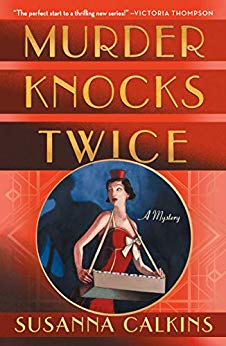
Murder Knocks Twice
Chicagoan Gina Ricci takes care of her father, an ailing widower. Money is very tight. Palsy makes it hard for her father to repair broken appliances, a task that increasingly falls to Gina. Her schoolfriend Louise Smith, now bobbed-hair Lulu, tells her about a possible opening for a cigarette girl at The Third Door speakeasy. Gina is intrigued.
It’s darb, Lulu had said, striking a glamorous pose. Then she’d dropped the affectation, adding more earnestly, Tips are great, I swear. There had been a weariness behind Lulu’s eyes when she’d spoken, and the memory of the redhead’s sly smile now gave Gina pause.
‘Darb’ is 1920s slang for excellent – an example of how Calkins infuses Murder Knocks Twice, her debut Speakeasy Mystery, with authenticity. Prohibition made alcohol consumption unlawful between 1920 and 1933: “When Prohibition hit the Chicago streets in 1920, speakeasies started appearing almost overnight. These hidden houses of spirits and socializing gave the public the opportunity to drink, sometimes eat and be merry.” This blithe description overlooks the criminality that was rampant in speakeasy culture. Chicago’s notorious gangster Al Capone controlled “over 10,000 speakeasies in Chicago,” although The Third Door is not one of them.
Gina approaches her interview with trepidation. On a cold January afternoon in 1929, shivering in a grotty, smelly alley, she navigates an elaborate system of knocks and passwords to gain access. The Third Door is gorgeous, filled with huge chandeliers, a grand piano, plush velvet furniture, portraits, and paintings. The forbidden atmosphere appeals to Gina: “small candles flickered in glasses on every table, adding a sense of magic and allure to the smoky haze.”
Owner Signora Castallazzo, described by Lulu as “the lady of stone and steel”, is the one person Gina must impress. She’ll only get one chance to make a good impression and unfortunately, Gina’s outfit is better suited to an office than a speakeasy. When the Signora tells Gina that she seems sweet, Gina knows that’s the kiss of death.
Putting her hand on her hip, Gina struck a pose like Clara Bow in It. “I’m no dumbbell,” she said. “No one’s gonna sweet-talk me.”
Even though Gina felt like an idiot, the Signora seemed to approve, for she gave the slightest smile. “Come with me,” she said. “Let’s find you something more appropriate to wear.”
Gina is no idiot. She spiffs up nicely and sells Lucky Strikes and Sobranies to the gents while Barkeep Billy informs her, “Marlboros for the ladies. Mild as May, you can tell them. Ivory tips to protect the lips.” Gina drinks in the repartee while lighting up smokes. Many of her clients are financiers, “talking nonstop about stock prices and market shares.” She’s ignorant of “the stock market and speculation”, but it “was clear that the rich were getting richer while the poor got even poorer, and that’s how the rich people liked it.”
Gina learns that Dorrie, the cigarette girl she replaced, died under the proverbial mysterious circumstances. Some heroines are TSTL (too stupid to live), ignoring the peril that surrounds them but not Gina. She keeps asking questions, even though she keeps her inquiries on the down low. Marty Doyle, the speakeasy’s in-house photographer, takes a shine to her. Marty takes pictures of famous folks, but he also photographs the staff, all the while “writing in a small notebook that he kept in his breast pocket.” It turns out that Gina is Marty’s cousin’s daughter, which is news to her. He doesn’t like Molly’s daughter working in a speakeasy, but Gina has no choice, telling Marty that, “It’s up to me to take care of everything, to put food on the table, to pay the rent.”
Tragically, a few days later Gina witnesses Marty’s murder. She asks him who attacked him but he’s beyond help. He claws at his coat and with a last burst of energy, says “camera” and after she pulls it out of his pocket, he tells her to hide it: “his breath was growing shallower and more pained.” She agrees, and then he dies. Gina’s talent at fixing appliances serves her well as she learns how to operate a camera and develop pictures.
The first story of a new series sets out a larger world for the protagonists to explore. Gina doesn’t intend to always be a cigarette girl – she’s fascinated by photography. She ponders the intricate arrangement between the ‘legal’ teahouse on the floor above The Third Door: why do the cops look the other way? When Marty dies, Gina is scared and isolated; she fears she can’t trust her co-workers let alone the police. But Miss Ricci is intelligent and intrepid. She’ll figure out who killed Marty even if she does it on her own.
Hold on tight readers, it’s going to be a bumpy ride; the stock-market crash that will trigger The Great Depression is less than a year away. How will that affect The Third Door? I’m looking forward to Gina’s next adventure in the Chicago underworld, perhaps looking through the lens of camera rather than selling smokes.
Buy it at: Amazon/Apple Books/Barnes & Noble/Kobo
Visit our Amazon Storefront
Recent Comments




Thanks very much! Stay tuned!
I hope you like it: the author has set things up really well for a continuing series.
Ooh I love Roaring ’20’s-set mysteries – this sounds fun!