
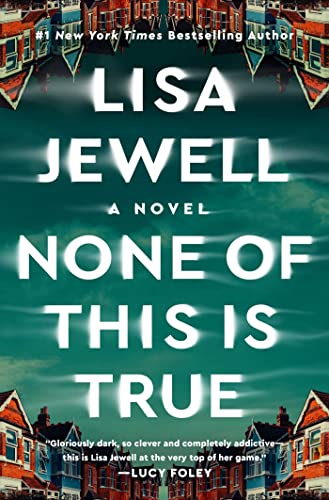
None of This is True
Lisa Jewell’s latest mystery, None of This is True, will remind you why our parents were so adamant about ‘stranger danger’.
Josie and her husband Walter are celebrating her birthday at a trendy new restaurant when they spot another birthday girl just a few tables away, having a bigger, grander celebration. Josie is enthralled by the beautiful woman who shares her special day, and when she sees that lady go into the restroom, she follows her and strikes up a conversation. It turns out that Alix was not just born on the same day but in the same year and in the same hospital as Josie. The coincidence inspires Josie to internet search her “birthday twin” and discover Alix is a moderate celebrity with a seemingly glamorous life. Josie can’t help but wonder why fate is so kind to some and so harsh towards others.
It should end there but Josie’s interest quickly turns to full-blown obsession, and she rapidly works to arrange another random encounter with Alix. When they meet, she compliments Alix on her work as a podcast host and asks to be a guest. Josie assures Alix she has a story well worth telling, and Alix, adrift as to where to take her show next, agrees. At this point, I was immediately reminded of another idiom, this one from P.T. Barnum: “There’s a sucker born every minute.”
Josie tells a complex and fascinating tale: Of being groomed by a pedophile, of being neglected by her mother, of the hardship of raising two daughters with special needs. Alix becomes enmeshed in Josie’s history and feels empathy for this woman who has seemingly been through so much. That sympathy is all it takes for Josie to quickly inveigle her way into Alix’s life, pushing the boundary between interviewer and interviewee into a reluctant (on Alix’s part) friendship. But when Alix begins to expand her podcast and contact the other players in Josie’s narrative, she discovers there are two very different sides to the yarn Josie has been spinning. Slowly, Alix comes to believe that she has let a very dangerous person into her life and into her home. The question is, will the danger come from Josie – or from someone else in this macabre chronicle?
Jewell’s writing is like catnip for me. She has a knack for creating relatable, likable characters and having their kindness and decency catch them up in bizarre, dangerous situations. She also has a gift for writing subtle mysteries that explore how our perceptions of the world affect how we view different situations and how societal standards play into that. Life in this author’s novels is inevitably complicated – with good never being perfect and bad never being entirely depraved. She explores the complexity of being human and how doing that in relationships, whether it’s marriage, family, friends, or community – multiplies the intricacies and difficulties of that experience. All of that gives her work a subtly gothic, atmospheric sense of pending danger that makes for an enthralling reading experience.
That said, this particular novel is not Jewell at her strongest. It’s pretty clear from almost the beginning, just which of our two characters is the problematic one and the only thing to be discovered as we progress in the story is just how huge their problem is and what the cost of that is going to be to the rest of the ensemble. There is also no real twist in the tale. I kept expecting to be blown away by a revelation that a different character was actually manipulating the whole situation, and that never happened. This is a ‘what you see is what you get’ kind of story.
Another quibble I had was that the book is, in part, driven by some rather questionable decisions by Alix. I understand that she is a kind, caring, loving, warm and helpful individual, but I wondered how she had reached forty-five and climbed to where she was in her profession without being a tad savvier. She seemed very gullible and naive, given her age and occupation.
None of This is True has the potential to be highly controversial because of the questions the author raises regarding adolescent pedophilia. I’ve watched numerous news programs that covered the subject matter of a teenager falling in love with and eventually marrying a much older man, which is what happens in this book, and it’s a difficult issue. If the couple waits till she is eighteen to out themselves, there is nothing that can be legally done. In this story, an adolescent Josie pursues a friendship with a forty-plus man whom she marries when she is eighteen. As she talks to Alix, she claims she later realized she was being groomed and accuses her husband of being a pedophile. I agree with her. Regardless of how sexually provocative Josie may have been or how aggressive in pursuing the relationship she might have appeared, she was a child. A troubled one perhaps, but still, he was old enough to know better and should have been wise enough to speak to her mother (whom he knew) and get Josie help. The fact that he didn’t points to his own salient interest in a teenage girl and a lack of ethics and morality in his character. The text agrees with me, although there is a certain amount of blame cast back upon Josie because of her difficult, rather twisted personality. I appreciate the author trying to explore all the facets here but that struck a discordant note for me.
None of This is True is one of those stories I hate to grade. There are problems, such as the above, plus other little foibles that keep it from being the kind of stellar work that really allows for the exploration of some of the issues it brings up. Regardless of the grade that appears on the review, know that I struggled between choosing a B for what it gets right and a lower grade for those few but important things it gets wrong. It is up to the reader to decide which they think is the right choice.
Note: This book deals with pedophilia and just what the definition of that is, child abuse, child neglect, and domestic violence.
Recent Comments



This book was rough. On the one hand, I love Jewel’s mysteries. On the other hand, this one had a host of issues that made me feel a bit squicky.
If you want to read a thriller book with a podcast plot that zings, I’d pick Conviction by Denise Mina.
I agree, it made me feel squicky as well.
I don’t want to read a book where an underaged character is treated as if they always had full agency and autonomy. I had the same reaction a few weeks ago when I read a book called UNHOLY CRAVING by new-to-me writer Lynn Burke. It was one of the most baffling “romances”I’d ever read. On the one hand, the book showed how the vehemently anti-gay stance of fundamentalist religion leads to self-loathing and significant mental health issues for LGBTQI people who are caught up in that belief system. On the other hand, Burke undercut her premise and muddied the waters significantly by presenting a relationship that had an enormous power imbalance, with one MC being in a position of authority (as a youth pastor) over the other, who was underage (at least at the start of the story) and unable, legally, to consent to any sexual encounter—no matter how much he asserted that’s what he wanted. The younger MC’s age (and the fact that the older MC was his youth pastor and teacher) was an enormous red flag for me: regardless of the gender pairing, relationships can only flourish if all parties are consenting adults. I don’t care how you slice it, one MC was still legally a child when the book began. Making things even more inexplicable were places in the story where the younger MC’s assertiveness and determination to “seduce” the older one reminded me uncomfortably of the behavior sexual predators often ascribe to their victims, as if the predator was the one being seduced. And Burke gave these MCs an HEA—after the younger one turned 18–when, instead, the older one should have received a prison sentence! TL;DR: Writers, regardless of their genre, should steer clear of normalizing relationships where one character is still a child.
That sounds pretty horrible. If this had been a romance, it would have been an F for me. Instead, this is a psych thriller/mystery where the whole question of the “bad seed” comes up. Do some people just have a penchant for evil? Is nature or nurture responsible for the most dangerous members of our species? I really disliked pedophilia being used as a possible trigger for evil because most of the people who suffer this disaster wind up self-destructive, not as a danger to others.
This reminds me of something else I’ve seen sometimes that is less obviously egregious but still imho similarly problematic.
It’s usually a brother’s best friend or best friend’s brother situation, with an age gap. The younger character had a crush on the older character and, in the backstory, while still a minor, made an advance on the older character, who rejected them.
Flash forward to the present day, and the younger character still harbors a grudge against the older character for the rejection and often has cripplingly low self-esteem because of it, which they often blame the older character for. When the couple eventually gets together, this inevitably comes up, and it inevitably ends with the older character apologizing for the rejection and often specifically saying that they should have respected the younger character’s right to know their own mind. As a teenager. Who could not legally consent.
This is so deeply messed up. The older character did the right thing! They owe no apologies for doing the right thing. Meanwhile, the younger character never looks beyond their teenage hurt feelings or acknowledges that it would have been illegal if they hadn’t done the right thing; the author and text don’t either. If any apology is warranted, it should be from the younger character for potentially opening the older up for criminal charges if someone had seen and thought that the older character was the instigator. But the younger character apparently hasn’t matured emotionally since the incident, and the authors don’t seem to think they should have.
I’ve also seen other examples of power differentials not involving minors where the less powerful character is the pursuer, they practically bulldoze the other character into a relationship, and it’s the other character who has to apologize for their reluctance to participate in a relationship with ethical considerations.
Sexual/romantic rejection is treated like the ultimate cardinal sin in Romancelandia, even when the rejected character is a minor. I think we need to examine why this is the case, because I absolutely agree with @DDD that it normalizes things that should not be normalized.