
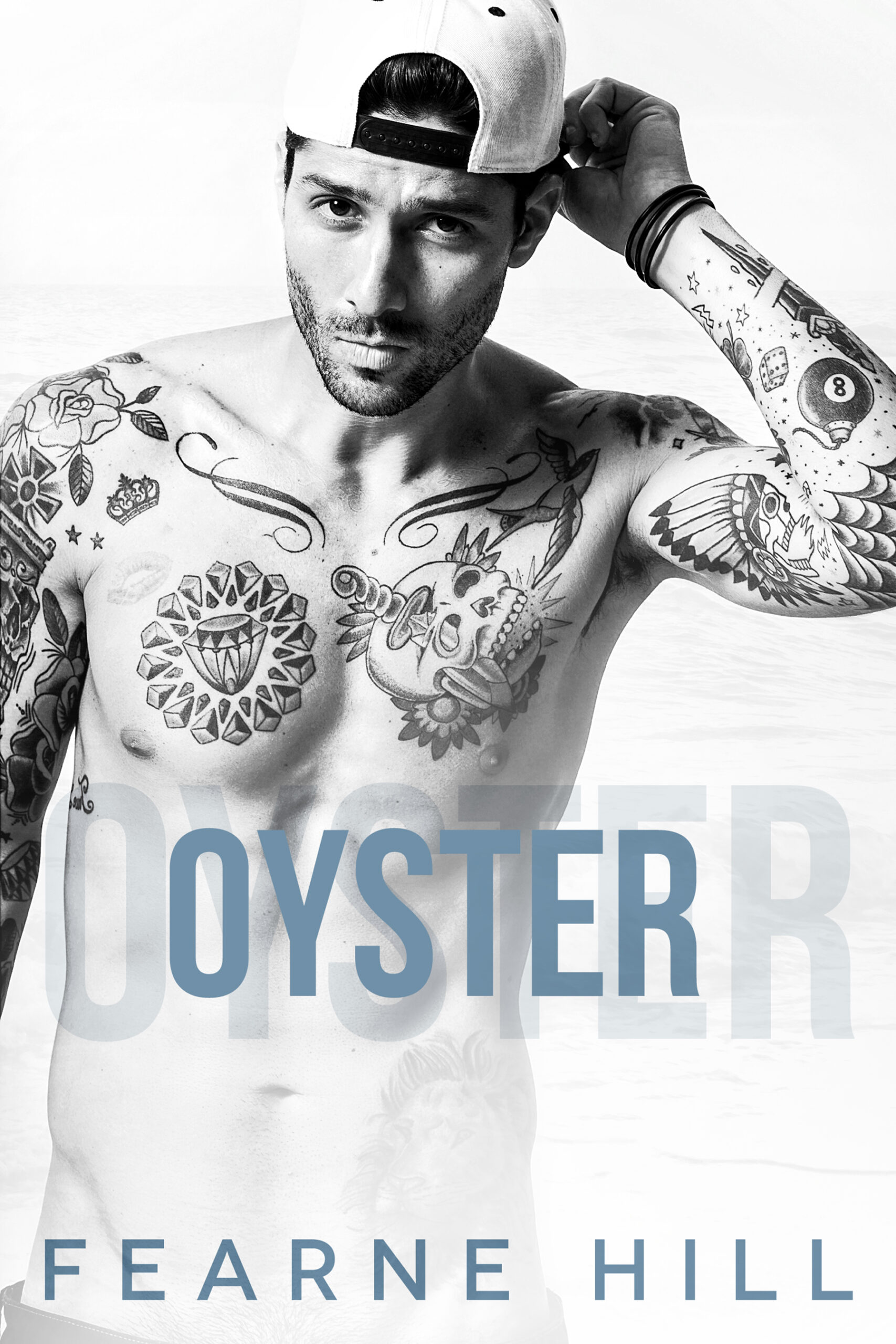
Oyster
As Fearne Hill is known primarily for writing m/m romance, I’m opening this review by making potential readers aware that Oyster, the second book in her Island Love series, is a queer m/f romance featuring a transwoman protagonist. As I’ve come to expect from this author, we’re treated to a beautifully written and emotionally satisfying romance between two complex and interesting characters in which the issues they both face are handled in a sensitive and sympathetic manner. It’s warm and funny and poignant, and while it doesn’t quite hit the heights of the previous book, it’s nonetheless a fabulous read.
Set once again on the Île de Ré off the Western coast of France, the book opens with Nico la Forge, best friend of Florian (Salt) and farmer of the island’s finest oysters, coming to the aid of a young woman – who has clearly had too much to drink – sitting in the waves of the incoming tide. She says her name is Éti when he helps her up, and he escorts her off the beach and up into one of the secluded holiday homes that belong to the rich and famous, intending to deposit her into the arms of her family and leave. But when she reveals she’s there alone – and Nico finds the half-empty bottle of vodka and the trail of pills along the floor – he realises his plans for a quick exit will have to be set aside. Managing to ascertain that while Éti did indeed drink the vodka, she didn’t down a load of pills with it, he’s helping her to get comfortable on the sofa when he finally gets a good look at her face. And it’s one that is very, very familiar to any French person not living under a rock. For looking up at Nico is the face of Étienne Salvador, star of Paris St. Germain and one of the most famous footballers in the world. Merde.
Éti may be drunk, but she’s not insensible and immediately assumes the worst, that as soon as Nico leaves, he’ll be on the phone to the media. He’s confused at first and wonders why she’d think he’d do that – he’s tired after a long night harvesting oysters – but then understands and insists he has no intention of telling anyone about her, but Éti doesn’t believe him.
When, two days later, Éti tracks him down and offers him a very large sum of money to keep quiet about what he learned, Nico isn’t completely surprised – but insists that he doesn’t want her money. As far as he’s concerned, Éti is Éti; Étienne Salvador is someone Nico has never met, a celebrated professional footballer and winner of many prestigious awards while Éti is a charming, whimsical and funny young woman he’s coming to realise he’d like to know better. He continues to refuse to take Éti’s money, although he agrees to sign an NDA if it’ll make her feel more secure.
The way Nico simply accepts Éti is wonderful to read and reaffirms one’s faith in the goodness of people in a world that so often seems full of bigotry and hatred. He never misgenders her, doesn’t miss a beat when he recognises her and he really listens when she explains how difficult it’s been for her to live a lie and how she doesn’t think she’ll be able to stand to do it for much longer. To Nico she really is ‘just’ Éti – a bubbly, vibrant chatterbox with a big heart and a great sense of humour who simply wants to be able to live her life as her most authentic self.
But as Nico is falling hard for Éti, other aspects of his life are falling apart. His mother is terminally ill (from breast cancer) and Nico is struggling to hold his family together as they all try to come to terms with what is just around the corner. Nico’s father spends the time he isn’t working getting drunk, his sister rarely emerges from her room, and he worries that his younger brother, Max, who was diagnosed with selective mutism as a child, is becoming less communicative with every passing day. Nico doesn’t know what to do. He’s trying to be there for everyone, but he’s floundering, just as they all are, and worries he’s not doing the right thing for any of them. Fortunately, he has Florian on his side to support him and give advice, and although it takes Nico a while to open up to Éti about his mother’s illness, once he does, she’s determined to be there for him while he supports his family as best he can.
Fearne Hill writes with insight and sensitivity and does an excellent job of balancing the emotional highs and lows of her story so that, while grief and loss feature prominently, Oyster is nonetheless an uplifting read. Nico and Éti are likeable, well-drawn characters who are both at a turning point when they meet – Nico, facing the imminent death of his mother, Éti, knowing that she can’t live a lie for much longer – and I loved that they find each other just when they most need to. Not because love magically fixes everything, but because finding your forever person when things are tough makes it just that little bit easier to deal with whatever life is throwing your way. Nico never expected or wanted to find love – he was happy playing the field and didn’t see any reason why that should stop – until he meets Éti. Éti’s joy at finally having found someone she can truly be herself with leaps off the page, although intimacy and sex is difficult to start with because she dislikes her (professional male athlete’s) body and worries Nico will not find her attractive when he sees it.
The small secondary cast includes Salt’s Florian – who is a wonderful best friend to Nico and will clearly be the same to Éti – and his partner, Charles, who has absolutely no idea who Éti is (which she finds incredibly refreshing) and takes her completely at face value. Nico’s brother, Max, is a sweetheart whose story is up next in Vine (out later this year).
Oyster is a beautiful story of love and grief and acceptance that addresses issues surrounding identity, sexuality and belonging in a subtle but impactful way. The romance reader in me was absolutely delighted at the novel’s ending; the pragmatist couldn’t help thinking that what the author depicts is a such a contrast to the reality for so many (especially in today’s political climate) – and how much I wish it wasn’t.
But romance novels are, by their very nature, meant to take us away from the everyday, even when they tackle difficult subjects – and Oyster does that extremely well. The island setting, Éti’s infectious delight in simply being herself and Nico’s unquestioning love and acceptance are lovely to read, and the balance of light and dark in the novel is very well done. I enjoyed it and am more than happy to offer a strong recommendation.
Recent Comments





On my TBR!
There aren’t enough romances featuring trans characters and this is a really good one.
Have you read anything of hers before? I highly recommend all her books – she’s getting better and better, which is wonderful to see.
I haven’t, but I want to!