
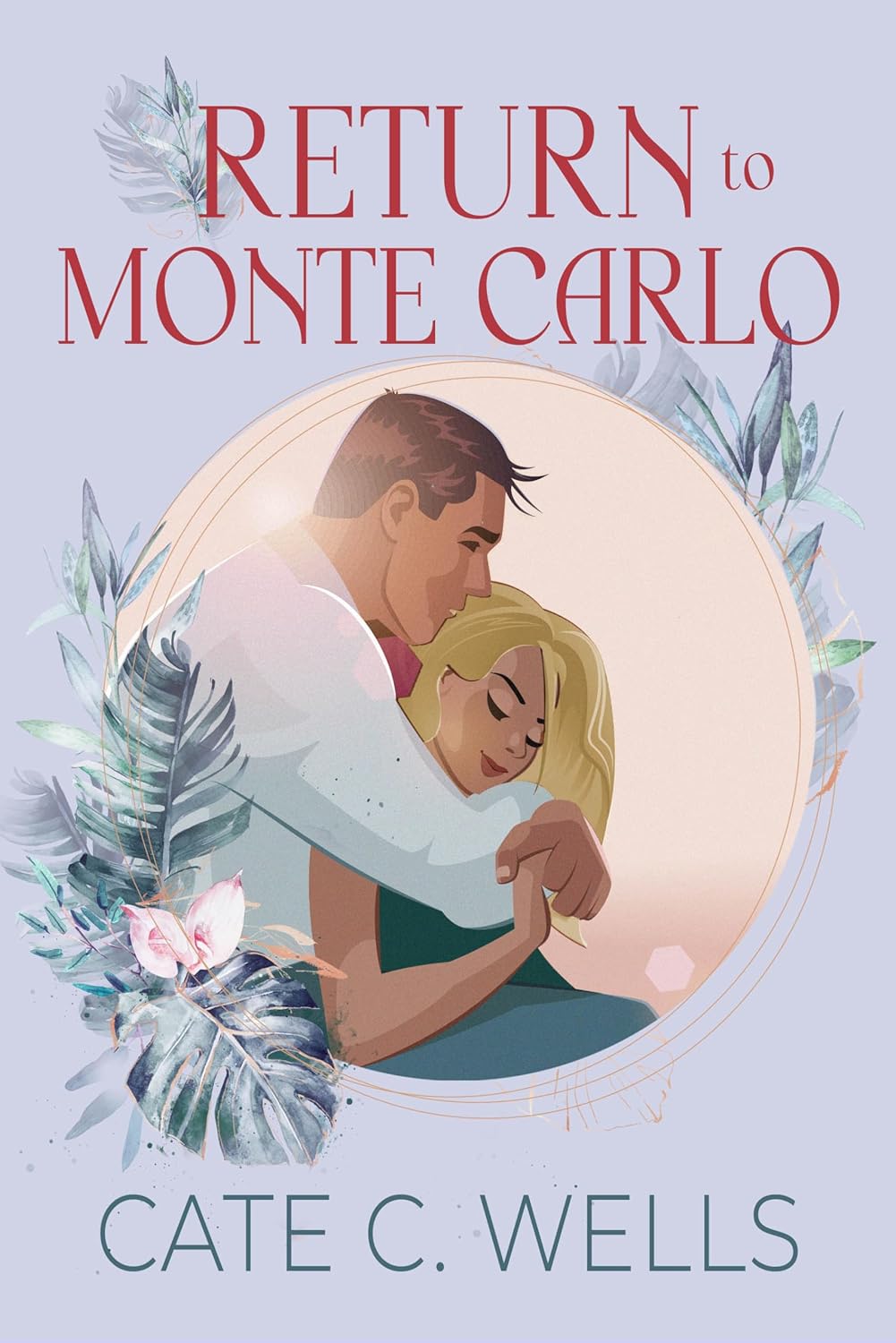
Return to Monte Carlo
Cate C. Wells’ latest offering, Return to Monte Carlo, attempts to revisit the sizzling romance novels of the 1980s, but instead, sinks into a morass of missed chances, icky sex scenes, and uninspired narrative.The story begins, in 1982, with 20-year-old Diane de Noli waiting for her husband, 32-year-old Marco, to show up for their first anniversary dinner. The two met in a whirlwind romance, right out of an old Presents novel if they’d had sex scenes with graphic violence and many mentions of bodily fluids. Marco, the older, suave Italian billionaire has to have big boobed, blonde virgin Diane the moment she inadvertently cuts his throat during a shave. When he realizes that she LOVES him to f*ck her violently–this kind of kink is apparently called consensual non-consent–he marries her and brings her back to his horrific family where they all live in misery in extraordinary wealth in a fictional–as in no bearing to reality–Monte Carlo. Unsurprisingly, his relatives treat Diane like sh*t but Marco, too busy saving his empire, doesn’t notice.When Marco does finally show up for dinner, he’s accompanied by his secretary, Sienna, whom Diane is sure he’s banging. So she bolts.Five months later, Diane, despite having been on the pill, is pregnant, and living in semi-squalor with two friends. She–and this took five months–decides Marco has the right to know he’s to be a father and calls him. Within 24 hours, he’s at her door. After a brief discussion and an aggressive banging over the kitchen counter, Diane gets on his private jet and, yes, returns to Monte Carlo. I really wish she hadn’t.Wells’ writing is crisp and clear, but the narrative doesn’t do it justice. The story tries to spice things up with a kinky twist, but, here it too often reads as just another name for rapey roleplay. Yes, Diane enjoys playing hard to get–she also likes to beat up Marco but her tiny female fists and feet never leave a mark– and Marco delights in bondage, using belts, and calling her names. Not one but two of their love lust scenes involve literal sh*t but despite riveting discussions about “stuff on your thing,” the two are unable to talk about anything of importance.The book’s brevity, reminiscent of the old Harlequin romances, fails to deliver depth. The plot is thinner than the actual novel and predictably dull.Despite being set in 1982, the story fails to evoke a genuine ’80s vibe. Return to Monte Carlo, despite the occasional reference to Folgers, pantyhose, and Mr. Coffee, feels firmly tethered to our era so much so that, if the novel hadn’t stated it was set in 1982, I’d have placed it this century. (It does lack cell phones so there’s that.)Worse, almost all the characters are wildly unlikable. Diane is a terrible heroine: self-absorbed, immature, and profoundly annoying. It’s challenging to find any redeeming qualities in her character. Especially egregious is her hatred of Sienna, a smart and ambitious woman with a degrees from the London School of Economics. As for Marco, his baffling behaviors make him an asshat rather than an enigma. He’s one of the heroes who is supposed to be brilliant professionally, but he’s so clueless about his wife, his family, and his actions that he just comes across as an entitled jerk. I loathed them both.Return to Monte Carlo feels more like an failed experiment gone wrong than a successful foray into retro romance. Wells’ writing remains her strong suit, but the romance fails in its portrayal of characters and their inability to communicate, its lackluster historical setting, and its eye-roll inducing epilogue. Readers considering this 80s tinged love story should take their cue from one of the eras most visible women, Nancy Reagan: Just say no.
Reviewed by
Dabney Grinnan
Grade : D+
Book type :
Contemporary Romance
Sensuality : Hot
Review Date :
October 28, 2023
Published On :
09/2023
Recent Comments
trish commented
A Lady's Code of Misconduct by Meredith Duran was very good.
Dabney Grinnan commented
It gets worse. I recommend Jewel's most recent, It Could Have Been...
Jason Ward commented
I am 60% through this book and am thinking exactly this -...
Maggie Boyd commented
Easily one of my favorite books of the past decade.
Dabney Grinnan commented
This is on sale today. It's everything Maggie says!



I was wondering when contemp writers were going to discover what consensual non-consent is.
It’s interesting to me how some are interpreting the book as a satire, and others just see it as a relitigation of the Bad Old Days of bodice rippers.
It was neither for me. If it was a satire, it lacked bite. It had none of the charm of the old Bodice Rippers and the context–the 80s–was, for me, paper thin.
My take was the complete opposite of yours. I really liked it–but I went into it expecting Wells to bring a subversive approach to the material. I hope I’ll be forgiven for pasting my thumbnail review here: Cate C. Wells dedicates her latest, RETURN TO MONTE CARLO, to Lucy Monroe, which is absolutely fitting because RETURN TO MONTE CARLO is simultaneously both an homage to and a deconstruction of the Harlequin Presents storylines of which Monroe has written scores. In RETURN TO MONTE CARLO, working-class American Diane marries wealthy Italian businessman Marco after a whirlwind romance (characterized by some very intense D/s sex). But once Diane arrives at Marco’s family home in Monte Carlo, she is slowly worn down by his odious family (to whose toxicity Marco seems oblivious), and, after Marco misses a dinner celebrating their first anniversary, Diane flees back to the States. By the time Marco catches up with her, Diane is five-months pregnant and grudgingly returns to Monte Carlo with her husband. But will things be different this time around? Wells sets the book in 1982/83, and I think that works for the story because it removes the technology we take for granted today (would it take a wealthy man five months to find his runaway wife in 2023?), and it also eliminates the way the internet lets us know so much about so many things. Both Diane and Marco are baffled by how much they love the dominance-submission dynamic of their sexual relationship, they understand nothing about it and have nowhere to go to acquire non-judgmental information about it. Today…well, that would be a different story. Marco is another in a long line of Wells heroes who want to do better but often lack the emotional bandwidth to do so without blunders. Diane is another of Wells’s wise working-class heroines who live in the world of the realpolitik and are disinclined to believe in Cinderella fairy tale endings. I think Wells is writing some of the best, most subversive, romances being published today. If you like Wells—even if you’re not a fan of Harlequin Presents—RETURN TO MONTE CARLO is highly recommended.
I’ll just say I like Wells!
I did not like this book–the fact that it has literary deconstruction as one of its goals sailed completely over my head.
I like icky HPs as a guilty pleasure. Dark macho man, clueless innocent, weird vibe in a super rich setting. And dubious consent.
I also occasionally like some dark romance.
In those books, everyone gets redeemed somehow, or punished, all settled at the end.
And you accept that her innocent virgin love healed him, and that he just had communication issues and always meant well, and so on.
I read this one as satire on those books and enjoyed it as exactly that:
Macho idiot, clueless bombshell, everyone is mean to each other, kinky sex, deranged aunties, yachts and villas, crazy interior design competitions, senile grandfathers in wonderful suits at elegant dinners, evil Russians, …
If felt like a tell-all:
And this is what really goes on in those HPs, when you lift the curtain.
I had fun.
And I was happy that Sienna walked away to become a success as a business woman – she was the only sane one around.
Yeah–Sienna has my vote.
Sorry but Sienna also had absolutely no redeeming characteristics. Plotting to interfere in someone’s marriage doesn’t make you likeable in my opinion. So she was a woman with a university degree. So what? I have four. Doesn’t make me any more special than the woman next to me.
And here goes a little rant: There seems to be this thing at the moment where another woman can’t be the villain. I’ve seen people absolutely rip Mariana Zapata’s books to shreds because they don’t like how her heroine has referred to another woman in the text. I guess I believe we can all be the villain. I don’t have to like everyone I come across. I don’t have to automatically support someone because they share my gender. I’m getting sick of books beating this drum incessantly. It’s preachy as hell and it was refreshing to actually have a slightly take.
I disagree a little: the fact that you did the work to educate yourself, and that Sienna was doing a good job and showing up to do it every day is laudable. Compared to the whiny heroine, who was offended that people were horrible to her, and her sense of entitlement, I feel justified in admiring Sienna more for having studied and for her professionalism.
On the other hand, You are right , Bronte.
I was ignoring the interfering part.
For a long time, I thought that she was the only one actually doing her job and saving the company by keeping the H’s attention on the bottom line. And that she just did not actively care about his marriage, which is her right.
And I must admit that looking at the amazing mess the heroine was making of it all – and yeah, the others were unkind, or mean, but not learning the language as a form of protest(??)… looking at that destructive mess, I think that waiting for this marriage to fail was legitimate.
But yes, she sabotaged that whole big event at the end, and that went too far.
On your rant:
Yes & no.
I hated the trope of the mean rival, even in HPs, it really grated how women were portrayed – they had no reason and went out of their way to poison another woman’s life because they could, as the hero’s trusted mother, sister, old friend, colleague, ex. I am glad this is out of fashion.
Having to be nice to anyone, or going out of my way to smooth their path, and never shall a negative word cross my lips, just based on gender, that is grating, too. And all women are not wonderful. So Yay the Villainess!
Well, no one in the book gets my joy, but I preferred Sienna’s obvious ambition to Diane’s bratty baby behavior.
I agree with you about women–really anyone–as villains. There seem to be lots of groups that can’t be portrayed as evil whereas, in reality, bad actors can come from anywhere.