
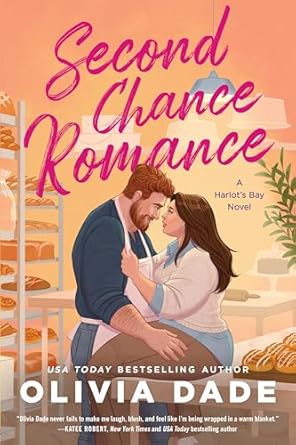
Second Chance Romance
Olivia Dade returns to Harlot’s Bay for Second Chance Romance, the second book in the series which, for my money, is just as wonderful as the first, At First Spite.
The prologue covers the history between Karl Dean and Molly Dearborn over twenty years earlier. They weren’t a couple in high school but life and study overlapped and they were constants for each other, until Karl got a girlfriend and Molly left town. Then recently, Karl overheard an audiobook recording and recognised Molly’s voice. For the last two years he has been listening to her narrating monster romance as he works hard in his bakery/café.
In the present, Molly hears that Karl has died, and in a moment of weakness and grief she heads back to Harlot’s Bay, a place she has avoided for over twenty years. She’s nearly forty, with some health troubles and a messy divorce behind her. Her work as an audiobook narrator is isolating so she has few close friends in LA, and with holiday time booked, it’s relatively easy to leave her home and get a one-way ticket to Harlot’s Bay. When she gets to Karl’s café, she realises that he is very much alive and an unguarded hug between them unleashes all the feelings they have suppressed over the years.
In the interim, Karl has been busy with his bakery, helping his siblings and mentoring his young staff. He’s a control freak though, so he won’t delegate the big jobs and he is exhausted. Karl recently had the flu and closed the bakery for a week which had the run-on effect of a mistaken obituary – a neat piece of comedy gold that shows how small-town rumour mills work.
Karl and Molly were never a couple, but he never got over her. She’s been a measuring point for all his relationships and that, combined with his combative and avoidant communication style, means that although he is liked, nobody is really close to him. Now that Molly is single and within reach, Karl concocts a ridiculous scheme to keep her in Harlot’s Bay, persuading her to stay for a month, learn to trust him and go with him to their high school reunion – although what he really wants (of course) is for Molly to stay permanently. To that end, he organises picnics for her, makes her delicious lunches, introduces her to the Nasty Wenches Bookclub (delightful!) and comes up with a number of trust-building games which he hopes will cement their bond.
It’s very sexy, but their attraction is grounded in their growing affection for each other and both Karl and Molly give of themselves to give each other pleasure, which is delicious to read. It’s also unpredictable, as events don’t go quite in the way I expected! Karl is fabulously drawn – his language is dramatic and profane and his voice is distinctive. If you don’t love (a lot of) swearing, this might be a tough read, but I adored how grumbly and unfiltered he is. (It’ll be a fun listen in audio!)
At its heart, Second Chance Romance is about miscommunication and how there’s risk in being vulnerable. When one person needs the words, and the other expresses themselves through their actions, both of them have work to do.
If I was picky, I’d want to know more about Molly’s narration work. We get lots of detail about the reality of running a bakery – the long hours, early morning starts, physicality of the work, but other than passing references, we know very little about how Molly manages her voice, or indeed, Molly’s work in general.
But if you love Olivia Dade, you’ll love this, and if she is new to you, this is one for readers who like mature and interesting characters, body positivity, small-town romance with a strong sense of place and sensitively handled real-world issues. Second Chance Romance is a #DIK for me!
Recent Comments




On my TBR; love me some Olivia Dade.
I love Olivia Dade.
With this book, which I started immediately yesterday, I am at about 30%, and I am generally not sensitive to strong language, but here, it is really strong.
It is at the level where it is really like a kind of limitation or disability for the hero how he cannot filter his words, both for vulgarity and for constantly being negative to others – I need to accept it as a part of who he is, and sometimes it is hard.
I love the characters apart from that, but I need to put the book down occasionally because this gets too much.
Hi Lieselotte, I agree the hero’s language is a lot, but I loved how consistent it was from when he was at school, and how it becomes almost a crutch for him to avoid articulating his feelings. I also think his characterisation is spot on and he feels authentically ‘male’ – I hope you persevere with it! Cheers, Laura