
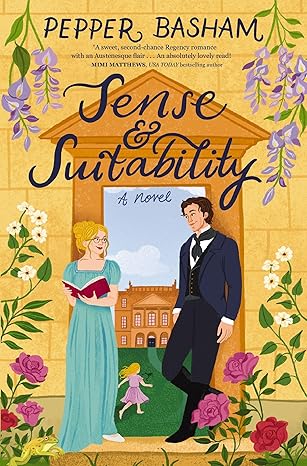
Sense and Suitability
If you like sweet Regencies, you will find much to enjoy in Sense and Suitability.
Emme (Emmeline) Lockhart’s first season was both a success and a failure. A success in that she had fallen in love with a handsome, dashing suitor who offered marriage, but a failure in that he’d broken her heart on the very night they were to announce their betrothal. The obvious jilting was the cloud that rained over the entirety of her second season. Now, her Aunt Bean (technically Albina, but everyone prefers the nickname) is determined that Emme’s third season will be her last and will end with her a wedded lady. Or not. Emme herself is in no rush to marry. Thanks to a lucrative (but anonymous) writing career aided by her cousin, Thomas, who acts as her agent, Emme is a lady of independent means. She doesn’t need a husband to support her, and she has no plans of engaging in nuptials unless she is in love.
Simon Reeves, Viscount Ravenscroft, found his perfect match two seasons earlier. Then tragedy struck, and he became the guardian of his five wayward siblings and the inheritor of a title and a slew of debts. Soon after, his mother passed, one of his young brothers joined the military, and one of his sisters eloped with a most ineligible man. He’d practically left poor Emme at the altar as he had dashed off to deal with all his troubles, and he’d never written to explain, too caught up in his spiraling life to make time for anything but his immediate concerns. Now he’s trying to find a wealthy heiress to be his bride and take control of his family. He has returned to St. Groves, where his estate is, so he can hopefully choose from among the locals. He has every intention of avoiding his erstwhile love.
God has other plans, apparently. A series of events, one of which involves a set of pilfered chickens, works to draw Emme and Simon together. This closeness also helps to resolve the lingering bitterness in Emme’s heart as she realizes just how desperate Simon is for funds and how very much in need of discipline and guidance his siblings are. She can’t be the heiress he needs to resolve his financial woes, but she can be the friend who helps him find one. Ever one to face a task head-on, Emme rolls up her sleeves and gets to work. In between helping Simon make business connections, locating his perfect governess, and penning her novels, Emme sets out to find the girl who will love Simon, fix his solvency issues, and help raise the rascals in his care. But what if the only girl who is perfect for him is the one in her mirror?
This is a light, easy romance with two amiable, era-appropriate leads. Emme’s only scandalous behavior is writing adventurous Gothic novels wherein true love prevails and keeping that a secret. She is, otherwise, the ideal Regency lady. She visits elderly neighbors, befriends the neighborhood rapscallions (in this case, Simon’s siblings), attends balls, and keeps company with her family. She is kind rather than witty, although she can hold her own in difficult conversations. She is also patient and, for the most part, practical.
Simon has no marketable skills other than being a decent manager of his estate. Unfortunately, the debts left behind by both his father and cousin, as well as the fact that the estate was in disrepair before they passed away, mean that sound management won’t quickly generate the necessary funds to make repairs and care for his siblings. His wealthy aunt is currently keeping them afloat, but that is dependent upon his swiftly marrying a suitable, respectable, wealthy bride. Simon knows his charm and good looks will help him do that, and in fact, finds himself much sought after at balls and parties, even though his circumstances are widely known. However, most of the young women are either dull conversationalists or ladies in search of a title and eager to take full advantage of whatever perks that brings. He appreciates Emme’s help, but it actually makes things more difficult since it encourages comparison between her bright, winsome personality and the scheming or dull candidates she brings him. To be fair, she is doing her best, but the pickings are slim for fortune hunters. The author does a nice job, though, of painting his fortune hunting in a very favorable light. Simon isn’t lazy, capricious, or callous; he is simply seeking an era-acceptable solution for a problem not of his own making and is both responsible and caring in how he approaches it. He is kind and honest in his relationships with potential spouses, seeking to do what is best for all involved.
I liked that finances play a significant role in the plot, highlighting how society is stratified by wealth and how the need for it genuinely impacts the lives of the characters. Even Emme is presented as being able to make the choice to remain single only because her commissions have made such an option possible.
I could easily see why Simon and Emme had fallen in love. They are good friends with similar goals and views on life, and are also passionately drawn to each other. The author keeps the heat level at kisses, but they endlessly steal glances whenever the other is in the vicinity, seek each other out when in the same room, and touch (appropriately) whenever possible. Though separated for most of the novel by Simon’s need to take a wealthy wife, they kiss against their better judgment because they are so strongly drawn together.
Kids and bossy aunts can ruin an otherwise good novel, but that doesn’t happen here. Simon’s siblings are adorably precocious, but they fit neatly into the plot without being used as deus ex machina. Aunt Bean and Simon’s wealthy Aunt Agatha can be stubborn and wrong-headed, but they are genuinely trying to help.
On a scale of one to ten, with one being almost no mention of God and ten being a sermon masquerading as a novel, this is a five. Faith is displayed through both action and conversation. This is made more natural by the fact that Emme’s cousin Thomas is a clergyman, whose good-humored lectures on not listening to gossip, giving others the benefit of the doubt, honesty, and forgiveness all weave seamlessly into the narrative.
The title would imply a tie-in to an Austen tale of a similar name, but this story doesn’t bear much resemblance to that one. Sense and Sensibility is discussed since Emme lends it to Simon and they share their thoughts on it, but that’s as far as it goes.
My one complaint against Sense and Suitability is that a shorter length might have worked better for the story. There just isn’t a lot going on here, and the book flags at several points. Despite that, I did enjoy it and would recommend it to fans of trad Regencies who don’t mind a bit of religiosity with their romance.
Recent Comments




I am #1 in line to get it at my library! I hope it’s in soon. Sounds adorable.
Well, this sounds good!
It was cute!