
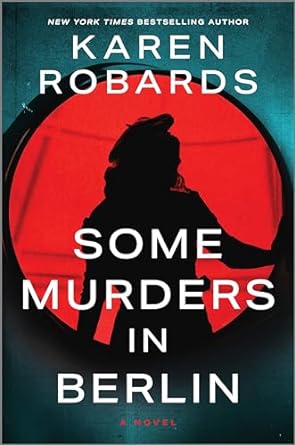
Some Murders in Berlin
One of my favorite books last year dealt with a killer using the backdrop of war to get away with his crimes, so when I saw Some Murders in Berlin I was excited to revisit that plot. Unfortunately, the author fails to make good use of the possibilities presented by such a setting and instead provides us with a rather generic romantic suspense novel.
September 1943: It’s an offer she can’t refuse. Dr. Elin Lund is summoned to Berlin just days after Denmark is placed under direct military occupation by the Nazis. Elin has earned herself a reputation as an expert in the budding science of psychological profiling, and the German higher-ups have determined to put her and the entire field under scrutiny through the investigation of the horrific murders of eight young women in the Fatherland.
The situation is precarious. The Germans have been permanent “guests” in Denmark since 1939, but this latest maneuver is a frightening escalation of her nation’s troubles. It’s especially terrifying for Elin, since her in-laws are Jewish, her husband died while opposing the Nazis when they first arrived, and her son is, therefore, a half-Jewish child of a political criminal. Elin does not wish to leave him and travel to Germany, but she has no choice
Elin meets Homicide Detective Kurt Schneider, head of the criminal police unit, at the scene of the latest crime. He’s not thrilled to see her, and at the start, the two find themselves at odds over how the investigation should be handled. Then they learn that the Führer himself is following the case, which means certain death for them, their teammates, and most likely their families if they fail to find the killer quickly. Realizing that their lives depend on their ability to cooperate, the two combine their expertise to chase down a clever sociopath determined to evade them. But as they grow ever closer to finding their heartless perpetrator, they find themselves with heart issues of their own. Falling in love is impossible – they each have a lot of baggage to handle, which makes the war particularly dangerous for them. But falling in love seems inevitable – Elin is the brave, beautiful, intelligent partner Kurt has always longed for. And he is the only man caring enough, fearless enough, and protective enough to heal her of the losses this war has inflicted.
This is a murder mystery set in WWII Germany. It deals with subjects relevant to the time in language used by the people of that era. This includes antisemitism, harm to children, concentration camps, infanticide, and many other similar issues. The violence is not graphic, but it is prevalent.
I struggled with this book from the start. It was hard to care about eight people dying at the hands of a serial killer when so many around them are dying equally horrific deaths due to the system those folks were supporting – whether it’s the endless bombing or the concentration camps, a whole lot of innocent people were facing death in Germany or because of Germany at that moment. I also didn’t see a clear distinction between the villain and those chasing him. The police under this regime participated in events like Kristallnacht and the roundup of Jewish citizens, so for all intents and purposes, they were equivalent to the murderous SS. (For a non-fiction look at a police unit with a particularly brutal history, I recommend Ordinary Men by Christopher R. Browning). Elin and Kurt often find themselves reporting to generals, some of whom are in Hitler’s inner council. In addition, Robards falls back on her sexually dysfunctional uber-villain formula, a hallmark of her mysteries since 1994. There were many paths she could have taken with that character, and given when and where our story takes place, that would have added some depth, but alas, it was not to be. As a result of all of this combined, the mystery was a struggle for me to immerse myself in.
None of the characters fare any better than our trite villain. Let’s begin with Kurt. I knew it would take a lot for a German police officer working for the Third Reich to be a romance-worthy hero, so I was expecting him to secretly loathe the Führer and be actively working against him. Nailed it. However, the fact that Kurt is being carefully scrutinized by numerous military officials but still somehow manages to participate in clandestine anti-government activities triggered my suspension of disbelief. The passing of vital information, perhaps helping forge documents or hiding evidence were all things I could accept, but the other actions he takes just make zero sense. They could only happen in a novel.
While I found Kurt unbelievable, I found Elin confusing. When she first meets Kurt, she’s the typical feisty heroine, eager to assert her expertise and opinions. I wouldn’t have thought that would be wise with a Nazi whom she knew nothing about, especially since her “team” consists of two Dutch resistance agents who are being searched for in Copenhagen. She brings them with her because she believes they will be able to hide better in Berlin. That logic perplexed me. Equally confounding is that Elin’s husband was hanged for resisting during the early days of the occupation, but somehow the Nazis are unaware of his connection to her. (In fairness, she uses her maiden name, but given how thorough the Germans were, I found it hard to believe that’s all it took for her to be able to hide.) I would have thought being cautious would have worked better than being argumentative, but whatever. The author also throws in a complicated mid-narrative twist to Elin’s backstory which seemed both unnecessary and unbelievable, disconnecting me from her even more. In the end, she’s more of a caricature than a person.
I recognize that life is messy, humans are challengingly multifaceted, and numerous people miraculously evaded the Nazis, but within the confines of this text, it didn’t work, and the author failed to convey any sense of plausibility to me as the reader. Much of the blame lies with the fact that the characters have complex backstories but no personality beyond those anecdotes about their past.
There is some interesting history here, and Ms.Robards is a thirty-year veteran of the genre whose experience is exhibited in her smooth prose. However, a mystery that doesn’t work coupled with characters that are little better than tropes makes Some Murders in Berlin a slow and occasionally arduous read.
Recent Comments




Well, I think I’ll pass on this book but I’ll check out Hunter’s moon since you liked that one.
Robards is such a veteran. When she hits, she hits, but I haven’t taken to her mysteries yet.
I loved her book Hunter’s Moon, which is a suspense, and I liked a few others, but most of them don’t work for me. She brought all the elements that are problematic to this novel :-(
I remember her romances and yep. Not surprising.