
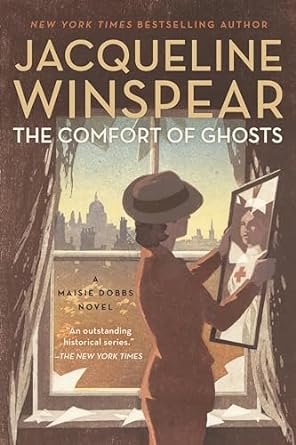
The Comfort of Ghosts
The Comfort of Ghosts is the final novel in the Maisie Dobbs series. It references several events from past instalments, which means it contains spoilers for those books. This one also relies heavily on the reader’s knowledge of occurrences/characters in previous installments
Our story begins with a funeral. Lord Julian Compton, father of Maisie’s first husband, James, is being laid to rest. The Comptons had been a huge force for good in Maisie’s life since she was very young, and she, Lord Julian, and his wife Rowan remained close even after James’ death and Maisie’s remarriage.
After the funeral, in conversation with the family’s lawyer, Maisie learns the Compton’s London residence has been requisitioned by squatters. It’s a common problem now that the war is over, and those displaced by bombs are looking for shelter. However, the will requires the unlawful tenants be evicted and the property promptly sold. The lawyer wishes for the family’s authorization to call the police, but Maisie wants to exercise compassion and is determined to go herself. She hopes she can arrange an alternative dwelling for the people involved.
What Maisie finds is a much larger problem than she expected. One of the residents is Will Beale, Billy’s son, just back from a Japanese war camp and much the worse for wear. He doesn’t wish his family to see him in his current state – indeed, his guilt coupled with his poor physical condition have him hoping for death – and Maisie sends him to Pris’ house so the former nurse can whip him back into shape. It is the other guests, however, who represent the real conundrum. The four bright but wary teens – Mary, Grace, Archie, and Jim – are orphans who were trained in Britain’s Civilian Army, a plan implemented in case of invasion. They know how to fight, how to sabotage the enemy, how to spy, and most importantly, how to run.
They witnessed a murder that is being hidden by the authorities, and they are very much concerned that the powers that be might wish to silence them permanently as well. Never one to back away from a problem, Maisie quickly determines to help them – but that will be easier said than done.
It is almost impossible to rate/grade a finale eighteen volumes in the making. If you have traveled this far with Maisie and company, there is no question as to whether or not you will wish to read this. As to whether or not you will enjoy it, I would say temper your expectations. This is more a soft but flawed landing than a fireworks show ending with thrilling bursts of colors and inspiring music.
The first seventy-five percent of the tale deals with the mess the teens have landed in. The clues are easy to follow, and Maisie makes quick work of tracking down leads to come to a satisfying conclusion. A tad disturbing is that the author uses this as a chance for Maisie to catch up with men who used to carry a torch for her. We find out that they still do, which felt a bit awkward to me. I’m not sure what the purpose of that was but I think it ties in to what propells the last twenty-five percent of the story.
The back blurb tells us that Maisie’s quest “to bring comfort and the promise of a future to the youngsters . . . brings to light a decades-old mystery concerning Maisie’s first husband.” The enigma of the final quarter of the book deals with the above. While in the house, one of the teens stumbled upon a set of letters that harken back to the very first book in the series, and Maisie’s old friend Enid. If you have forgotten about her, you might want to do a quick dive back into that initial narrative to refresh your memory. I won’t get into the details of it but will speculate that this plot, along with the failed romances referenced in the earlier portions, are meant to remind us that Maisie is with whom she is meant to be.
If you write a good character, you don’t need to make their competitors bad in order for them to shine. On the other hand, if you write a bad one, surrounding them with worse options won’t add any luster – it’ll just make me wonder why you didn’t fix the initial problem. I’ve mentioned before that I find Mark, the winner of the race/war/battle for Maisie’s heart, a rather tedious addition to these stories, and I will say that despite the author’s efforts, that does not change in this book. The story would have read more smoothly and been far more interesting if the mysteries had been more intricate and we had seen Maisie once more at her investigative best. The little puzzles she is given to work with here feel too easily resolved, and as a result, we spend far too much time on her annoying personal life.
Of course, reviews are just one reader’s opinion. Some of you may well love Mark and find The Comfort of Ghosts just enhances that. For me, it was bittersweet. I have been with Maisie and her friends for over a decade and am sorry to see them ride off into the sunset. I am grateful, however, that the author gives us this closure and that she does so by reminding us of where we started.
Recent Comments



I need to reread book 1 to remember some of the primary secondary characters. I don’t dislike Mark, the 2nd husband, but I’m not a huge fan. I didn’t care for Ms. Winspear’s last stand alone book, I felt the ending was wrong to the character she developed and frankly since book 10 in this series, Maisie hasn’t been the same either. I do appreciate that she ended the series though since another British author I have been reading died about halfway through her newest series and left the characters hanging unresolved as a result.
Maggie, thank you for this review. I’ve read each and every book in this series, and I have been looking forward to this final book. Somehow, despite my dissatisfaction with the turn of events in Book 10 and some of the subsequent books, I just couldn’t give up on Maisie and Billy and the rest of the characters. The historical backdrop on the series really spoke to me, and every book taught me things I didn’t know about the time period. I agree with you about Mark. I wish we’d had more detective Maisie and less married mom Maisie in recent years. Nothing against married moms, but I was in it for the detecting. I will be reading it the not too distant future but won’t rush to it. It’ll keep.
I felt much the same. I liked, in particular, how Maisie and Billy worked together to resolve mysteries. While I did like certain people in her personal life—Pris and the Comptons—I didn’t like how that portion of the stories progressed. And, as you said, we were in it for their unique detection, not the other portions.
Maggie, I finished this last night, and I wanted to let you know I completely agree with your review. The first 75% was a pretty solid entry, and I was happy to see more of Billy than we’ve seen in some recent books. However, the whole James storyline, along with Mark’s pushing to make a major, huge change in their lives (using Maisie’s money, no doubt) and telling her what to do constantly, was really annoying. I wish Winspear had fleshed out the squatter mystery more and skipped the James mystery altogether. I give it a B as well.
I hate to admit, but I gave up on Maisie about halfway through the series. Just too much angst and just didn’t love the characters enough to continue.
Honestly, it’s been hit or miss since book ten, so I don’t blame you at all