
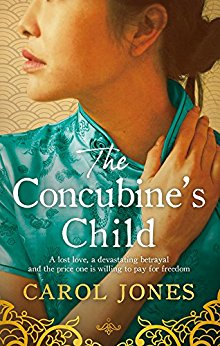
The Concubine’s Child
I was drawn to The Concubine’s Child by the unique premise and even more unique location. Set primarily in 1930s Malaya (known today as Malaysia) it is the story of a group of women and how they handle the limited choices life gives them.
Madame Chan is praying to – although it’s more like berating – the ancestors for not giving her children, when her joss sticks blaze to life and the girl comes into view. Her tall form, healthy glow, wide hips and strong physique make her ideal for bearing children. If Madame Chan were to introduce this young woman into her household as her husband’s concubine, it would be advantageous for all. Her husband will get the sons he desires, her mother-in-law will stop penning letters dripping with disrespect and chastisement for Madame Chan’s barrenness and best of all, Madame Chan will have chosen the young woman herself. She won’t be replaced in her marriage bed by someone her husband already desires but instead will have found him a simple, not so attractive vessel for his seed. If she plays her cards right she will have a son – and all the credit for the getting of that son – within a year.
Yu Lan had not noticed the strange older woman staring at her in the square. Her focus had all been for Ming. The handsome neighbor often meets her in the byways of their small community, surreptitiously holding her hand behind the folds of his samfu as they walk home together after completing their errands. Ming has promised to speak to his father, when the time is right, about marrying Yu Lan but she knows it will not be an easy thing as her family has neither the wealth nor the prospects the Wang family does.
When Madame Chan makes an offer for Yu Lan and it is accepted by her father, Yu Lan doesn’t panic. She runs to Ming, believing he will either force his father to accept their marriage or agree to flee with her to another city. He, of course, does neither, as it turns out he has long been engaged to someone else. Many of the people in his father’s kopi shop witness Ming’s rejection and Yu Lan pleading for help, but she doesn’t care. Her teenage heart is broken. Unable to figure another way out of her dilemma, she dresses herself in mourning clothes and allows herself to be taken to the Chan household.
Mr. Chan likes his new concubine very much and quickly gets her with child. Yu Lan does not return the affection of the elderly man and despises Madame Chan, who rapidly becomes jealous of Yu Lan’s youth and fertility. Bitterness and anger strain the relationship between the two women, causing dangerous undercurrents in the household, and the birth of Yu Lan’s son seems to push the situation to breaking point. It won’t be long till both women begin plotting how to best destroy their rival. Ultimately, only one of them will be victorious.
Imperialist Western societies are still struggling to know how to best handle their interest in foreign cultures. This is often made more difficult when they spend time in those areas and grow to believe they have a certain kinship, understanding and ownership of the society. Most well-meaning people aren’t aware when they force Western standards on a non-western community and make it clear that it is the community that is lacking. I felt that is what happens here.
For most of history, it was not unusual for women to be married young because fertility was a fickle thing, and the window of opportunity for child bearing could close quickly. In much of the world it wasn’t unusual for men to have more than one wife. Even Western societies, with our emphasis on monogamy, included, for many hundreds of years, the idea of wealthy men having mistresses. Arranged marriages were also the norm in both the East and the West, with parents often making the decision as to whom their children should marry. So I was just a bit uncomfortable with the idea that Ms. Jones, an Australian, would choose to tell the tale of a young woman unhappy with the options available to her in 1930s Malaya when the fact is, she could probably have found an interesting tale about a young woman marrying an older man for financial reasons far closer to home.
It would have been more understandable if we had received an in-depth look at the culture of the country and seen the positive along with the negative, but we do not. The emphasis seems to be on how horrible the Asian system of marriage was and how misogynistic their society was with no thought to telling us what makes it special or great.
The characters are pretty much unlikeable and I found it especially hard to like Yu Lan, who isn’t particularly adaptable or intelligent. One of the household servants tries to help her understand how to work the system to her advantage but Yu Lan seemed incapable of grasping even simple instructions in that regard. Her age – sixteen – didn’t make me sympathetic to her plight. Women up through the 1960s married when they were sixteen to eighteen years of age in Western society, as well as in Eastern society. She should have been expecting her father to marry her off at the time he did and given what her father was like, should have expected her situation to be even worse than what actually occurrs. It’s not that I feel she wasn’t entitled to feel angry, used and unloved. It’s that it’s anachronistic for any of what occurred to have been a surprise to her.
The modern-day portion of the tale isn’t any better. I was confused by the characters’ actions, their acceptance of what most would dismiss as superstition, and especially the willingness to involve themselves in a ridiculous situation due to guilt at the end
The book does have one strong positive. The suspense portion of the story, wondering who would win the battle between Yu Lan and Madame Chan and how that victory would occur, kept me turning the pages. While they aren’t equal adversaries, since Madame Chan held most of the power and almost all the intelligence, Yu Lan’s willingness to play the game for all or nothing stakes makes her a ruthless opponent.
I understand that many readers today expect their historical novels to embrace and reinforce their twenty-first Century values. However, using another country’s history to make us feel good about our own ideals regarding feminism seems bigoted to me. I’m sure Ms. Jones, who has ties to Malaya, loves it deeply and is aware of the wonder and beauty of its culture. Had The Concubine’s Child highlighted that love and shown some of the wonders and goodness of that other time and place, its grade would have been higher. It didn’t, which left the story feeling judgmental of the Asian system of concubines and marriage, an unfortunate and I am sure unintended consequence.
Buy it at: Amazon/Barnes & Noble/iBooks/Kobo
Recent Comments



I’ve beta read or critiqued several manuscripts/query letters where a girl, in a society where marriages are routinely arranged, discovers that her father has chosen a man for her, and she reacts with shock and outrage. How could her father do this to her? She will only marry for love!
And as someone from an Asian culture where arranged marriage happens (not something I want for myself, but also not something I’m automatically against), I’m even less likely to enjoy a plotline which seems to stress how misogynistic and backward this custom is. I’d prefer the subject to be handled with more balance, insight and sensitivity.
We see this so much in 19thc. British-set historicals of the nobility. Authors want their heroines to be woke and feminist so of course they have to reject arranged marriages and choose to marry only for love in a
society and class where dynastic marriages were common.
What was missing in the tale for me was the balance. I have no problem with seeing both sides of a story – in any society you have good marriages and bad marriages, regardless of how the couple met. Here, the focus seemed to be so much on how wrong, wrong, wrong the culture was that I left the book feeling the whole system had been judged and found wanting.