
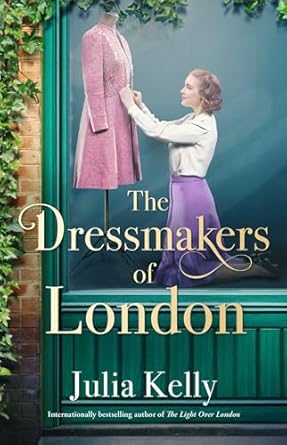
The Dressmakers of London
The death of their mother forces two sisters to confront some hard truths about their lives, their relationships, and their pasts in Julia Kelly’s The Dressmakers of London.
Sylvia Shelton Pearsall has married up. All the lovely things life can give one – a beautiful home, fashionable clothes, the right kind of friends – she has. Except for a loving husband. She’s not sure where her fourteen-year marriage to Hugo went wrong but she knows the love letters from another woman in her husband’s desk prove it has. As she is processing the hurt and worry this discovery has generated, she receives a note from her sister informing her their mother has died. Sylvia has long been estranged from the family but she determines to go to the funeral.
Izzie (Isabelle) Shelton has devoted her life, willingly and fervently, to Mrs. Shelton’s Fashions, her mother’s small dress shop. She works as a seamstress and errand girl, her mother having long ago crushed her dreams of being a designer. As one of only two remaining employees and the only living relative still speaking to her mum, Izzie expected to inherit the business, so she is stunned to discover at the reading of the will that her sister has received an equal share. Her mother has left the bookkeeping in shambles, making it hard for Izzie to determine if she even has the funds to buy her sister’s stake. And wouldn’t you know it, just as she is struggling to figure everything out, she is conscripted into the WAAF. Sylvia had, before her marriage, been the one to deal with the finances for the shop, and the sisters’ best hope of keeping it open while Izzie is gone and working out exactly where the business stands money-wise is for Sylvia to return and work whatever magic she can with the accounts. With Hugo gone to do his bit for the war, Sylvia can step back into the role of middle-class merchant’s daughter with none of her social circle ever finding out. She can also rebuild the once-loving relationship she had with her last living relative. Or so she hopes.
This story is told in both epistolatory and expository form. Once Izzie is conscripted, the two women communicate through letters, which, initially, are mostly about the business. This really works to show where their relationship is and what about it needs fixing because their mother’s shop was and is such a huge part of their family dynamic. I loved the author’s exploration of how a family-owned business can become a part of the family and so hugely impact that entity.
Izzie has never been away from home before and quickly realizes she is much more capable than her mother had ever let her believe. Making friends from all ranks of life while also excelling at her new work gives her the confidence and self-worth she never realized she was missing. As the letters from Sylvia grow increasingly personal and the sisters confront some painful truths about their lives, being among her friends provides Izzie the mature guidance she needs to leave behind childish hurts and build a more adult foundation for her future.
Stepping out of her married life enables Sylvia to see how little there is in it. Having never been blessed with children, she has made a family of Hugo and his friends and relations, and it grows increasingly clear that they do not see her in the same light. She wrestles with what this will mean for her going forward, especially as she slowly starts to rebuild her relationship with Izzie, her old friend William Gray, and the folks in the neighborhood where she grew up. Like her sister, Sylvia comes to realize that she is so much more than her former situation had allowed her to be.
I loved how the story was laser-focused on the two sisters and their relationships with each other, the shop, and their mother. The author does a fabulous job of showcasing how making life changes impacted all of that, and also of peeling back the layers of each woman and utilizing their history to build their characters. By the end of the novel, I understood why Sylvia and Izzie had approached life so differently, what had made them vulnerable to their perspective foes, and how self-examination regarding the past enables them to once more fully embrace themselves and each other.
The book does have some serious flaws, though. The first is with the setting. This is the first wartime novel I’ve read in which WWII in England is treated like a minor inconvenience with the only concerns being conscription and rationing. Little is said about the bombings, the serious shortages, or how the war affected literally everything about life in London. It felt more like the American homefront than the British one. The author also has a tendency to paint things in all black or all white so that people with money (minus two notable exceptions) are evil snobs and the working class are good-hearted saints. I would have preferred a bit of nuance.
The Dressmakers of London is hard to grade as a result. I thoroughly enjoyed the novel because I have sisters, and this book really nails how difficult those relationships can be. On the other hand, the flaws were serious enough to put a damper on my pleasure. I’m giving it a tepid recommendation because I think that if you enjoy women’s fiction about the relationships we build with our friends, significant others, and families, you’ll like this one. Otherwise, give it a miss.
Recent Comments



I have to disagree with the setting “flaw.” It is possible the author felt that including more stuff about the war was extraneous to her story about “dressmakers.” There are so many other books of historical fiction that cover the bombings and food shortages that she probably felt she couldn’t contribute anything new, especially since her story was specific to one area of British war life.
Sounds like setting it in America might have been more beneficial to this one?
Yes, set it on the American home front and I would have given this one a B/B plus. But the war in Europe, especially London, was not just background filler the way it is in this book.
Yeah, it’s one of those time periods where you have to be on point.