
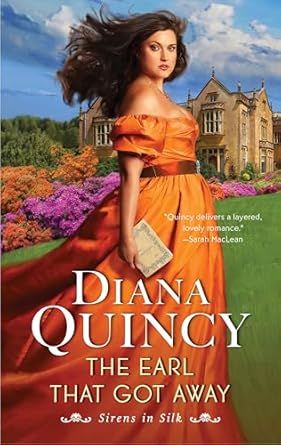
The Earl That Got Away
The Earl That Got Away is a retelling of Jane Austen’s Persuasion set in the Victorian Era. I love Austen’s novel (and the 1995 BBC adaptation starring Amanda Root and Ciarán Hinds), so I was excited to read this variation, especially as it features an American-Arab heroine
Eight years earlier, Nalia Darwish had met and fallen in love with Basil Trevelyn, a charming Englishman she’d met while visitng Philadelphia. But although he’d made her heart soar, her family had forbidden the match; not only was he not from their community, he also lacked any wealth or station that would have made him more appealing. After losing her chance at love, Nalia turned herself into the perfect spinster aunt. She wears drab colors to all events, plays the piano so others can dance at parties, and if a niece or nephew grows ill, she’s the one who rearranges her schedule to sit with them.
She’s stunned when she encounters Basil at her sister Raya’s wedding in England. Basil is now the Earl of Hawksworth, with tremendous wealth to complement his title. He’s cool to Nalia, making it perfectly clear that he has no desire to spend any time with a gold digger. Which becomes even more confusing when he seems smitten by her cousin Hind, a cheerful and charming young woman who appears determined to be a countess.
Realizing that her dull, service-oriented existence for the last eight years has been a form of self-flagellation for not having the courage to defy her family and marry her love, Nalia decides it’s time to start living. Among the guests at her sister’s wedding is Mr. Kareem Amar, a kindly man, only a few years older than Nalia, who shares her love of architecture. It’s awkward for Nalia to see Basil – now known as Hawk – with Hind and to try to develop a relationship with Kareem with Hawk seemingly watching their every move. Still, she is determined not to continue to punish herself for one bad decision made in her youth. So why can’t she help being distracted by Hawk whenever he’s in her vicinity?
I was pleasantly surprised at the start of this story by how well the author captures and refreshes the plot of Persuasion, and fans of the Austen novel will recognize many scenes and characters here that reflect that story. Nalia, especially, is very much like Anne Elliot in her calm demeanor and deeply practical personality, and her behaviors fit the times perfectly. Victorians were noted for their (at least on the surface) strict adherence to societal norms and strictures, and Nalia seems to navigate that world with ease. She is also a completely wonderful aunt, cousin, sister, and daughter. Another thing the author gets entirely right is that while Nalia loves architecture, she isn’t able to be an architect because she’s a woman. She does, however, work at her brother’s firm, assisting him in his projects. It’s a win-win situation since he gets free labor and she gets to spend time doing what she loves. This seemed very era-appropriate to me.
The leads are cool to each other but never hostile, which is another plus. Hawk has a legitimate reason to be hurt, given the promises Nalia made him, and I appreciated her maturity in recognizing that. Nalia also had good arguments for her decision, which Hawk slowly comes to understand. They also realize that their youth made it hard for them to work around the issues keeping them apart, and their ability to see and acknowledge that is another plus.
However, once the story hits the mid-way point, it veers into strange territory. When Nalia learns that the exorbitant cost of maintaining the beautiful estates and country houses of England is causing many people to abandon their ancestral homes, she devises a solution. She becomes convinced that encouraging wealthy American heiresses to trade their money for titles by creating a catalog of British landholders for those ladies to peruse will infuse the necessary funds into the aristocracy. She calls her pamphlet An American Heiress’s Guide to Landing a Lord.
I couldn’t get over the fact that Nalia essentially doubles down on the idea that marrying for money is a good thing while still trying to convince Hawk that she isn’t a gold digger. It seemed a bit counterintuitive to me.
I also struggled with the sex scenes in the novel. Nalia and Hawk have all their encounters in somewhat public places – a tree in a secluded area of a park, a boathouse, an alcove near the entrance of her brother-in-law’s estate, which give the rendezvous a feeling of being rushed and fumbling hookups. There’s a scene where Hawk, who at that point has no intention of ever being with Nalia again, masturbates in the room she has just moved out of, which seemed stalkerish. The sex never seems to be about unity or love, but just to satisfy their lust in that moment (or some kind of industry standard of there needing to be X number of sex scenes per book). In short, these moments don’t enhance the romance but feel awkwardly added, yanking me out of the story.
Nalia’s family is from Palestine, but her culture is primarily reflected in food and the idea that marrying within one’s own nationality is essential. It doen’t affect her behavior or her beliefs in any way. She also doen’t encounter any prejudice, which I found unusual given the times.
The Earl That Got Away had a strong start but fumbled near the finish line. I certainly didn’t dislike the book, but the cumbersome depictions of intimacy, the lack of clarity in how Nalia’s heritage influenced her life, and the endless discussions of the monetary side of marriage meant I didn’t love it either. If you are a fan of the author, you may enjoy this second tale in her latest series. If not, I don’t think this is the novel that will make you one.
Recent Comments


I noticed that none of her other books reviewed here got higher than B-. If I can get a copy from the library, I might give it a read.
I noticed that as well and wondered if she might work better for me than she had for other reviewers in the past. At first, I thought that would be the case – the start was really strong- but she fell apart in the middle for me. I’ll be interested to hear your thoughts if you do get a chance to read it. Maybe she will work better for you.
You mentioned that there were some awkward sex scenes too. I remember the uproar over the kiss in the last scene in the Amanda Root/Hinds BBC version. Many viewers thought Anne Elliot would not have engaged in PDA. Since this is a Victorian version, the sex scenes here seem out of character.
Of course, this is just my opinion, but the sex scenes felt out of character for several reasons. One was that they leaned towards exhibitionism, which I mentioned in my review. Sex in public places would have been an uproarious scandal in that era. It seemed odd to me that, given her family background, she was so willing to take that risk or the risk of premarital sex in general in an era that frowned upon it. And then I just found them lacking in any emotional relevance to the tale.
This reminds me of my intense dislike of Season Two of Bridgerton where Kate has unprotected, unmarried sex with Anthony without a proposal. Even within the context of the show it was unbelievable.
It definitely all lies in the writing for me. In this case, the writing was poor, making the whole thing unbelievable.
I read and reviewed some of DQ’s earliest published titles – from 2016 and 2017 – and gave them B-/C+ grades. I’ve said this before about other authors, too – but you’d think that after eight years, there would be an improvement! Seriously though, it speaks, once again, to a lack of good editorial guidance – someone should have pointed out the plot holes and helped to sort out the problems with the writing.
I tried to read her first few books and wasn’t able to finish any of them, but she was trying to do interesting stuff, so I decided to monitor her reviews for indications of improvement that still haven’t materialized. But I hadn’t done the math on how long that’s been.
It’s disheartening how common it is for potentially interesting authors to be published prematurely and then never really allowed to develop.
Absolutely – it’s something I’ve said many times over the years. But trad. pubs aren’t really interested in nurturing talent any more, so readers are more or less left with a swathe of ‘partly-cooked’ authors who never rise above the middling because nobody is there to help them to do it.
And self-pubbed authors are churning out stuff to pay the bills and much of it is poorly edited as well. Just as we’ve enabled severe income inequality in Europe/India/the US etc…., we’ve enabled severe support inequality for authors.
Many are indeed doing that – thankfully, not the ones I generally read, whose books are often better edited and proof read than trad pubbed ones. But that’s a tiny number of the whole.
I am reading one now from a good author that is riddled with editing errors. It’s a bummer.
This was the only work I’ve read by her, and I was so pleased with the first third of the book that I was certain I would be giving it a B or B+. Nalia is one of the few period-appropriate heroines I’ve read in historicals in years. What derailed the book for me was that the latter portions started to fall into familiar patterns – the heroine does something ludicrous, like writing a pamphlet advertising house-rich men in need of cash-rich wives to pay for the home’s maintenance and the lifestyle associated with the man’s rank. Or a heroine who throws caution to the wind and doesn’t just have unprotected sex when a) her conservative family would be humiliated by an unplanned pregnancy, b)society would likely ostracize her c) the man has said repeatedly he doesn’t want to marry her and she has said repeatedly she doesn’t want to marry him BUT she adds on having that sex in near public places. A deserted spot in a park that can be walked into (they’d clearly walked there), a boathouse that can be visited by others looking for lost items after a rowing event, (which is what our h/h were initially there), and an alcove beside the front door of a house which is not private (someone sympathetic does catch them). It was the combination of the awkwardness of the scenes (like high schoolers in a car), the unlikeliness of a sheltered young woman of the time being this free with her love, and the silliness of writing about marrying for money while assuring a man you won’t marry him for his money that weighed it all down. The whole thing almost read like she felt she had to include 21st-century sensibilities, but felt so embarrassed doing so that she fumbled it.
And there is the problem we have with so many historical romances!
Yep – you beat me to it. I remember saying something similar in a review of an author whose books usually work well for me, that it seemed she was forcing the story in a direction she might not otherwise have taken it in order for it to fit in with the current fads.
Too bad, it sounds like this could have been great.
I was really excited during the first few chapters because she did such a great job of following the original work while still telling a unique story. Things just fell apart at the halfway point. It was like she ran out of steam.
Quincy is another “just okay” writer for me. That might be why!