
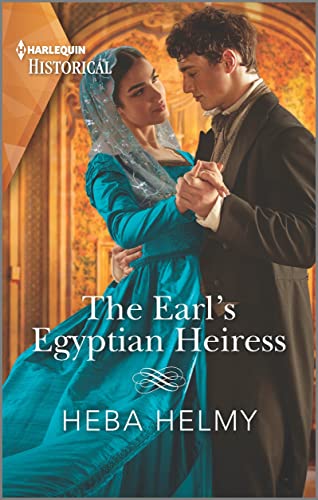
The Earl’s Egyptian Heiress
Ranya Radwan, heroine of Heba Helmy’s The Earl’s Egyptian Heiress, is the daughter of a cotton pasha whose family honor is at stake: her brother was sent to buy out the Earl of Warrington’s shares in the cotton production business, but he has disappeared with all of the town’s money. It’s now up to Ranya to find the earl (as well as her brother) and finish the sale. Meanwhile, Owen, the Earl of Warrington, also lives as Iskander, the name given to him by his Egyptian mother before she returned to Egypt. This book has a new perspective on a country we see a lot of, an insider’s look at a country we generally see from outsiders, and characters who are well developed in their identities.
First, let’s talk about what I loved.
The author is Egyptian by birth and now lives in Canada. Her love for, and deep personal knowledge of, her birth culture and country come through so clearly here.
There are plenty of romances set in Egypt, especially during the nineteenth century, but I’ve only ever seen ones written by outsiders. Heby gives us an insider’s Egypt, both when the story is set there and when Owen and Ranya visit the Egyptian community in London. A child’s lullaby about a father who is a lemon seller, people who would never wear shoes into the home, drinks made from apricots, and meals, like lentil and rice koshary eaten with your fingers, a community that knows the exact number and identity of all of its members in a foreign country, the rhythms of a day based on the five Muslim prayer times. Even in England, Ranya observes her faith, including covering with a hijab.
She washed, made wudu and then prayed. She wasn’t sure of the direction of the Ka’aba. Nor of the timing for which prayer it was, but she knew God was all-forgiving. And her parents had taught her that whenever people remembered Him, He would be there for them.
With each prostration Ranya expected the flood of tears she’d been holding back to come, but there was only a trickle. More than anything, she felt a kind of calmness come over her.
How lovely to see a Harlequin heroine practicing and deriving peace from Islam, in the way that heroines of Christian inspirationals have been able to do for decades.
Owen, whose mother is Egyptian and whose father is white English, could have been one of the many ‘half-X’ (Greek, Sicilian, Arab, etc) Harlequin loves to milk for ‘exoticism’. The author, however, refuses to take that route, making Owen’s relationship to his Egyptian identity rich and absent the stereotypes we unfortunately still see. As mentioned, he feels more connected to and often lives under the name Iskander, given to him by his mother. An African barber taught him how to take care of the thick, curling hair he inherited from her. He visits the London immigrant neighborhood to maintain his Arabic (I liked how the author explores the nuances of bilingualism, with Ranya wanting to avoid using Arabic with Owen because it feels excessively intimate). The ending, which requires the author to address Owen’s dual heritage, genuinely surprised me – and also satisfied me.
It’s also interesting to see England from a less glamorized perspective. Ranya is served “a tepid broth that tasted like something given to babies without teeth.” She is challenged to maintain the reputation of Owen’s mother, her hostess, and retorts, “If correctly memorising a sequence of waltz steps and knowing which of three forks matches which course is knowledge which will make your family proud, then you can count on me to demonstrate it.” (Well, when you put it like that…) The author also gets into the labor movement and the treatment of workers within the company that Owen has neglected. The historian in me applauded and appreciated the realistic depiction of the challenge of locating Ranya’s brother alive or proving that he is deceased. In one scene, Ranya and Owen walk graveyards to check individual plots.
So, with all those positives, why doesn’t this book get an A?
It’s overwritten. There are pages of text which could have been paragraphs, paragraphs which could have been sentences, and sentences which could have been omitted altogether.
The plot is all over the place. The book opens with Ranya planning to seduce Owen into handing over the document by going to a ball in a skimpy dress. This is… not generally how business works. Owen agrees to bring Ranya back to England in the capacity of corporate cotton advisor, which seems wildly unlikely. Yet for some reason, which does not seem consistent with Ranya’s ‘business advisor’ role, his mother is going to bring her out in society. Oh, and also his mother is his stepmother because his mother, his father’s Egyptian wife, is alive and living in Egypt, and the stepmother, who couldn’t have children, passed Owen off as hers. I still am not completely sure how this could work, with both wives alive and both claiming to be married to the Earl at the same time. I think maybe the mother was only legally married in Egypt, perhaps in an Islamic ceremony, and then also got a divorce? It’s confusing.
And then, it’s excessively clear that there is some kind of scheme afoot within the company, and that it definitely involves the white English company officer, because he’s a gross human being, and Owen’s stepmother, because she’s so obviously sketchy around company matters. Yet Owen takes forever to bother to do anything about any of this.
The Earl’s Egyptian Heiress is Heba Helmy’s debut, and I loved how different it is from everything I’ve been reading lately. It’s not perfect, but it’s definitely worth a read. And I am extremely excited to welcome Helmy to this genre, and to see how she grows as a storyteller.
Recent Comments



On my TBR!
Intriguing!
The wins in this sound great and worth reading the book for!