
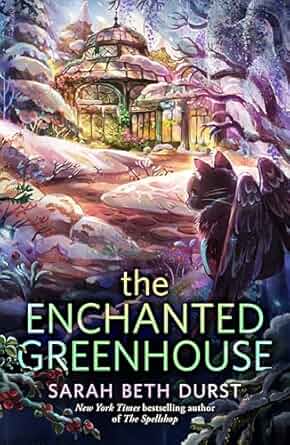
The Enchanted Greenhouse
The Enchanted Greenhouse is book two in Sarah Beth Durst’s The Spellshop Series. If you don’t want to read any spoilers from that tale, please stop here, because the entirety of this review contains surprising information about a character in that story.
In The Spellshop we met Caz, a sentient spider plant who had worked as a library assistant until the Great Library of Alyssium was destroyed during the rebellion. In this novel, we meet his creator, Terlu Perna, who, in the last book, was turned into a wooden statue as punishment for practicing magic without a license. Everyone assumed she had been destroyed along with the library, but an unexpected ally saved her.
Terlu has drifted in and out of consciousness since being turned to wood, but she is plunged into full awareness when she awakens in a frozen forest. She is wearing her thin library uniform, designed for a temperature-controlled environment, and is in no way prepared for the weather. Lost and confused, she wanders about until she stumbles upon a greenhouse and enters, hoping that whoever reversed the magic is there. He is.
Yarrow thought the spell hadn’t worked becauseTerlu remained a statue long after he’d cast the incantation; that’s why he’d left her out in the cold. Now that she’s alive, he gives her food, clothing, and shelter for the night, but doesn’t want to house her permanently. After all, he’d sent to Alyssium for a magician, not a librarian. Terlu, however, has no place to go, and is likely to be turned back into a statue – or worse – if she is returned to the capital. Yarrow, who was left alone to serve as gardener to hundreds of enchanted greenhouses, reluctantly agrees to let her stay, but prefers she not make a permanent residence of his home. He advises her to refurbish one of the abandoned cottages on the island. While she is searching the various structures, she stumbles upon a sentient rose plant named Lotti, and the two convince Yarrow to let them awaken the other sentient plants in one of the many greenhouses scattered across the small island of Belde.
Terlu has found as good a sanctuary as she can hope for, given that she is a major magical criminal, but her security is short-lived. The enchantment that sustains the greenhouses is failing, which is why Yarrow had sent for a magician. Unless she, Yarrow, Lotti, and the other plants can figure out a solution among themselves, they are all doomed.
Like the last instalment in this series, The Enchanted Greenhouse is a charming and cozy story about finding your place in the world. It’s brimming with vivid, delightful, and delectable imagery, from delicious breads that taste like autumn, tiny dragons who love honey and hoard treasures, to singing flowers, and a magical aquarium. The world the author places us in is as warm and inviting as a thick blanket and comfy armchair on a snowy day.
Ms. Durst peoples this world with amiable, fascinating characters. Terlu is all the things a heroine should be – honest, earnest, clever, compassionate, and politically correct. Yarrow is the hero equivalent – handsome, supportive, and fiercely loyal. He is a caregiver who bakes and cooks and tenderly cultivates the plants and creatures of his island home. He isn’t put off at all by Terlu’s criminal past because he had great compassion for the deceased wizard who bent laws to turn Belde into a bewitching paradise full of creative sorcery. While both are initially a bit shy and insecure about building a romantic relationship – Yarrow is taciturn by nature, and Terlu is wary of trusting others after being turned into a piece of lumber – they soon settle into a rhythm of neighborly camaraderie and amiable co-working that blossoms into something more. Their relationship works well because each provides what the other lacks. Yarrow is cautious and meticulous, a planner who carefully considers the impact of his actions. Terlu is brave, curious, and willing to take risks. All of that is needed to work the magic that will save their home.
Most novels have flaws, though, and I encountered a few minor ones here. The first portion of the story reads very young – at one point, I wondered if the intended audience was middle school or late elementary school children. The second half, which explores themes of forgiveness, child abuse, redemption, second chances, and immigration, reads more like adult fiction. The issues are definitely addressed from a mature perspective, with Yarrow and Terlu viewing the problems through the wisdom gained from their life experiences. This struck a somewhat discordant note, making the book feel almost like two different stories.
In the latter half, we also have the addition of people who had a past on the island and have returned only out of necessity. Their presence evokes painful memories for Yarrow, and those hurts are, in many ways, left unaddressed. Part of that is because the author insists on portraying both sides (victim and perpetrator) in a sympathetic light. In some cases, it was a stretch for me to see both as equally to blame. The author also works so hard to include specific political points that they are not woven naturally into the text but are glaringly obvious public service announcements. To be clear, it’s not the themes themselves that I am pointing out but the author’s heavy-handedness in addressing them.
Those quibbles aside, The Enchanted Greenhouse is a sweet story about healing from past hurts, reconciling with estranged loved ones, and working towards a better future while celebrating our todays. If you can see past the blips listed above and you enjoy fantasy novels, you’ll likely enjoy this one.
Recent Comments

This is on sale at Amazon today. An amazing .99 for the audiobook and 5.99 for the Kindle.
This has been on my TBR for awhile – I’m glad it’s decent!
If you liked book one, you’ll definitely like this one also.