
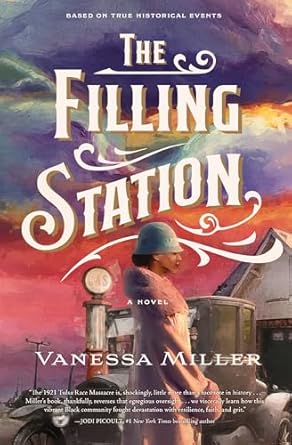
The Filling Station
You can’t change the past. You can, however, forget it. Or bury it so that it is barely spoken of. The Filling Station speaks of a critical ‘lost’ moment in American history with courage, integrity, and grace.
Greenwood, 1921: Just outside Tulsa is Greenwood, a thriving community known as Black Wall Street, where folks not welcomed in the white-owned stores of the city can spend their money at movie theaters and entertainment venues, beauty shops, and clothing stores. It’s a haven for the maids, cooks, laundresses, and other working-class people who help keep Tulsa going. The families there have all prospered, and their children go to college or take over the enterprises left to them by their parents. Margaret and Evelyn Justice are two such young ladies. Margaret has just finished getting a university degree and plans to teach, while her younger sister Evelyn is graduating from Booker T. Washington High School that weekend. Evelyn plans to head to New York to get a fashion design degree after spending a lazy summer having fun with her sister. Both girls are determinedly ignoring all the whispers and agitation around town being caused by the possible lynching of Dick Rowland, a young man arrested for allegedly accosting a white woman in an elevator over in Tulsa.
Pretending the problem doesn’t exist becomes much more complicated when graduation practice is canceled and Evelyn is forced to go home while Margaret, at the movies with her dad, is surprised when the film is turned off midway, and they are forced to leave. Margaret heads back to the house, but her father joins other men on the street who are arming themselves in an effort to protect their families. A white mob descends on the city, and it isn’t long before bullets are flying and buildings are burning. Rather than putting an end to the massacre taking place, police help the rioters, and the once prosperous residents of Greenwood find themselves fleeing with little more than the clothes on their backs, Margaret and Evenlyn among them. The two barely make it out of their home after an incendiary device sets it ablaze.
Their escape from the city is horrifying. They watch the local doctor, unarmed, be shot in front of his home. Old women are yanked off the streets and shoved into cattle cars by the National Guard. After a long night’s walk down what will eventually be called Route 66, hiding whenever they hear a car coming, they make it to Threatt Filling Station, where the kindly owner and his wife take them in. Evelyn, her dreams shattered and her soul traumatized, stays behind as Margaret, after a brief rest, heads back to Greenwood to search for her father and help rebuild the community where she was raised. What she finds when she arrives will force her to question all she knows about herself, her family, and her faith.
When we first meet Margaret, she doesn’t seem very strong, but that impression quickly changes once the riot begins. With her father missing in action, she takes on the role of parent and promptly gathers the courage and drive to get herself and Evelyn out alive. As the novel progresses, we see her intelligence and will to thrive rise to the forefront over and over as she faces incredible odds to try to rebuild Greenwood. Margaret refuses to cower, even when it becomes clear that the white citizens of Tulsa do not intend to let their Black neighbors rebuild without a fight. The author carefully folds real history into everything happening around and to Margaret so that her tale reads like that of a genuine survivor.
Evelyn is just eighteen when the story begins. The baby of her family, with artistic leanings rather than the sharp intellectual/entrepreneurial pursuits that are the hallmark of Margaret’s character, she takes what happened a lot harder than her sister. Rather than fight, like Margaret, she wants to choose flight. The fact they no longer have the money for her to attend college is a devastating blow, and that she lost her sewing machine, beautiful dresses, and loving father all on the same night adds to her anguish. Throughout the book, we watch her struggle to regain her footing and discover the path she is meant to be on.
I actually loved that neither sister bounces back perfectly from their terrible experience. Evelyn makes bad decision after bad decision as she tries to figure out how she can turn back time and take the steps she’s always wanted to take, while Margaret becomes rather cold-hearted and loses her faith. Neither has an insta-healing, and neither ever stops mourning the horrible night (and awful days that followed) that they lived through.
The titular filling station is the Threatt Filling Station, a historic landmark in Oklahoma where many of the Black residents of Greenwood went when they fled their homes. One of the few Black-owned businesses along what is now Route 66, it served as a safe-haven for travelers and an entertainment destination for locals. It turns into a second home for Margaret and Evelyn, with Allen and Alberta Threatt treating them like members of their own family.
The story’s only flaw is that the romance between Elijah, the Threatt family’s farmhand, and Margaret doesn’t get enough exploration. We see it slowly unfold as he helps her rebuild her home, her life, and then her faith, but I would have enjoyed a more in-depth look at their courtship.
This is an Inspirational, so the examination of where God is when things on earth strongly resemble hell is explored, and the author does an absolutely fantastic job of handling this complex subject with grace, compassion, and wisdom. Margaret is never judged for her doubts nor fed platitudes to heal the anger and hate in her heart. Easy answers aren’t given because they don’t exist. This subject is woven naturally throughout the text and is both historically and culturally accurate.
There isn’t enough space in this review for all the trigger warnings I would need to give. The Tulsa Race Riot was a horrific event, and the first chapters of this novel are filled with violence and terror. The author’s detailed account of the aftermath is also chilling and heartbreaking.
Very rarely would I say that absolutely everyone should read a book, but The Filling Station is one such novel. The rich and vital American history contained in its pages should be known by all, and the story it tells is one that will stay with you long after you have finished it.
Recent Comments



I agree with your review. I found the sisters and “their men” to be interchangeable almost in my mind. I couldn’t keep them apart for some reason and not usually an issue I have. I also found the book super depressing. But definitely important history!
Yes, the thorough exploration of the history meant the story development was sometimes rushed through, especially the romance portion. But as you said, that history is significant.
She’s one of my favorite authors! You have to read them all!
Whelp, I already wanted to read this one and your review helped me decide to put a hold on it at the library. Thank you, Maggie!
I’d say hope you enjoy it, but this book is more impactful than fun. Definitely do give it a try at the library.
I noticed! I was totally hoping for a thought provoking one.