
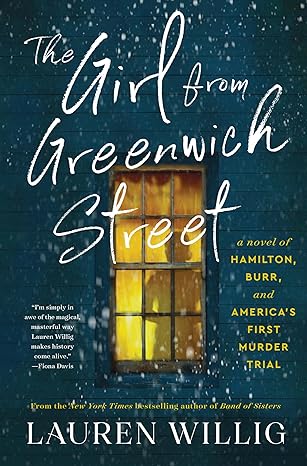
The Girl from Greenwich Street
The Girl from Greenwich Street is a fictionalized account of an actual murder trial bursting at the seams with famous Americans. Ms. Willig does a fantastic job summarizing the event in her notes at the novel’s end, but a slightly less spectacular one of bringing it to life in her primary narrative.
A few days before Christmas 1799, Elma Sands leaves her home and never returns, and around the New Year, her body is discovered in the Manhattan Well. Speculation as to how she got there quickly turns to talk of murder, and a suspect is arrested. Levi Weeks lived at the same boarding house where Elma lived/worked, had been seen flirting with her, and seemed the most likely candidate for her killer. If murder is what it was. An argument could be made that the girl had committed suicide.
The latter is the tactic Aaron Burr and Brockholst Livingston, the attorneys hired by the Weeks, intend to use. The evidence against Levi is flimsy, and there are those who can testify Elma had threatened to kill herself earlier that year. Aaron is less concerned with guilt than he is with gold. Deeply in debt and on the verge of a political campaign, he desperately needs the money that successful builder Ezra Weeks is willing to spend to get his brother freed.
Alexander Hamilton had not been chosen as attorney for the defense, but once he learns of the case, he determines to take part. He quickly ingratiates himself with the Weeks family, inserting himself into the defense team, much to the chagrin of the other two lawyers. He becomes the third attorney of record, hoping not just to get Levi Weeks acquitted but to clear the man’s name entirely and bring the real killer to justice.
Cadwallader Colden is certain that this will be one of the easiest cases he has ever prosecuted. Public opinion is decidedly against Levi Weeks, and he has numerous witnesses who can place the man at the scene of the crime. But as the old saying goes, pride (or certainty) goes before the fall.
This story is told in multiple points of view, and that works as both a weakness and a strength. The weakness is that the head-hopping kept me from immersing myself in the tale and essentially erases the victim from the narrative. We never get a strong feel for who Elma was or what she was thinking since we learn of her only through others’ memories, and even those are very brief and biased snippets. Most people’s thoughts center less on Elma and the tragedy of her death and more on how that event impacts them.
The strength of the numerous viewpoints is that it gives us a look at how politics and politicians of the period worked through the characters/thoughts of Aaron Burr, Cadwallader Colden and Alexander Hamilton. I was especially fascinated by how Burr sees Hamilton as idealistic and naive and is able to use that to his advantage, and how Hamilton’s sincerity and focus on the big picture can cause him to trip over details and fall into less honest men’s traps. Both come across as very human, flawed but ultimately sympathetic. Colden shows how prosecutors for the state answer to both government officials and voters and how victims can unintentionally be re-victimized by the very people standing up for them.
Willig does a fabulous job with her research, and the ending notes of her novels are always worth perusing. In this instance, she explains about reading the trial transcript, as well as other sources, which led her to an interesting conclusion as to what precisely occurred. She also quickly points out that a friend who did the same thing came to a very different conclusion. What happened to the real people after the events of this novel is included in those notes and is as fascinating as what occurs on the page.
The Girl from Greenwich Street suffers from pacing issues, and the multiple viewpoints keep the story from having a primary lead we can root for. The mystery is intriguing, but the lack of certainty as to whether or not a crime had occurred kept it from being riveting. In the hands of a lesser author, those flaws would be damning but Ms. Willig’s excellent prose and outstanding historicity save the work from itself. I would recommend it to the author’s devoted fans or readers interested in a historical novel involving key figures of early American history.
Recent Comments



On my TBR; I had no idea this was based on a real case!
It is! And these are all big names—Livingston winds up being an associate Supreme Court justice, Cadwallder Colden becomes Mayor of New York, and the Weeks brothers are infamous. The end notes really are worth a read.
It was also featured in Hamilton (for about twenty seconds).
That’s so cool! Thanks for sharing it.