
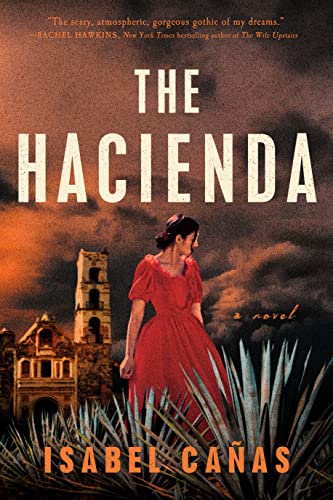
The Hacienda
The Hacienda has been described by the publisher as “Mexican Gothic meets Rebecca”. Being a big fan of both those books I was naturally excited to read it, but unfortunately, the novel does not live up to the publisher’s hype.
Beatriz lost her home when her father was executed during the Mexican War for Independence. She and her mother have been forced to live with Beatriz’s aunt and uncle, who look down on them and mock the dark skin Beatriz inherited from her father’s side of the family. All Beatriz wants is to find a new home, a place where they will be treated with respect and kindness. In an odd twist of fate, she meets and captures the attention of the handsome and rich estate owner Don Rodolfo Solórzano. Beatriz loves to hear him talk about his family home, La Hacienda San Isidro, and when he proposes, she ignores all the rumors surrounding his family, first marriage and estate, and eagerly accepts.
Beatriz has the choice of living in the capital with her husband while he works in the government or going to Hacienda San Isidro in the countryside and refurbishing the house, which hasn’t really been in use since Rodolfo’s first wife died years earlier. She chooses the latter – her marriage to Rodolfo is best maintained at a distance since Rodolfo and her father took opposing positions in the recent conflict. She is thrilled by the idea of remaking San Isidro into a warm, inviting sanctuary for herself and her mother.
However, her arrival at the hacienda shows her that such a project will not be easy. It is clear that Juana, a sister Rodolfo barely mentioned, is actually the one in charge at the estate. She runs the planting and harvesting, and chooses to live among the workers rather than at the main house. Juana seems to hold her brother in contempt and her attitude towards Beatriz is one of tolerant amusement, as though she expects Beatriz to run back to the city at any moment. Ana Luisa, the head housekeeper, is another who seems to scorn the idea that Beatriz will be able to revitalize and rejuvenate San Isidro. That’s because both women know what Beatriz doesn’t – there is a presence in that house. A powerful, malevolent presence.
Beatriz soon encounters her ethereal enemy, the being determined to keep the house all to itself – and it scares her. A lot. But Beatriz has no intention of yielding her hard won home without a fight. By turning to the young local priest, Padre Andrés, she is able to obtain an ally who not only can exorcise the home in the name of God but who, as a witch, is uniquely skilled in dealing with ghosts. But is he strong enough to fight the power that now reigns over San Isidro?
Gothic ghost stories rely a lot upon a few key factors. The first is ambience – while the reader knows they are about to enter the realm of the supernatural, a lot of the chilling atmosphere of the tale comes from the fact that the protagonist doesn’t and instead walks blissfully unaware into their doom. I didn’t get that sense in this story. Beatriz’s determination to claim the house for herself undermines any sense of beatific, good-hearted innocence and instead sets us up from the beginning for a fight between two strong-willed protagonists, neither of whom really has a right to what they are laying claim to.
Another vital aspect of a gothic is that the house is often a character in and of itself, and that, too, is absent here. The house seemed to me a dilapidated, haunted building that would simply be dilapidated once the ghost was exorcised. In and of itself, there isn’t much creepy about the place.
Typically, these kinds of tales are told by a single narrator. That limited perspective really adds to the sense of impending doom since we are completely tied to the story by the narrator’s own fears and anxieties. Here we receive both Andrés’ and Beatriz’s viewpoints, and at least at the start, that breaks the reader’s connection with the emotional sense of growing terror these narratives are known for.
Without these crucial elements, The Hacienda becomes little more than a ghost story, something I would classify as light horror – not as scary (nor complex) as a Stephen King novel but definitely more dependent on the supernatural and scare factors than most gothics. I don’t typically read horror so I can’t really say how this book compares to the average story in that market. I found it readable, but I wasn’t especially interested or invested and again, that could have been simply because this genre tends not to be my cuppa.
There is a romance here and I frankly didn’t like it at all. Again, this is not so much a negative in the writing as a personal preference. I have no problem with women marrying for money – for centuries this was one of the few ways we could obtain it – but Beatriz makes it clear from the start that Rodolfo is a means to an end (having a home of her own) and doesn’t even try to make a go of her marriage. It seemed almost cruel. The author employs the ‘he’s bad anyway’ solution later in the plot but I didn’t buy it. Also, while I understood that personality-wise, Beatriz’ affair with Padre Andrés makes sense – they seem a natural fit for each other – given the circumstances they were facing, it seemed odd that they took time out to fall in love. Their romance just isn’t a necessary or positive inclusion to the plot.
On the plus side, the characterization of both Andrés and Beatriz is done fairly well. We get a strong sense of who they are as people and the factors that formed them. Their strength of will is thoroughly examined and shown as easily a match for that of the ghost, which is vital to the story since the spectre is so strong and malevolent. The secondary characters needed a bit more fleshing out, though, especially since the plot hinges upon many of them.
The author does a good job of making the back story very clear, which I appreciated. There are no mysteries left when this tale ends.
In the end, The Hacienda was a mixed bag. Clear prose, a concise and cleanly explained plot, and a strong male/female lead were all definite positives but the poor secondary characterizations and the lack of crucial gothic elements were dissappointing. If you’re a big fan of ghost stories this might be a match for you, otherwise I would give it a miss.
Note: This story includes adultery, violence, discussion of rape, witchcraft/horror elements, and a sexual relationship involving a priest.
Buy it at Amazon, Audible or your local independent retailer
Visit our Amazon Storefront
Recent Comments



Too bad, I’ve been looking forward to this one!
Yeah, I had really been looking forward to it, too. I adored Mexican Gothic and so had high hopes this would be in that same vein.