
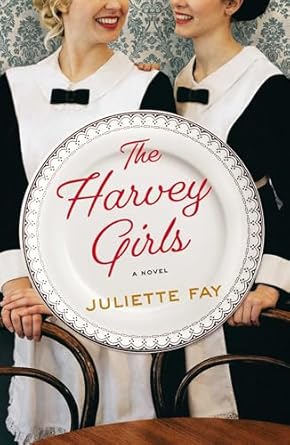
The Harvey Girls
The 1920s are a rich historical period which have seen little exploration in either women’s fiction or romance. Juliette Fay’s The Harvey Girls offers a uniquely feminine look at this fascinating era.
Charlotte (Crowninshield) Turner needs this job. The position with the Harvey Girls is one of the only career options available to women in 1926, and certainly among the few that will whisk her far away from St. Louis. And she needs to get far, far away from the city that contains her alcoholic, abusive husband. Fortunately, the recruiter doesn’t balk at Charlotte’s explanation for her black eye and, in what is an obvious burst of sympathy, hires her. The placement comes with a train ticket for training in Topeka, KS, and then a posting somewhere in the Southwest.
Billie MacTavish does not want this job. As the oldest of nine children, she’s been used to helping her ‘maw’ from the time she could first lift a baby or wash a dish. She’s no stranger to doing more than her share within the confines of her warm, loving family, but their needs far exceed what can be provided by her dad’s salary or her mother’s washing and mending business. When Billie sees the ad in the paper, she knows it is the family’s – and her own – best hope. A Harvey Girl should be eighteen years old and preferably have a high school education, but although fifteen-year-old Billie quit school in the sixth grade to help her mother, she’s tall, mature, and well-read. She doesn’t want to leave home, but they are desperate, so she finesses her way through the interview.
Charlotte and Billie’s initial meeting, over a free breakfast the day after they are hired, doesn’t go well. Charlotte, who came from money before her poor marital decision, is disdainful and patronizing of the awkward, unsophisticated Billie. It’s pretty clear the girl has never before stepped outside her small Nebraska town, and she seems slow-witted. The loathing is mutual. Billie finds Charlotte’s pride ridiculous, given that both of them are about to train for the same trade. Their reciprocal antipathy is unfortunate since being hired on the same day through the same office sees the two women lumped into a unit, forced to travel together, room together, and train together.
They are thrust into twelve-hour work days almost immediately. Charlotte’s intelligence enables her to pick up on things like the cup code quickly, but her naturally acerbic nature makes customer service a challenge. Billie has a way with (most) people that has her rapidly earning big tips to send home. She easily makes friends with other staff, but her clumsiness and lack of experience are a significant irritant to management. Slowly, Billie and Charlotte realize that their complementary skills can make them a powerful team if they can just learn to work together.
This is a women’s fiction story with romantic elements. Billie is easily the more lovable of our two protagonists. While her naïveté and homesickness are grating in the first few chapters, once she settles in, she becomes a charming guide to the world of a 1920s Harvey Girl. Watching her make friends with people from all walks of life, and from all kinds of different places, was heartwarming. Her down-home demeanor and good-natured personality remain in place even as she learns to stand up for herself. Gaining familiarity with how things work in the greater world allows her natural intelligence to shine through.
Billie’s winsome ways quickly attract beaus. The first, Leif, is a young man not much older than she is, and although he doesn’t share her Catholic faith, he does share her simple, homespun values and her interest in living a quiet, family-oriented life. Both of them have Harvey jobs not because they seek adventure in the Wild West, but through necessity. Their connection is sweet and earnest, and highlights their similarities.
Robert is a park ranger at the Grand Canyon whom Billie meets when she is sent to one of the crown jewels of the Harvey establishment, The El Tovar Hotel. He’s older by almost a decade, well-educated, ambitious and he shares Billie’s Catholic faith but not her charitable values. Robert is morally upright and treats Billie with great respect, but it is clear he doesn’t see her in any way as an equal. Choosing him, however, would be a clear case of ‘marrying up’. Watching Billie carefully weigh her options, while keeping in mind her own youth, is a lot of fun. I liked that she knows her own mind and heart, but is willing to hear some outside advice on the issue, too.
Charlotte was puzzling to me. We never gain a clear understanding of why she married her husband, which wasn’t just a case of falling for the wrong man but also of turning her back on so much that was good in her own life. I understand completely how a handsome face and charming demeanor can beguile women, but Charlotte’s personality – with her pride in her own intelligence, her ambition, her assertiveness, and acerbicness – didn’t fit with that of a woman who had been abused for years, nor with someone likely to fall for an abuser. To be clear, intelligent, skillful women can fall prey to abusers, too. However, Charlotte isn’t written in a manner that helps the reader understand why she sacrificed everything for that man. Her love interest, introduced later in the story, is equally confusing. He seems to be a property owner of some worth, but is doing a menial service job and speaks of selling personal items to pay for simple things. I found their relationship a conundrum as well. For reasons I never did fathom, he seemed determined to be the shiny accessory in Charlotte’s exciting new life.
The positive here is that Charlotte’s changed station in life, from rich socialite to waitress, helps her see people in a new light. Her expanded experience becomes a key factor in the story when she is transferred to the El Tovar and becomes the authorial spokesperson for the injustices inflicted upon the Native American people of that region. This is one of the many social issues that are brought up in the text. From the existence of and attitudes toward the KKK at the time, to the regulation of anyone who isn’t white to backroom help, to the plight of women as possible punching bags for a spouse, and ladies’ limited career choices, the author shines a light upon some of the darker aspects of the era. For the most part, Ms. Fay does an excellent job, neither glossing over the difficulties nor weighing her text down through too much exposition of the matter.
The Harvey Girls is a great look at an important piece of American history. While the text isn’t perfect, I found it a quick, enjoyable read and would recommend it to anyone who enjoys women’s historical fiction novels.
Recent Comments



Intriguing; I think people tend to think of Harvey Girls as being an old west subject.
That’s probably due to the Judy Garland film. The Harvey Houses were almost exclusively in the American Southwest, though, but apparently there were a few locations on the Kansas Pacific Railway. The history in this novel is great at explaining what the job was like.
Definitely; it’s one of the first things I think of when I think of the Harvey House brand! This sounds really neat TBH