
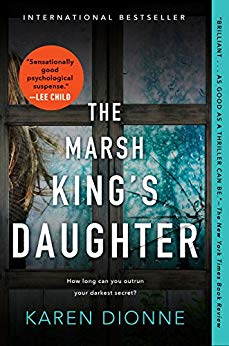
The Marsh King’s Daughter
Deep in the wilds of Michigan’s Upper Peninsula is an infamous cabin where there once lived a little family. Father, mother and daughter spent cold winter days and fabulous summers in primitive conditions, living off the land. But the picture is far darker than it seems for this was no happy little unit but the result of an abduction and rape. When Helena Pelletier is just twelve years old she finally learns the truth about why her parents don’t seem to get along. She learns who her father really is – and what he’s really capable of.
For Helena, her love for the father she once idolized might have disappeared like an early fall snow but the love of the land he taught her has never left her. Married with two young daughters, she has a successful business selling jams and jellies made from natural ingredients grown in the wild. But those early years scarred her. Not just the hard years of primitive living in a cabin with a harsh man but the years of her return to civilization where she had to learn social skills she still doesn’t quite understand the reasons for. With a desire to leave that all behind she has done something she knows she shouldn’t have: she never tells her husband of her background, spinning instead a story of stoicism and heroics nothing like the actuality of her former life. But we never really leave the past behind us. Helena’s father, incarcerated just thirty miles away, has escaped from prison – and she has no doubt about just where he is going and who he plans to take with him.
AAR staffers Maggie, Kristen and Shannon were eager to tackle this novel of suspense and to share their thoughts about it.
MB: This is a very unusual type of mystery. Most of my recent suspense reads have been whodunits or psychological thrillers. This tale was far more straightforward with the emphasis seeming to be on the surroundings and the minutia of hunting, whether hunting for food or being involved in what is typically called a “man hunt.”
Would you agree with that or did you see the tale differently?
KD: There were a few times I wasn’t actually sure what story was being told. The writing is arresting, but I wouldn’t really classify the book as a thriller, so I agree with you there. It was almost a meditation on abusive parenting and the importance of childhood development, with a dash of First Nations hunting traditions, UP culture, and psychopathy thrown in for good measure. The structure of past flashbacks and present narrative prevented me from really settling in and figuring out what was happening, I think.
SD: I’m not really sure how to classify this novel. It’s not straightforward by any stretch of the imagination. The structure is complex, and although we know who the villain is from the very start, there’s a lot of ground, both physical and metaphorical, to be covered before justice is served.
MB: I didn’t really connect with any of the characters. I had a feeling Helena’s mom would have had an interesting tale but we don’t get a chance to hear it. I had no empathy for her father and I was indifferent to Helena. She was an interesting narrator but not someone I wanted to get to know any better. What did you think of the characterization within the novel?
KD: I never need to spend time with any of these folks again, so I agree with you, Maggie. What I found interesting is that I’m not sure the author has empathy or connection with any of them either. She wants us to understand why Helena would feel for her father the way she does, and that was successful because I could follow the logic, but the whole narrative feels cold. Was that intentional and I’m just missing the point?
SD: I think the author made a clear choice not to share Helena’s mother’s story with the reader. She seemed to want the focus to be firmly on Helena herself and her relationship with her parents. Flashbacks showed us the horrors of Helena’s upbringing, but we also saw how she still loved her parents fiercely. I found her father to be quite reprehensible, and her mother seemed kind of weak, but Helena herself fascinated me. I enjoyed reading about her life both in and out of captivity. I loved seeing how events shape people into who they are today, and Helena’s early years definitely shaped her.
MB: Kristen, I agree about the whole narrative feeling cold and I am not sure if that was intentional or not. That coldness had me wondering if Helena was mentally ill, more behaviorally induced than biologically, but I definitely got that vibe from her. Her lack of empathy for her mother and the manner in which she handles things with her father once he escapes were indicative to me of continuing emotional problems; I thought perhaps dissociative disorder or emotional detachment disorder, both of which can be caused by trauma. When I closed the book I feared for her daughters, especially the youngest who had a developmental delay. I wondered too, if that delay was mentioned because it was supposed to clue us in to cognitive problems within Helena’s bloodline.
The setting seems to be almost another character in the book. We spend, I felt, a lot of time on learning about it and how to survive in it. I can’t say I enjoyed that much. I understood what the author was doing by handling the story in that manner but for me it distracted from the emotional showdown that was happening between a deeply flawed father and the damaged daughter he had produced. What are your thoughts on how the author handled the setting?
KD: Yeah, I didn’t need that much detail about the swamp or the texture of the dead animals or any of that. There were a few passages in this book that made me comment to my husband that “this is why I don’t often like literary fiction”; it’s too descriptive of setting and I just don’t really care. Did the detail of how she tracked add to the tension for y’all? It didn’t for me, but I’m curious.
MB: Nope, did nothing for me.
SD: The setting was actually one of the main reasons I wanted to review this story. I thought the author brought it to life beautifully. I personally enjoyed all the descriptions of Michigan’s Upper Peninsula. I felt like I was really there, something that doesn’t often happen to me when I’m reading. As to your question, Kristen, I did find Helena’s tracking quite interesting. It made the whole story seem so real to me. I’m glad the author wrote this the way she did.
MB: What are your overall thoughts on the book?
KD: I finished it a few days ago and I’m still not sure. It’s not one I’m planning on revisiting because of the heavy focus on the setting, but I was so drawn in that I cannot deny that power. I wish it had given us some more exploration of the sociopathy that would lead a man to do what Jacob did, and some more time on why Helena chose motherhood, how she handles bodily autonomy or capitalism in childhood, things like that. I think overall I’d give it a B-, because it offers lots to think about; I’d recommend it for anyone who likes nature literature, and I know Helena will stay with me for a while. Y’all?
MB: I found the book very well done technically, but I can’t say that I was drawn in. I had a vague curiosity about how it would end but other than worrying about Helena’s kids, the novel elicited no real emotions from me. I would give it a B- as well. As far as who would enjoy it, I would recommend it to fans of books like Cold Mountain or Snow Falling on Cedars, although both those novels are stronger examples of what can be done with this kind of tale.
SD: This book has a lot to recommend it. It’s very different from anything else I’ve read recently. The characters are multi-faceted, and the author’s attention to detail brought the whole story to life quite vividly. There are some scenes that might be disturbing for some readers, but I’d definitely recommend it to anyone who is looking for something thrilling, atmospheric, and unique to read. I want to check out more of this author’s work. I would give it an A-.
Recent Comments



The New York Times just hailed this as a thriller to read this summer. Here’s their take.
Interesting. I can see why he sees the choice to not delve into emotions as daring, but it just left me feeling disconnected. I wanted an exploration of the incarnated character and how she interacted with her present and past colliding. Perhaps that’s what all the tracking narratives were designed to do, and perhaps I’m too much of a suburbanite to connect with that, but it just didn’t work for me on the level I wish it had. Brilliant writing, would discourage no one from reading this and if it’s the book of the summer then that’s fantastic because I love the idea of folks wrestling with Helena (she demands nothing less).