
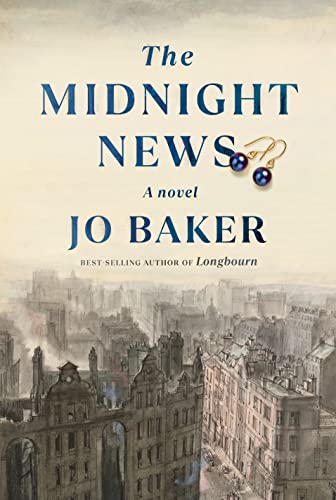
The Midnight News
The WWII time period is starting to feel a bit overused in fiction, but some stellar works set during this era are still being published. One such story is The Midnight News, a haunting tale that captures the essence of London during the heart of the fighting.
It’s 1940 and Lottie (Charlotte) Richmond has built a new life for herself. She has a tiny London attic apartment, where she can watch from the skylight as enemy planes come to bomb the city. She has a job at the Ministry of Information, which, while not exactly riveting, fills the hours of her day with purpose. She has made a friend of her kindly landlady, enjoys watching the same young man feed illicit crumbs to the birds in the park and when the opportunity arises, spends time with her friend Elena. The latter has become more and more rare, as Elena’s work appears all-consuming. There is, of course, Lottie’s godmother Saskia, but she is all the way across town and often too busy to keep a grieving young woman busy. And that is exactly what Lottie is. The death of her brother Eddie, who never returned from France, has left her a former shell of the vibrant person she once was. Her family, rather than being a comfort during this trying time, has been a burden. Her falsely cheery young stepmother and overbearing father are the opposite of the support Lottie needs. They had sent her to an asylum when they found her bereavement a problem, claiming her sorrow had made her go mad. Now that she is out in the wide world once more, she has carefully cultivated an existence that keeps them as distant as possible.
When yet another loved one is claimed by the war, Lottie is devastated. In denial. Unsure whether her tenuous hold on sanity will survive yet more loss. Then she realizes something. While most bombing victims come back in pieces if at all, her friend had been beautifully intact. Not a mark on her. Lottie’s life has been scarred by loss – her mother, her brother, and her dear friend – so she had long felt singled out for suffering. Many assured her she was wrong, she wasn’t being targeted. But something about this loss is so suspicious. Her dear one had been nervous and on edge the last few times they had gotten together. It felt as though someone had watched them during their rendezvous and has been watching Lottie ever since. Is it possible she is not paranoid and that someone or something really is stalking her from the dark?
Literary-style novels are all about atmosphere and this tale does an absolutely lovely job of capturing the ambiance of wartime London. The incessant bombing is almost another character in the book, omnipresent and devastating each time the sun goes down. Mortal stalkers make an almost welcome relief to the whistle and boom of the incendiaries that fall with such regularity. Shortages, outages, daily death tolls, the ever-changing landscape, and the sheer relentless suffering are beautifully captured here.
The history is detailed and excellent. Especially well done is the way the author shows the vulnerability of women at this time. We see how easily controlled they are by the men around them, the double standards they face, and the expectations that could often be suffocating. The author weaves all this smoothly into her text, the lesson deployed subtly in the background rather than ham-handedly or clunkily through whining conversations.
The characterization is also outstanding. It’s not just that everyone is three-dimensional but that what makes them who they are is so understandable and well explained. As in real life, the events around them are often seemingly random and almost nonsensical, but each of our characters responds to these hiccups exactly as one would expect, showcasing how tautly drawn they are and how predictable humans can really be.
Another positive is that as Lottie begins trying to unravel the mystery she proves painfully bad at it. Like many of us, she has no idea how to run an investigation nor how to question someone without raising their suspicions. It made a refreshing change from the amateur sleuths who always wind up being better investigators than trained detectives.
As mentioned, asylums and how institutionalization was used to deal with unwanted people are part of the makeup of this novel. Also included are rape, eugenics, abortion, and suicide and how all this played as a reality both during the war and the years leading up to it. I have read numerous novels that mention female promiscuity as a coping mechanism for grief, which continuing into today, can be seen as psychosis, and that is also included here.
The foibles that keep The Midnight News from being perfect are those common to novels that forget they are, first and foremost, stories. The book has loose threads which are left unresolved. The prose seemed so obsessed with being weighty and beautiful that it was, at times, as laborious to read about the meaningless but artfully captured minutiae as it must have been to write it. Lottie is clever and independent but the nature of the text and the historical accuracy of the narrative leaves her at times seeming to lack agency.
Those are quibbles in an otherwise excellent tale, though. For those looking for a meatier read that captures the history and aura of wartime London, The Midnight News is perfect. It’s a lovely story that ends on a hopeful note and with a sweet Happy for Now (It’s war; we can’t guarantee either of them will survive). I would strongly recommend it to readers who love history, especially this time period.
Recent Comments



My late in-laws lived through the Coventry blitz and he was an officer in the Home Guard and an Air Raid Warden; both worked in an aircraft manufacturing factory making Spitfires. They rarely talked about it and other than the esprit de corps that they felt with others, they never considered their experiences in any way glorified, romantic or a worthy subject of casual conversation. I enjoyed the author’s Longbourn but I don’t think this one would be something I want to read. The review here (excellently written, BTW) and others elsewhere indicate this may be a dark, depressing, sad, tortured book. Not something I relish in the slightest. It’s why I avoid much literary fiction because the subjects are often so dark: suicide, depression and other mental illnesses, dysfunction on many levels, misery, deprivation. Not for me.
It’s definitely not a tale for everyone and if you aren’t in a place for even a slightly angsty book, I wouldn’t pick it up. However, the story actually came across as very hopeful – the good guys win in the end, our heroine finds love, and the people of Britain prove they are resilient and tenacious under the worst circumstances. What I appreciated about it was that it captured the actual history of the era – the danger, the inequality, the grief that people had to deal with – in a beautiful way. I love all the stories about the idyllic countryside where the worst wasn’t happening, but in London, the worst was happening, and it was so well written I felt like I finally understood what that must have been like. Again, totally get it if you want to give this a pass, but to be fair to the novel, it’s not a total downer.
I’m very picky about my WWII books at this point; this sounds intriguing, with a realistically researched case to boot.
I think it is a good one. Hope you enjoy it.
Thank you for the excellent review, Maggie! I was hoping that this might be one for my book club, but it sounds pretty heavy. Would you agree?
I think the author does a nice balance between dark and hopeful. I found it more uplifting than Madeline Martin’s most recent novel and would compare it to The Librarian Spy in terms of “heaviness”.
Thank you! That helps. I think I will try it.
Glad I could help :-) I really did like this novel. Hope you do, too.