
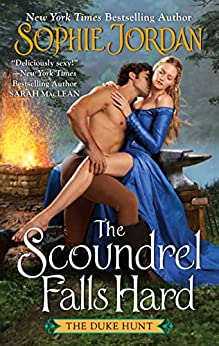
The Scoundrel Falls Hard
For all that it’s part of The Duke Hunt series, Sophie Jordan’s The Scoundrel Falls Hard doesn’t really involve dukes, or noblemen of any kind. Instead, it’s a refreshing historical romance that looks at more common people – if a female blacksmith can be called ‘common’ in Victorian England.
Gwen Cully may live in the Victorian era, but she would fit right in with the feminists of today. She serves as the primary blacksmith to her small village in Shropshire, and is as fierce and independent as one would expect a single woman in a male-dominated field to be. Although it does get lonely, Gwen keeps a stiff upper lip and doesn’t generally let on to her friends and neighbors how much she could use a partner in her life (and business).
Then twenty-eight years of keeping to the respectable side of ‘unconventional’ are thrown out the window one afternoon when Kellan Fox runs into her shop. He and his duplicitous father have just been caught out masquerading as the Duke of Penning and his heir, and with their deception revealed, the local villagers (who feel foolish about all their pandering to the Foxes) are out for blood. While the elder Fox escapes, Kellan has been left to face the mob alone, and he pleads with Gwen to allow him to hide out in her smithy.
Gwen is inclined to help out of Christian charity, but quickly discovers Kellan needs a good deal more than just a place to take cover. The mob easily finds him at Gwen’s and drags him out to be hanged. Staring into the faces of her neighbors gone mad, Gwen is moved to do something truly outrageous to stop them from hanging a man whose primary crime was making everyone feel foolish. So she does something which is admittedly foolish herself – she demands that the hanging be stopped because she and Kellan are in love.
After much hemming and hawing about the veracity of these claims, the villagers ultimately decide they will allow Kellan to live… if Gwen takes responsibility for him and proves her love by marrying him. Kellan, faced with the choice of death or marriage to a woman he doesn’t know, reluctantly decides that Gwen is the better option. They retire to her house, negotiate a deal where he will stay for a year and help in her smithy in payment for saving his life, and then quickly fall in love over the few weeks it takes for their banns to be read. Throw in a little villainy from the new blacksmith in town, some insecurities around Kellan staying with Gwen, and worries that he’s not good enough for her, and you’ve got yourself a book.
Although it was a fun read and I dashed through it, I had a few problems with this book which kept it from earning a higher grade. First and foremost, the opening scene did not sit well with me. In the space of an hour or two, Gwen and Kellan meet, face down a mob, and get engaged. None of that made sense to me – pretty much everyone acts out of character, and the fact that it’s at the beginning of the book made it all the more jarring. The villagers are flip-flopping from angry enough to do murder, to peevish and embarrassed, to skeptical yet protective of Gwen. She moves from uninterested bystander to some mix of rash, courageous, and smitten as she stands up for Kellan. It took me a while to get a sense of Gwen as a character, because that beginning is so unbelievable.
And even when I did get a sense of her, Gwen still felt out-of-place to me. It’s always hard to strike the balance between writing a character who belongs in the nineteenth century and writing a character who will appeal to twenty-first century readers, but Gwen definitely crossed the line. I admired how independent and strong she is, ready to face the world alone and maintain her family business after her father and uncle passed away. But those ideas don’t fit in the setting – while I know that there were female blacksmiths around in the nineteenth century (yes, I checked), Gwen’s casual attitude and expectation that the community will accept her as a single woman in trade feels off. For most of the book she has a live-in lover who’s not yet her husband, and yet this appears to be met with a shrug or a smile by most of the townspeople. In other words, Gwen’s characterization makes this book an historical in name only.
Finally, while the development of the romance between Gwen and Kellan is sweet, as is his slow move to the straight-and-narrow, the action in the majority of the story never lives up to the promise of the first few chapters. It was like eating dessert first – delicious, but you regret it at the end of the meal when you realize there’s nothing sweet left to enjoy. The plot is actually fairly well paced throughout, it’s just that the climatic action is all at the beginning.
So unfortunately, as much as I enjoyed the change of scenery from balls and house parties amongst the ton, The Scoundrel Falls Hard isn’t coming out as a rave review. It’s certainly a fun romp and redemption story, but not the first I’d pick up if you’re looking to read Sophie Jordan.
Buy it at: Amazon, Audible or your local independent retailer
Visit our Amazon Storefront
Recent Comments

I would’ve never guessed that this is a Victorian romance from the cover, whew. I want more commoner romances but as I said in Jessica’s review this has some cardinal Jordan sins.
I haven’t read Jordan in years but it’s a bummer she’s not writing great stuff anymore. I love One Night with You and her Devil’s Rock books were interesting.
She used to be great; most of her output since 2019 has been pretty bad and I can’t put my finger on why.
Maybe it’s explained better in the book, but how does marrying a con artist mean people are no longer at risk of being manipulated and lied to by him? Especially back in the day when men had a great deal more power and freedom of action than women did.
Interesting that both you and Jessica disliked this book, but for different reasons! If you’ve both found so many problems with it as to be able to fill two completely different reviews, then it MUST be bad!