
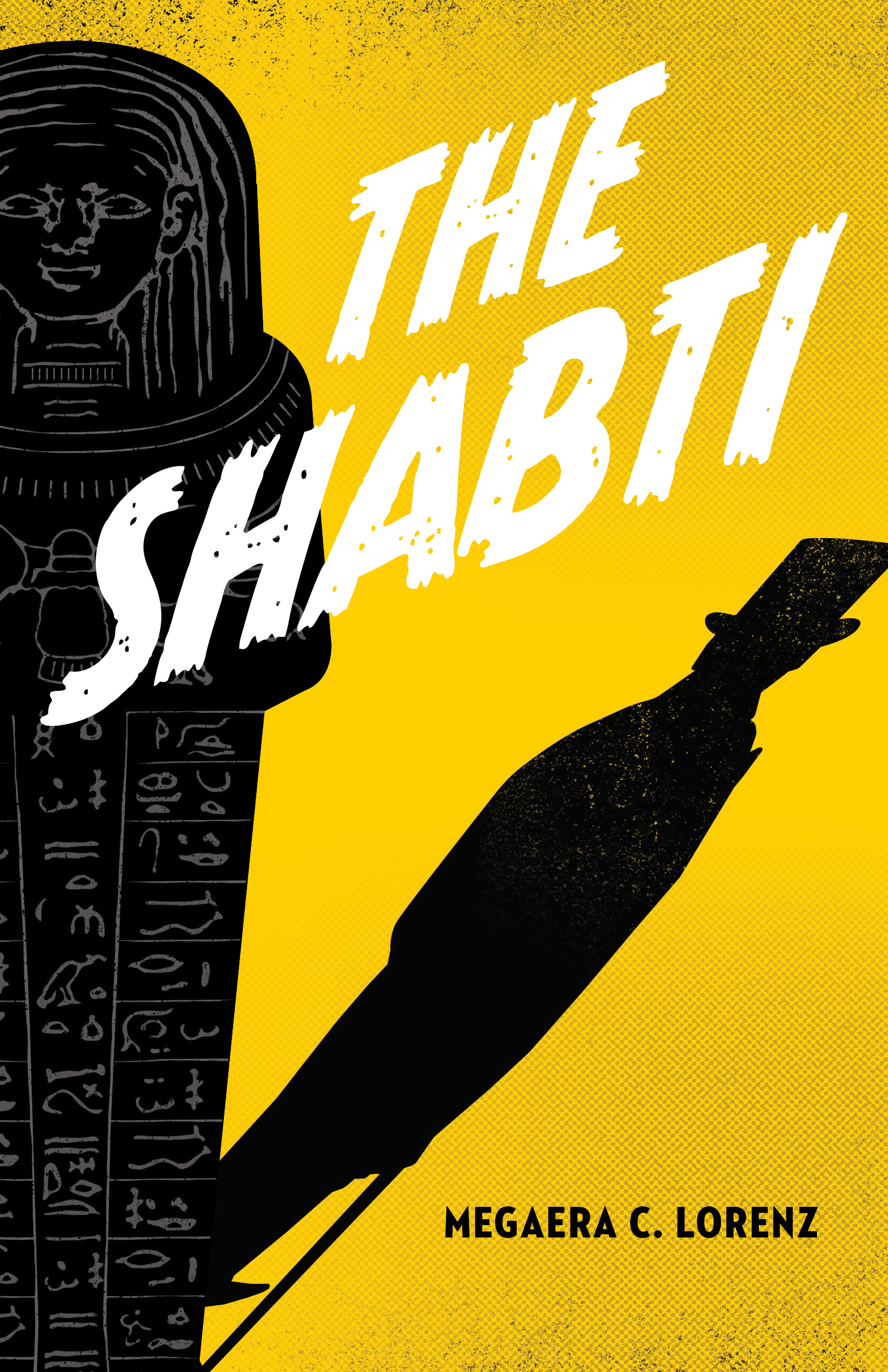
The Shabti
When KJ Charles recommends a book, I sit up and take notice, so when Megaera C. Lorenz posted on social media offering review copies of The Shabti I was quick to grab one!
This, the author’s début novel, is an atmospheric and eminently readable mixture of historical romance and paranormal mystery set in the US in the 1930s, featuring a former con-artist and a university professor, both of them in their late forties/early fifties. The 1930s setting isn’t one often found in historical romance, and neither are protagonists in their middle years, so those things, combined with a story revolving around Egyptology and a seemingly malevolent Egyptian artifact had me hooked right away.
Dashiel Quicke is a former showman/spiritualist fallen on hard times. A few years before this story begins and after his long-ignored conscience was pricked one too many times, he renounced the good life he’d made for himself by bilking people out of their money, and now barely makes a living by putting on shows unveiling the Dark Secrets of the Psychic Flim-Flam Racket! and running small cons here and there. When the book opens, he’s playing at a university campus in Willowvale, to an audience composed mostly of students – and one handsome middle-aged gentleman sitting in the front row.
This man is Hermann Goschalk, professor of Ancient Studies and Egyptology. Unbeknownst to him, Dashiel had previousy decided to invite him up on stage during the show in order to show how fake spiritualists work, how they use clever but very corporeal means to find information they can use to ensnare and maniupulate their audience. When the show is over, Dashiel is surprised to find Goschalk waiting for him outside the venue, and even moreso when the other man offers to buy him dinner. Dashiel is wary, but in no position to turn down a free meal.
As the two men chat over their food, Dashiel begins to relax a little, enjoying Hermann’s company and conversation – so he can’t help but feel a sting of disappointment when the professor finally reveals an ulterior motive for the dinner invitation. He explains that he’s noticed some strange goings on in the museum/research archive where he often works late at night –
“Weird noises. Things moving around when they ought not to. And, um, the bleeding walls. That sort of thing.”
Dashiel responds by reminding him that the whole point of his show was to prove that spiritualism is a hoax, but Hermann isn’t ready to let the matter drop. After all, he points out, if what he’s experiencing is nothing but a flim-flam, who better to sniff it out than someone who knows all the tricks?
Dashiel has to concede to him there, so he agrees to take a look around and does, in fact, come up with a set of perfectly reasonable explanations for the walls (a leaky pipe and rust) and the moving objects (absent-mindedness and the vibrations caused by the renovation work in the next room), and cheerfully tells Hermann he’s positive he’s not being haunted. He’s a bit surprised to note the disappointment mixed with the relief on the professor’s face, but they part on good terms, with Hermann inviting Dashiel to drop by for lunch the next time he’s in the area.
Dashiel could certainly have used another free meal, but he doesn’t take Hermann up on his offer. He thinks of him often over the next few months, but doesn’t return to the university – until a chance encounter with his old boss, Maude Pembleton Fink, has him wishing he’d returned before now. She tells Dashiel about a letter she’s received from some “kooky professor… who thinks his museum is haunted” and that she’s on her way there to see how she can turn the situation to her advantage. When Dashiel tries to warn her off, Maude not-so-subtly threatens him – and he knows she’ll follow through if he doesn’t toe the line. He feels sick to the stomach at the thought of the gentle, good-natured Hermann being scammed, and it kills him to have to sit back and do nothing in the face of Maude’s threats, but as soon as he dares, he heads back to Willowvale, where he discovers a very pleased-to-see-him professor – and that things in the museum have taken a turn for the spookier.
The Shabti is a highly entertaining caper in which the author skilfully builds a sense of unease and mounting tension as the strange goings-on slowly start to escalate and become a real threat to life and limb. The horror elements of the tale are genuinely scary (not in a gory way, though) and the story is full of small but fascinating details about ancient Egyptian language and customs (the author is an Egyptologist whose knowledge and love for the subject shines through without ever becoming essayish), and the fake spiritualism elements are really well done.
Dashiel is the PoV character, and he’s a complex, morally grey individual. Often brash, rude and angry, he doesn’t like himself very much, but he’s brave, clever, and willing to do the right thing (even if it takes him a while to get there). By contrast, Hermann is very much a heart on the sleeve type; he’s quiet, sweet and loves his job, but is also one of those people who digs his heels in when he wants something – and he absolutely does that when he realises that whatever is going on in the museum is not just smoke and mirrors and that it has to be stopped. They’re very different, but they make a great couple and there’s a real sense that here are two people who don’t – or no longer expect – to find love finding each other and becoming each other’s support system. I liked the way Hermann helps Dashiel to realise that, regardless of his past, he’s worthy of being loved, and that Dashiel shows Hermann that there’s room in his life for more than his work and his beloved cat, Horatio. (Bonus points for Hermann being so indignant when his cat is insulted! That, right there, is a true cat person.) Their chemistry is solid rather than intense and the bedroom door is closed, but both those things feel right for the characters and in the context of the story.
There’s a strong sub-plot concerning Dashiel’s ex – a dangerous individual who wants him back, both as a romantic partner and a professional one, and will stop at very little to get what he wants – and a nice element of found family as Dashiel and Hermann find friends and allies in Hermann’s neighbour, Lucille – a down-to-earth Black woman and nurse – and department secretary Agnes, who are both instrumental in helping to set up and enact the final showdown.
The Shabti has to go down as one of the most unusual reads of the year, a pulpy, noir-ish thriller combined with a dash of horror and a rather lovely, gentle romance that kept me glued to it from start to finish. A couple of pacing issues and a bit of awkwardness in the dialogue here and there just keep it from DIK status, but I enjoyed the book a lot, and will definitely be on the lookout for more from this author.
Recent Comments





The scary elements might make this a no-go for me, but it sound exactly like something my husband would enjoy!! And who knows, I might give it a try. :-)
It’s scary in the way that old horror movies are scary, which I think is the best scary (think Night of the Demon) – it’s all build-up and atmosphere rather than blood and gore!