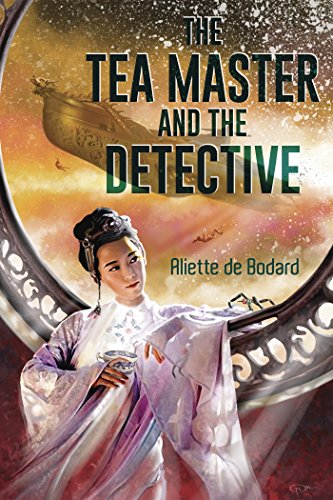
The Tea Master and The Detective
The concept of human immortality achieved through combining man and machine has always fascinated me, so when I saw The Tea Master and the Detective, I was eager to read it. The tale of a thinking ship and a young woman solving a crime in outer space, this unique story challenges the perception that a long life comes with wisdom and an ability to solve all problems. While touted as a standalone novel, I stopped reading The Tea Master and the Detective after twenty pages to double check fantasticfiction.com to see what I was missing. It was clear the book was part of a series, even though it wasn’t listed as one on NetGalley, Amazon or FF. After a bit of sleuthing I determined that the book was a part of the Universe of Xuya. I read book one of that saga and found this novel much easier to understand afterwards.
The Shadow’s Child, once a transport ship, was deeply damaged during the rebellion. She was discharged from the military after a traumatic injury left her crew dead and herself unable to tolerate the rigors of deep space anymore. Forced to make a living to pay for necessities, she brews teas which contain mind-altering drugs that enable people to think in the unreality of the deep space she herself can no longer travel in.
When the caustic Long Chau enters her shop, looking for a brew, The Shadow’s Child makes it for her. When Long Chau offers her money to take her off planet to find a corpse damaged by space for academic inquiries, The Shadow’s Child reluctantly agrees. The rent is due, and she doesn’t have another paying customer. But Long Chau is not satisfied with tea and transport and probes into The Shadow’s Child deepest secrets. Feeling that turn about is fair play, The Shadow’s Child uses her considerable abilities to unearth secrets from Long Chau’s past. What she finds deeply disturbs her – especially since the corpse they brought back for Long Chau’s research appears to have been murdered and The Shadow’s Child now finds herself involved in an investigation which may very well force her to confront her deepest fears.
The idea of biological brains running space ships is not a concept unique to this series. Anne McCaffrey used it in one of her sagas back in the late 60s and David Weber included one in his Dahak books back in the early 2000s. In this particular set of books, the mind ships are grown in a womb but implanted into an electronic ‘heart’, a being which then becomes much more than just the sum of its part. In the oriental empire in which this series takes place, these minds run the space ships and space stations. They work with their own biological families, serving as an Honored Ancestor, leading, transporting, sheltering and guiding their relatives through infinite generations. They can also use a system of bots and projections to exist outside the ship or station which serves as their home, enabling them to interact with society. That is the case with The Shadow’s Child. She rents rooms on a station in the Scattered Pearls Belt, where a portion of her brews teas and connects with her customers.
When she first meets Long Chau, The Shadow’s Child is still recovering from what happened to her long ago. She is barely functional, her family is gone and she is forced to do something that is nearly unprecedented: make a living for herself using the weakest skill she has. She finds Long Chau rude and arrogant but also fascinating. While The Shadow’s Child doesn’t appreciate being forced to confront her past or work through her fears, she finds what Long Chau does intellectually challenging. And she hasn’t experienced such a challenge in a while.
Long Chau is reminiscent of other characters by this author. She is clever and strong-willed, and chafes under the restrictions imposed upon her by a system that evokes the shadow of ancient Asian empires. That was a real problem for me. This style of government unilaterally failed in that part of the world, proving insufficient to run a country, so it would be unlikely to fair better at running a multi-planet empire. That said, if you overlook the unlikeliness of governmental success, the culture is fascinating and makes an interesting backdrop for a space opera-style novel.
This is a short story and the gist of the tale is the unlikely friendship between the damaged and fragile The Shadow’s Child and the strong, enigmatic Long Chau. The author does a good job with that, showing how the two characters form an unlikely bond over shared secrets and a deep intellectual curiosity. In many ways, it is similar to the modern take on the friendship of Sherlock Holmes and John Watson as seen in the TV show Sherlock.
If you are a fan of books with thinking ships, you will definitely want to read The Tea Master and the Detective. It’s an intriguing and unique perspective on that idea. However, I’d suggest reading On a Red Station, Drifting first, since it provides the history you will need to understand it; at least I needed to do that to follow the story. If you aren’t a fan of that sub-genre, I would not recommend this as the place to start. Check out this list on sentient ships and then if you find you like the concept, circle back to this one.
Buy it at: Amazon/iBooks/Nook/Kobo
Recent Comments