Marion (The Thief’s Mistress)
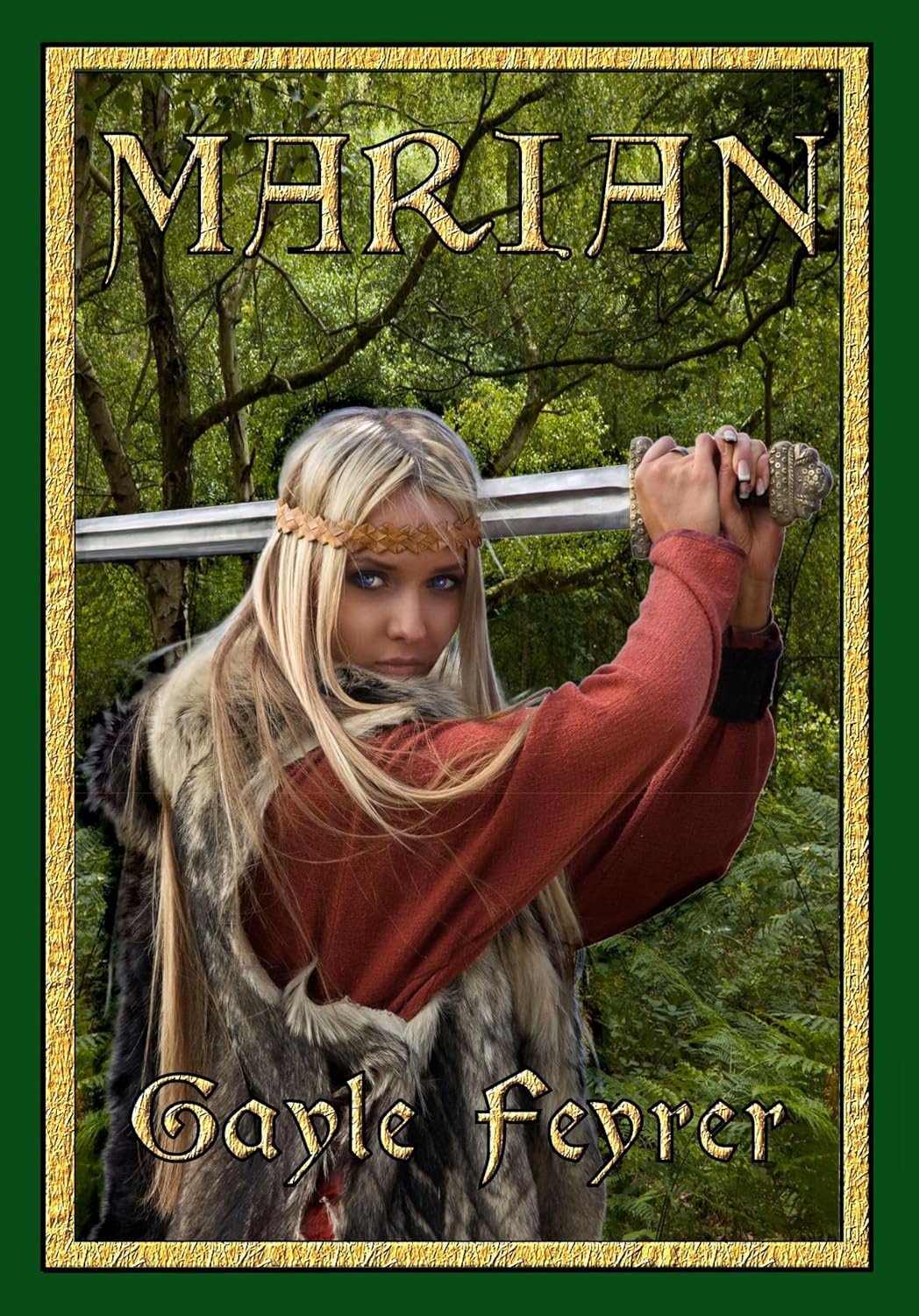
If you thought you were going to relive the romantic adventures of Robin Of The Hood and Lady Marian when you purchased The Thief’s Mistress, you’ll be surprised and maybe a little disappointed, because until the two characters finally do have sex, you’re at page 306 and still remembering Marian willingly doing it with Guy of Guisbourne on page 294 for the fifteenth time. Yes, Guy of Guisbourne, the notoriously mean and cruel nobleman, enemy of the people and of the Crown, the one Marian has an affair with almost throughout the entire story, enjoying it all the while, and ready to go even further if this will gain her the political information she needs.
What of Robin you ask? He’s there, somewhat between one tree top and another. He’s a thief, a rebel and all that the books and movies have portrayed him to be, except that Feyrer decides to show us another side of him, the one where is found casually playing with himself in the woods under Marian’s watchful and lusty eyes. Was this necessary?
If the author wanted to shock us into the reality of those times, she did it somewhat well, but she also did it at the expense of the story’s credibility, at Marian’s and Robin’s depth of character, and most of all, at the expense of romance.
What’s left, and I will credit Feyrer for this, is an incredible historical account of intrigue and political machinations familiarly known to the 12th Century. And even if this practically overtakes the book and the story and any other romantic considerations, you can easily picture its many scenes in a television mini-series or on Masterpiece Theatre. In fact, when you read the first 100 pages, you’re left wondering if what you know of Robin and Marian from fairy-tales and movies is true, or just embellished and cleansed by the Romanesque qualities of commercially-minded producers.
Mainly, when I finished this book (and I dropped it off several times in between), I felt that the author’s purpose was more to teach us a lesson in medieval history than to develop a romantic story.
Granted, when your entire story-line is based on a reported historical event, the author doesn’t have much leeway in enhancing the romantic side of the story, especially if this was not her purpose in the first place. But Feyrer went further. In her quest to render a realistic and crude account of the times, in this reviewer’s mind, she somewhat damaged the characters, rendering them unsympathetic to the reader.
Marian is nothing short of calculating and a cold blooded killer no matter how much Feyrer attempts to justify her actions. You’ll see it as early as the Prologue, when she wakes up from a tree top, “relieves” herself shortly after on the ground, hides again stalking her prey, gruesomely kills three men, a horse she aims for with little remorse, and another man whom she challenges and kills because he had her whole family butchered months before. Her next prey is another man, one who makes strange sensations course through her veins when they see each other, one who makes her feel naked just with his eyes, and wanton just with the imagination. Strategic parts of her body pucker at his glance and at his voice, until she could bear it no more.
Only it’s not Robin of Locksley. It’s Guy Of Guisbourne, a man who rescues her several times, and whom this reader, almost mistook for the hero…
Robin, on the other hand, is the merry leader of a band of men who stalk Sherwood Forest for passers by. He is more often drunk than anything else, and in dire need of a bath. There is nothing brave about him, and he is displayed as a master of self-love throughout most of the book. Consequently, amidst the enchanted forest of Sherwood, the reader feels more like a voyeur than a guest of the author.
Don’t get me wrong, I’m familiar with what goes on in the bedroom and am not easily scandalized. But what annoyed me the most about the way this story was written is that I felt cheated out of the romance. The few love scenes between Robin and Marian, are short and unconvincing of the all-encompassing love that’s supposed to have blossomed between them throughout the story. Maybe it’s because Marian’s willing and torrid affair with Guy kept getting in the way. Maybe it’s because by the time Feyrer got to the love birds, she had exhausted all of the sexual scenes and à parte’s with the nobleman, and had none left with Marian and Robin. So how do you justify Robin’s tacit acceptance of her affairs? His knowledge that she could very well be carrying someone else’s child (even if miraculously she never gets pregnant or worries about it)? You don’t; even less in the end where they get married. And how they get to that point, the author doesn’t show it. Nor do you see any progression in how Marian falls out of lust with Guy, nor what makes her humanity finally resurface. Result: you just don’t believe it.
This flaw in the book is obvious even if you want to ignore the crudeness and the historical manipulation; or consider my other comments as highly personal. You will not see the progression of the most important aspects of the story, particularly of the characters’ actions.
Maybe it’s because I don’t like to read about stories where the historical facts are re-invented; maybe it’s because I didn’t like movies like The Last The Last Temptation of Christ or books like The Holy Grail.
One thing is clear however, the book was not as engaging as it should have been although it was well written and researched. Borderline erotica, definitely, but that has its time and place, and I don’t think this was it.
Hell, when Marian and Robin did get married, I was even a little disappointed it wasn’t…… Guy.
Recent Comments