
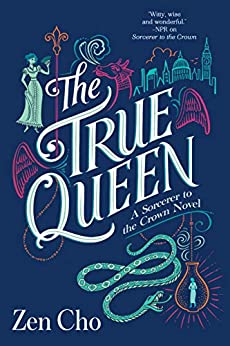
The True Queen
This sequel to Zen Cho’s Sorcerer to the Crown is satisfactory, but didn’t win me over in the same way as its predecessor.
Muna wakes up on a beach in Janda Baik, a fictional island near Indonesia, with no memory of how she and her sister Sakti came to be there, or of the curse that both are under which is causing Sakti to slowly disappear. Sakti has magic, but Muna does not. After a mishap with a local magistrate, Muna and Sakti arrange to join a women’s magic academy in England, traveling via magical pathways through Fairy. Unfortunately, Sakti disappears in Fairy, leaving Muna to continue on alone.
I find it so frustrating when the author sets up a mystery with a solution which is massively obvious to readers early on, but which the characters don’t understand, and their lack of understanding is essential to the advancement of the plot. For instance, Sakti and Muna do a revelation spell to learn more about their situation, which yields the word “Midsommer”. When Muna first arrives in England, she hears a reference to a person surnamed Midsommer – and doesn’t even react. Eventually, she does follow up, but why did she miss it on the first pass? There are also things the characters could do to learn more, but they don’t do it, because it’s not time for the plot to advance yet. Every time we actually DO learn something new, it’s immediately clear to the reader how it fits in and what it means, but Muna carries on oblivious. That, and the fact that Muna feels the need to lie about not being the magical sister upon arrival at the academy, are my two main complaints about this book.
There’s no plot tension from revelation of knowledge, but the actual plot is enjoyable. I liked following Muna through new situations, and her quiet and accommodating personality (Sakti’s the one with the temper) is unusual in a fantasy heroine. Seeing England and Fairy through her eyes is enjoyable. Her observations include interesting comparisons about how age, gender, race, and other characteristics affect Janda Baik and England. Muna is also a practicing Muslim, and it’s interesting to see that in a world with magic.
For a change, I enjoyed the return of a previous heroine, Prunella, who is now in her new capacity as Sorceress Royal and school manager. Things haven’t proceeded smoothly for her, and she continues to face resistance based on her gender and her mission to educate fellow women. Her relationship with Zacharias reflects their personalities authentically rather than becoming blandly perfect.
The relationship here – between Muna and another woman at the school – is both subtle and slow-burn. It’s much less central to the story than Prunella and Zacharias’ romance, and honestly, the book would have been the same without it. However, I did like the characters, and I was happy to see them find an ending that worked.
Despite its flaws, The True Queen is still a fun and engaging way to experience a magical, global Regency era. In the finale, when the characters finally catch up to what I’d already figured out, I went into full page-turner mode. So while this book isn’t as captivating as its predecessor, there’s still plenty to enjoy.
Recent Comments




On my TBR!