
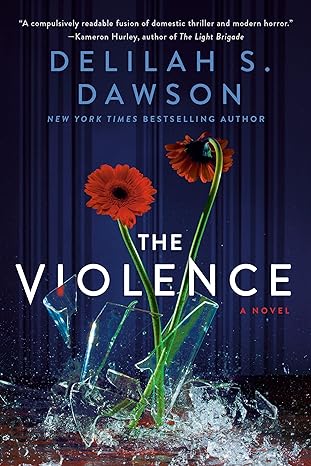
The Violence
Delilah Dawson’s books can’t be slotted into any one category, and The Violence is a great example of that. It’s women’s fiction and horror with a dash of psychological thriller, and while I wasn’t as transfixed as I was by her novel Bloom, it still kept me turning pages.
The story begins with a virus which makes infected people lapse into bouts of homicidal violence directed at the nearest target. Shortly afterwards, though, infected people come back to their senses with no memory of the last few minutes, and are horrified to realize that they’ve killed someone. There’s no indication of how this behavior pattern benefits the virus, but then again, the whole point of the virus is to be the catalyst that sets the plot into motion.
Chelsea Martin is married with two daughters, seventeen-year-old Ella and five-year-old Brooklyn. On the outside, her life looks picture-perfect, but her marriage is intensely abusive. When she hears about the Violence, though, she sees a way out. One day she provokes David by not having a hot meal ready when he comes home, and when he starts beating her, she manages to call the Violence hotline. The police drag him off to a quarantine facility. I looked forward to the rest of the story being about Chelsea and her daughters rebuilding their lives.
Except things get worse. David’s lawyer lets Chelsea know that David will be tested for the virus at once, and released just as quickly if he’s not infected. Without money or a support system, Chelsea realizes she has to get the girls to safety before David returns, and then the next bombshell hits. He may not be infected, but she is. In desperation, she turns to her mother, who’s married to a rich judge. They live in a mansion and aren’t likely to be intimidated by David.
Unfortunately Chelsea’s mother Patricia is cold, self-absorbed, and demanding. Patricia takes the girls to live with her – because Ella will see to Brooklyn’s needs – but kicks Chelsea out, so Chelsea goes on the run. And then, since things just weren’t bad enough yet, Ella disappears and Patricia’s equally horrible husband tells her he’s getting a divorce. When she says, “But I did everything you wanted”, he replies that this isn’t quite accurate. You see, she’s grown older.
So this is a story of three women’s journeys – Chelsea’s breaking out of her timid shell, Ella’s search for safety, and Patricia’s growth into a human being. I ended up liking Patricia’s arc the best. At first she’s shell-shocked by the divorce (even though she married for money and knows her husband cheats on her) and she doesn’t know how to take care of a child. Poor Brooklyn has to explain that she can’t reach the cereal boxes to fix her breakfast because, “I’m little.” Aww.
As the country-club trappings fall away, though, it’s clear that Patricia was also a victim of abuse who coped by telling Chelsea that the world was a hard and miserable place, therefore it was every woman for herself. Chelsea proves her wrong by stumbling across an underground community of fellow infected people who become a found family for her. But she’s still separated from her daughters, and David is determined to get his family back under his fist.
So why doesn’t this book get a higher grade? A few reasons. The first is that Chelsea’s new friends are actually an underground wrestling ring which broadcasts fights on TV. The author seems to be suggesting that the jaded-with-real-Violence audience tunes in for a controlled, entertaining form of violence, and Chelsea’s sessions in the ring give her strength and confidence. But – and this is my personal taste – I don’t enjoy wrestling, and I skimmed every scene with Chelsea’s bouts in the ring. If I had known in advance that wrestling played such a large role in this book, I wouldn’t have picked it up.
The second issue is that this story is set in the post-Covid US where most people are tired of pandemic precautions. The unnamed president, who has recently returned to power, isn’t worried about the Violence, and the vaccine is incredibly overpriced thanks to the government. Not only is this a little too on-the-nose, it feels like the author was trying to make one too many points. Domestic abuse and the patriarchy would be enough without politics being referenced, too.
Which brings me to the third problem. David is self-centered, manipulative and abusive. So is Patricia’s husband. So is Ella’s boyfriend. So are David’s friends, except for one who’s a cop, so his danger factor is even higher. Chelsea and Ella cross paths with decent guys later on, but the first half of the story is full of gut-wrenchingly unpleasant men. It’s also a bit unbalanced that while the women are allowed to change and grow, the male villains never stop their villainy.
That said, The Violence was a tense, unpredictable read with a satisfactory ending. This is definitely not a book for everyone, but despite its problems, there’s enough good that it earns a qualified recommendation.
Note: This story contains a scene in which a dog is killed.
Recent Comments


Oh intriguing
What kept me reading was the sheer unpredictability of the storyline. I knew David’s and Chelsea’s paths would cross again eventually, but nothing else was predictable (and there are a couple of really startling twists).