
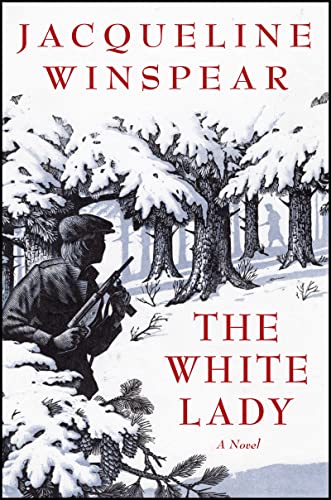
The White Lady
Jacqueline Winspear takes a break from her popular Maisie Dobbs series to bring us The White Lady, a story of friendship, bloodshed, and betrayal.
The cottage is a grace and favor home. Elinor White had done her bit (and beyond) for England over the course of two wars and was deemed entitled to the quiet life she now lives in rural Kent. She is civil but distant to her fellow villagers, polite enough but never friendly or inviting.
When Jim, Rose, and little Susie Mackie move into the cottage down the lane, Rose determinedly tries to make friends. Having left London for the safer, healthier atmosphere of the countryside, Rose knows no one and would love to have a neighbor to share a cuppa with. Elinor’s brisk courtesy makes it clear that is unlikely to happen until Susie, an open-hearted, outgoing toddler, takes matters into her own hands. She does all she can to capture Elinor’s attention whenever they pass her in the village or out on a walk on the lane, and reluctantly, Elinor thaws under the little girl’s charms. It isn’t a close relationship, but it is as cordial a one as Elinor is willing to allow.
Then the past comes calling. Jim hadn’t always been the hardworking farmhand he is now. Once, he had been a soldier in his grandfather’s powerful crime empire, and while England may have allowed its fighters to demob after the war, the Mackies aren’t the kind to let their veterans retire. His relatives drop by and pay a decidedly unfriendly visit. Jim and Rose are bruised and shaken after they leave, and Elinor is horrified by what little Susie has been put through. She also has enough experience to recognize this as a courtesy call. The next time the Mackies come, things will be even less amicable. People will be hurt, and after the violent conflicts of the past few decades, Elinor has seen all the broken families she can stomach.
She has a very particular set of skills – skills she acquired at a young age, at a great price, during two seemingly endless wars. Skills that will allow her to protect this little family, skills that will let her make up for all the families she helped destroy in the past. Elinor will try reason first. If the Mackie family is willing to let bygones be bygones, she will leave them alone. But if they don’t, Elinor has every intention of making them regret that.
This is a dual-timeline novel, with one portion covering the First and Second World Wars and the other covering a brief few months in 1947. I found the first three-quarters of the story absolutely riveting. The emphasis is on how women made up the bulk of the resistance movements since the men were either off fighting or too young/old to fully participate. Misogyny ensured that the enemy often turned a blind eye to these ladies, enabling them to do much more than the fellows training them had thought possible. I absolutely adored this look at war from a more feminine perspective.
Elinor is an outstanding action heroine. The story does an excellent job of showing us how she advanced steadily through the ranks in espionage work and just what makes her the kind of person who would excel in such a field. I liked that she has a personality that is both closed off, yet warm, and that she is a woman who knows how to be patriotic without being sycophantic. Elinor has her own sense of integrity, her own ideas about what lines should and shouldn’t be crossed, but still maintains an intense loyalty to the allied cause and those who worked with her.
I also very much appreciated this look at what happens to the skill set acquired in war once the battles are over. In the late forties, there weren’t a lot of places women with Elinor’s experience and abilities would be welcomed. I liked that the story shows how the past affected her emotionally, how even people who knew full well her talents and ingenuity underappreciated her, and how all of that led to her living a quiet life in the country.
The author peoples Elinor’s world with some truly interesting villains. Since their stories are integral to the plot, I won’t say much about them except that I found them intriguing, and the mysteries that surrounded them are equally engrossing.
I do have a few quibbles. I was a fan of dual-time novels before they were cool, so it’s with great reluctance that I say that not every story is enhanced by this writing device. In this particular case, a teaser opening chapter of Elinor in the present and then giving a linear backstory would have been a better way for this tale to be told. Flashing back and forth slows the momentum and pacing that is so vital in an action/adventure story.
My second quibble is the ending is almost totally unbelievable and, as a result, felt a tiny bit like a letdown.
However, those are minor disappointments in what is an otherwise riveting book. The White Lady is a excellent, well-written read for anyone looking for a low-key mystery or for fans of this author’s work.
Recent Comments



I read this back in March so a bit hazy on the ending but don’t think it bothered me. Elinor was a great character.
I liked her a lot and wouldn’t mind if the author turned this into a series.