
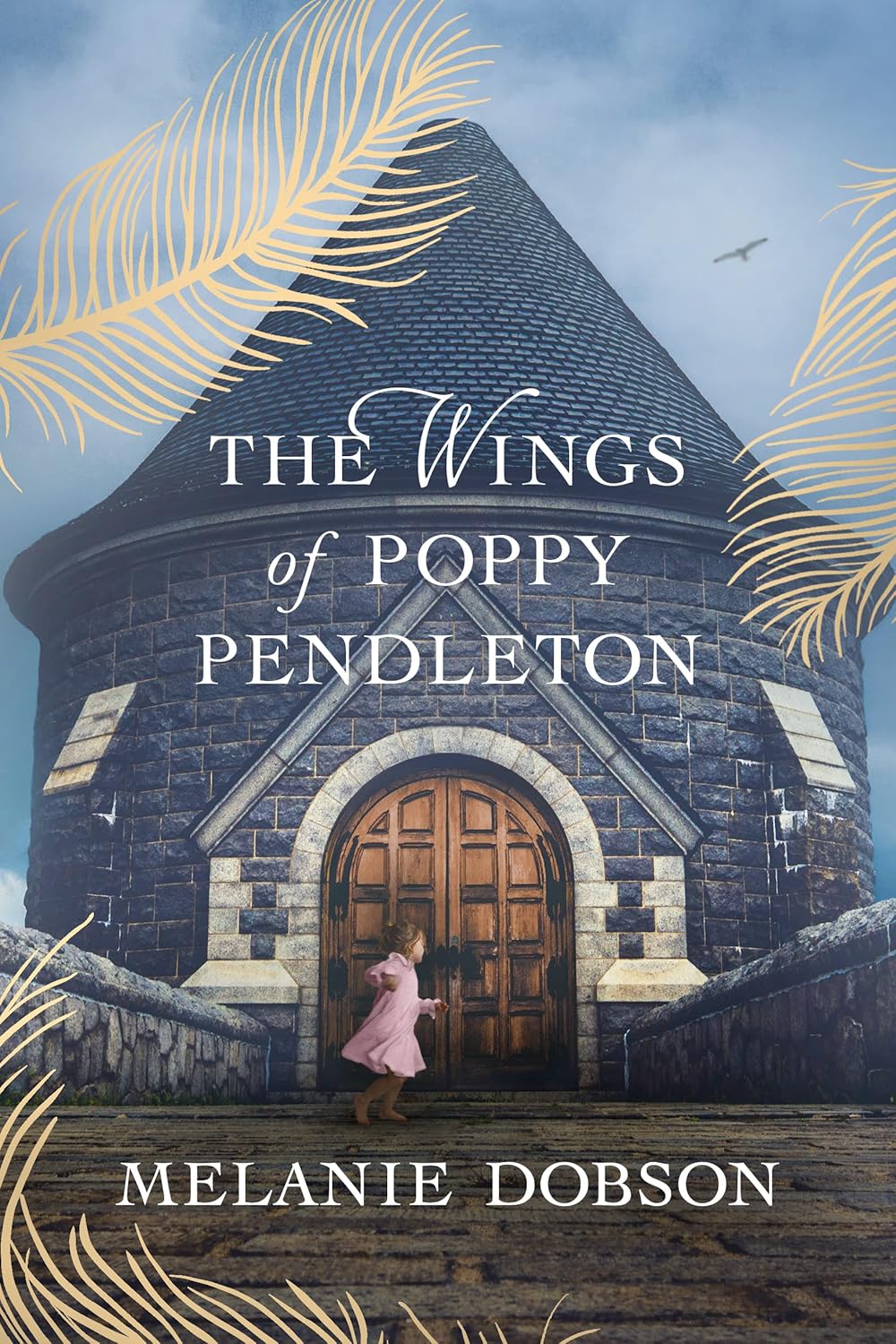
The Wings of Poppy Pendleton
The Wings of Poppy Pendleton is an engrossing dual-timeline story featuring three women whose lives intersect over the course of several decades.
It is 1907, and the world is in the grip of the opulence and glamour of the Gilded Age. At least as far as the Pendleton family is concerned. The patriarch, Leslie, has political ambitions he hopes to launch with a lavish party allegedly celebrating the birthday of his heir, five-year-old Penelope (Poppy) Pendleton. No children have been invited to the event, but the rich and powerful who surge over the private island where Leslie, his wife Amelia, and their young daughter spend their summers are the adult crème de la crème of the nation. Amelia finds the entire event tiresome. Her husband is philandering with her lady’s maid, his excessive drinking is causing him to risk his political ambitions, and his wealth is in a precarious position as his money maker Poppy’s Tip Top Tonic is a children’s medicine made with opium, and the new Food and Drug Act has labelled that substance dangerous. It is vital that the night be a success, so a frustrated Amelia has a maid watch her daughter while she does damage control with the guests and sends her husband to his study.
The morning dawns with Leslie dead and Poppy missing. Amelia, grief-stricken, insists the island be searched repeatedly for her daughter. The mainland police are called, and endless hours are spent combing the small isle, but no sign of the child is found.
In 1992, Chloe Riddell gets God Whispers. Quiet gut instincts which urge her to take actions that common sense will often say are unnecessary, foolish, or hazardous. This is why, when we meet her, she is battling a storm on the St. Lawrence to get to Koster Island. The whisper urged her to head to the isolated land mass whose only claim to fame is the ruins of Pendleton mansion. The only other house on the island, once her grandparents’, now belongs to her. When she arrives, she finds her dogs on the porch, curled around the form of a young girl taking shelter from the rain. Chloe is flabbergasted to discover a stranger there, but she brings the child in and warms her up with a shower and hot chocolate. The girl says her name is Emma but refuses to provide any more information
Chloe contacts the authorities and agrees to keep Emma until a more permanent solution can be found. She knows the solution won’t be her. Financially, she’s facing ruin. Her grandparents’ candy shop is popular but not profitable, their island cabin is in need of repair, and the island property has taxes that need to be paid and which she can’t afford. She has no idea how to remedy these situations, much less take care of a child. She also has to deal with the relentless pursuit of reporter Logan Danford, who is researching the Pendleton disappearance and has determined that Chloe knows more than she is telling. This seems impossible to Chloe since what she knows is a big fat nothing. She may have grown up in the shadow of the manse, but she has never been inside, nor does she have any information beyond the local lore regarding its inhabitants.
In the early 1900s, young Birdie is a river rat, living on a boat with her Mama and struggling to avoid the men who visit and seem increasingly more interested in her than her mother. She loves birds and listening to their music; she loves books, and she loves her capricious, troubled parent. What she loves most, though, are the stories her mother tells of young Poppy, who lives in a castle and plays in fields of red flowers. The tales resonate with her for some reason, though she can’t fathom why.
The Wings of Poppy Pendleton deals with child trafficking and pedophilia. It should be clear to the reader what is happening, but almost no details are given until near the end, and even then, it is from an investigative angle, telling rather than showing what is happening. Drug use and prostitution are both present, as is alcohol abuse. Although this is an inspirational novel, extra-marital sex is referenced, though it is alluded to rather than shown on the page. During the early time period, this action is classified as sin, and repentance and redemption are part of the aftermath, which is very appropriate, given the era and nature of the text. The narrative also has religious themes running throughout, mainly emphasizing the mercy of God and the importance of faith.
Each of our heroines is in a mess (mostly) not of their own making, and the novel details their struggles to rise above the ruins of their lives. Amelia needed to “marry well”, which she did if one looks at money as the only criterion, but her marriage was happy, and she is hiding a terrible secret that may well prove to be her demise. Her husband’s death and daughter’s disappearance move her from one gilded cage filled with misery to another filled with grief. I enjoyed watching her slowly come to the realization that her life is hers to live and to start taking agency over it. Some of her decisions are questionable, but I liked her in spite of her foibles.
Birdie’s mother is a horrible person who has isolated her young daughter and forced her to live under horrific conditions. It is only when tragedy frees Birdie from that prison that she is truly able to take flight and soar. Birdie displays the resilience and strength of youth, but she also showcases how meeting the right people can make all the difference in a child’s life. This theme is echoed in both Chloe and Emma, who also have rough starts. Chloe’s parents were drug addicts who died in a car accident on the way to Woodstock and she was raised by her grandparents, whom she idolized, which is why she is so desperate to keep their legacy alive. In Emma, Chloe sees an echo of her former self. However, young Emma seems to have no one but Chloe in her corner. Unraveling the mystery of who Emma is and how she wound up on Koster Island will not only resolve that young lady’s issues in the present but will clarify things from Chloe’s own past, bring Chloe a new love, and help her solve a decades-old riddle.
No story is perfect, and this one has some minor flaws. Several secondary characters pivotal to the plot aren’t drawn with depth, leaving us baffled as to what happened to them and why. One male character can be best described as a cad, but neither he nor his wife gets the comeuppance they so richly deserve. The mystery surrounding some necessary funds also seems rather absurd. But those are quibbles.
Otherwise, the author does a fantastic job of weaving multiple threads into a beautiful tapestry, rich with history and mesmerizing in its ability to make you emotionally invested in the characters. The Wings of Poppy Pendleton is a lovely read, and one I would recommend to those who enjoy inspirational women’s fiction.
Recent Comments


I couldn’t get into this one and reading the review, I know it’s just not for me. Depressing
I get that. Her stories always seem to be angst-ridden and the historical characters rarely receive HEAs- or they really, really have to earn them. I felt that was the case with Birdie. I did love Chloe’s story and I was fascinated by the mystery but I totally understand someone not wanting to wade through a bunch of sad to get to those portions.
I run a book club that has three rules for books:
1) Must be written by a woman
2) Must be under 500 pages
3) The book cannot be a downer.
The last causes no end of argument. One woman in book club believes that if there is a redemption, that’s uplifting, no matter how grim the book. Another believes that as long as the main characters are doing OK by the end, that meets the criteria. I believe, in this case, that books that bum you out while you are reading most of them, should be excluded.
This book sounds like one we would argue about!
Probably :-) The woman who likes redemption would love it. The one who wants the main characters to be doing okay by the end would also enjoy it. As to your criteria, I’m not sure I can answer because that is so dependent on the individual. This one bummed Cathy out, but I was fine with it.I’ll add that Kate Morton’s The Clockmaker’s Daughter had a storyline that both depressed me and stayed with me for a long time. And yet I know other’s found the story lovely and heartfelt. I would say both Morton and Dobson (as well as Kearsley) write stories that are YMMV.
Yes–we loved, for example, The Dutch House which is a YMMV book. That said, we have repeatedly refused to read Demon Copperhead!
I’ve tried Dobson’s various fairytale retellings and found them to be decent; will give this a read.
Are you thinking, perhaps, of Melanie Dickerson? She writes Medievals like The Golden Braid. I found her too light and modern for my taste but I know she is very popular. The author of this book is more like a Kate Morton or Susanna Kearsley. Her books tend to be dual-time novels and pretty angsty.
Yeep I am, sorry about that.
No worries! I should probably give Dickerson another try as I haven’t read her in years. Which ones have you enjoyed?