
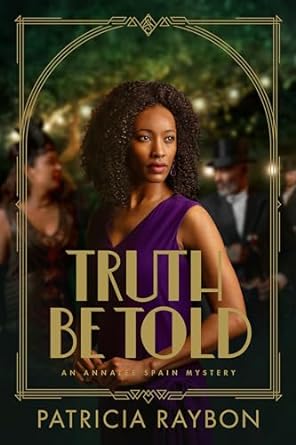
Truth Be Told
Truth Be Told is the third book in the Annalee Spain Mysteries series. Set in Denver in the early 1920s, the books chronicle the hold the Klu Klux Klan has on the state of Colorado, the dangers faced by the Black community of the time, and how one woman, a theologian by trade, has turned to detective work to ensure justice is done for all against incredible odds.
It’s not Annalee’s usual scene. She’s been in the papers a lot for her recent success at solving crime and (somewhat) bringing powerful people to account, or she wouldn’t have been invited to this elite political fundraiser. It’s being held in the lavish garden of Cooper Coates, a famed political fixer and power player who is not a big fan of Annalee. He’s one of the wealthiest men in Denver’s infamous Black neighborhood of Five Points, and his pull is such that he has Blacks and whites mingling freely at his event. In Klan-controlled Denver, where a Black cabbie can be killed for picking up a white lady looking for a ride, this is quite the coup. But his success quickly turns to ashes when his daughter comes screaming out of the greenhouse, claiming there’s a dead woman inside. At first, he tells her to stop being theatrical, but a quick search by some of the partygoers reveals someone lying in a crumpled heap among the plants and yard tools.
This isn’t Annalee’s first unfortunate discovery in a backyard this summer. She’d been planting in her far more humble patch of lawn (if the scraggly area behind her home can be called that) when she found an old tin container and, within it, a letter giving her a very limited set of clues as to her mother’s identity. Given a choice between unearthing a decades-old secret that is personally painful and a fresh, possibly dangerous, investigation into a recent murder, Annalee promptly chooses to focus on the latter.
Calling upon the aide of her trustee sidekicks, the young white orphan Eddie, who traveled with Annalee from Chicago to Denver, and Annalee’s pastor boyfriend, Jack Blake, she sets out to discover just who the mystery woman in the garden shed is and why she died in the home of one of Denver’s most influential men.
It’s always difficult to tell potential readers whether or not to read a series in order or if a novel can be read on its own. In this case, while the mystery is resolved within one volume, understanding the relationships between all the characters and getting a thorough grasp of the Klan and how and why they have such power requires reading at least the first story, All That is Secret.
The strong point of these tales is that history and how people navigate their daily lives in such difficult conditions. From lynchings in Alabama to the murders of inconvenient young Black women in Colorado, we get a glimpse of the world as it really was. Something that makes these narratives especially poignant is how human decency wars with a sense of survival. Many people – Black and white – hate the wrong that is happening but have learned through the brutal examples of what happened to their peers that it is unwise to stand up and fight back. Annalee recognizes and empathizes with this but quietly pushes back anyway.
I liked her soft, wise, dignified approach to the world she lives in. Annalee combines a nice mix of humble, intelligent, intuitive, compassionate, and practical. She cares about the people around her enough to fight for them, but she is smart enough to know that she needs to do so in ways that don’t destroy what she is trying to save. She accepts setbacks with grace and treats the people around her with dignity and respect. I loved how she navigates her treacherous environment.
I did have some problems with the book, though. While the history is nothing less than outstanding, the crime-solving often falls short, and Truth Be Told is no exception. People often just tell Annalee what is happening; she doesn’t really need to do much sleuthing at all. I was also a bit disappointed that Jack is once more regulated to the back burner. I have seen snails move more briskly than this romance.
Ms. Raybon is an author of color who writes about an area with which she is very familiar. She brings a lot of authenticity to her work, but that does mean including some language that modern readers might find uncomfortable. I appreciated the honesty with which she addresses the period, but those who are sensitive to such issues should know that the author shows things as they were, not how we wish they had been.
I also appreciated the inclusion of the historical figure George Washington Carver. It is wonderful to see his approach to faith and life and its effect on Annalee and some of the others with whom he interacted.
This book is an inspirational and shows faith flourishing in the midst of incredible odds. Especially poignant is the emphasis on the centrality of the Black church to their community, how they help each other through tough times, and how that influences Annalee’s investigations.
Truth Be Told can be a difficult read. Some of the events described are horrific and can leave one with little faith in humanity. The good news is that the story is balanced – showing how brave men and women worked hard to achieve the change we see now. I recommend this to anyone who loves history and isn’t afraid to spend time looking at the dark side of it.
Recent Comments


On my TBR pile!
I am so pleased that you have reviewed this book. I have not yet read this one since I am waiting for a price drop. But I just finished reading the previous two and I so wanted Patricia Raybon to be introduced to this site. Thanks.
Everything you have said about this book holds true for the first two books also. As a mystery novel, both plotting and mechanics are somewhat weak and disjointed. But I liked the fact that though Annalee Spain is inspired by Sherlock Holmes, the novels are not SH fan fiction. Annalee is not set up as a showboat and the combination of intuition, deductive reasoning and occasional calls for divine help that she uses in her work makes her an intriguing detective. Romance between her and the pastor was most thrilling in book 1, but the pastor disappears half way in book 2 (he is kidnapped) but his place is taken up by a dashing white male pilot and since racial miscegenation laws were very much enforced at that time, the hook for the reader is whether Annalee would act on her attraction to the pilot. Looks like book 3 does not advance much in romance area.
The biggest strength of these novels is the bright light that Raybon shines on the brutal racism, utter corruption, Jim Crow lawlessness and the power of KKK’s Invisible Empire of early 20th century. One always associated these things with the South but to realize that Colorado too was part of this malevolent web was mind blowing. Raybon also draws a nuanced portrait of the black community that had a solid working class, educated achievers (Annalee herself was one) and wealthy businessmen and powerbrokers.
I hope Raybon continues with her series and I for one would really like to see how Annalee Spain grows as a detective.
I am so glad to find another fan of the series. I just recently discovered it myself and am loving it thus far. I do hope Annalee grows as a detective, or perhaps it would be better to say that I am hoping the author matures in her writing in this portion of the novels. But really, I’m here for the history. It’s absolutely incredible.
I was just reading an article about voting in my home state of NC. It’s incredible how much sway the KKK had for years. In 1964, when Blacks were pushing for the Voting Rights Act, the KKK and similar groups were determined to shut them down. And still, Blacks and others would not quit. Here’s an example of one of their platforms.
The right to serve on juries;
The right to work at more than menial labor jobs;
The right not to have signs like “White” and “Colored” on water fountains, rest rooms, waiting rooms, courtrooms and other places in public buildings;
The right of black patients to be treated at the same hospitals as white patients, and the right for elderly black people be cared for in the same rest homes as elderly white people;
The right of black families to have police protection at their homes and businesses, and especially protection from Ku Klux Klan attacks;
The right of black children to attend school with white children;
And lastly, the right for African American elders to be addressed in a dignified manner (as “Sir” or “Ma’am”).
I remember seeing separate bathrooms and run down schools when I’d visit the Virginia towns my parents grew up in–and deliberately left. I never saw a KKK meeting or saw any crosses burned but I’m sure it happened there too.
I don’t know if you’ve read Caste by Isabel Wilkerson, but it is probably one of the best nonfiction works I have ever read. Another book on a similar subject is Killers of the Flower Moon. Both do a great job of showing how commonplace and far-reaching racism was.
Caste is one of my brother’s favorite books. It’s been on my TBR forever. I liked her The Warmth of Other Suns. My undergraduate degree is in 20th Century American history–it was pretty much all about how, to quote a professor I had, how being red, black, or white played out in America to the detriment of the first two.
Then I think you would definitely find those two books worth a read. They speak exactly to what your professor described!