
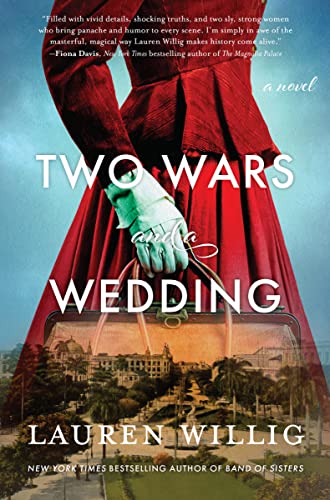
Two Wars and a Wedding
Two Wars and a Wedding is a loose prequel to Lauren Willig’s delightful Band of Sisters. This epic tells us the backstory of Dr. Ava Stringfellow and Betsy Rutherford, née Hayes, who led the Smith College Relief Unit that was the focus of that novel. It’s an interesting look at how history often repeats itself – the names and places might change, but as the old saying goes, the more things change, the more they stay the same.
We begin our story with Ms. Betsy Hayes, who is on a mission of mercy. She had goaded her friend Ava into being more adventurous and was subsequently horrified when she received a letter advising her that the medically minded Ava has decided to begin her exploits by heading to war-torn Cuba as a nurse. Betsy, having served as a nurse herself in the Greco-Turkish War, definitely doesn’t approve. War is a dangerous, horrible business, and she wants Ava nowhere near it. To forestall Ava’s going, Betsy comes up with the harebrained idea to volunteer herself in Ava’s place. Like many of Betsy’s ideas, this one goes wrong from the start.
This is a dual-timeline novel, so chapter one ends with Betsy in a bit of a mess in June of 1898, while in chapter two, we go back to find her in a bit of a mess in 1896. She’s with the American School of Classical Studies in Athens, determined to join them on their dig at Corinth. She has, after all, traveled halfway around the world with the express purpose of participating in an excavation. Betsy doesn’t quite understand why the professor thinks her class-skipping, feisty self isn’t suited to the work, but naturally blames it on misogyny. (It is, but she is also not the ideal person to break that glass ceiling.) Fortunately, making a friend of Aikaterini MacHugh means Betsy’s trip to Greece isn’t a complete waste of time.
Betsy quickly finds herself caught up in the social whirl that surrounds Aikaterini and is especially captivated by the charms of that lady’s good friend, Monsieur de Robecourt. He’s older, a wealthy historian who is enchanted by Betsy’s opinions and delightfully captivated by her spunky personality. For Betsy, who has faced endless disapproval from those who find her fiery temperament and determination to participate in unladylike activities unappealing, his fascination with her is enthralling. Betsy dreams of their being another “Mr. and Mrs. Radcliffe Emerson, both covered in dirt and dust, posing next to a half-excavated column”. A dream that is shattered when she learns Charles is very much married with no intentions of getting a divorce. She friend-zones him and redoubles her efforts to prove she is capable of the hard work and of mastering the difficult living conditions required of those who participate in archeological expeditions.
Part of her plan to prove her capability includes nursing during the war that has just broken out. Through a series of convoluted events, she finds herself running a small hospital for a week – which is apparently all the time it takes to master that particular profession. This begins her months-long odyssey in aiding the sick. Much will happen during this period that will change who she is, the trajectory of her life, and subsequently, Ava’s life as well.
It’s easy to wax lyrical regarding almost anything Ms. Willig writes. Of AAR’s listed twenty-two reviews of her work, nine are DIKs, with another nine being B+ grades. Her lowest ratings are the Bs that account for the other four reviews.
There’s a good reason for this. The author is an expert wordsmith who writes thoroughly enjoyable stories. Her historical research is nothing short of outstanding, and she regularly shines her spotlight on fascinating, often overlooked aspects of the past. Her stories are heroine-centric, and those heroines are spectacular, intriguing, intelligent women who are well worth knowing. Most of that is true of this novel.
What keeps the book from being a DIK read is Betsy. She is more spirited than smart or capable, and her emotions drive her more than her reason. At the start of the story, she is also woefully naïve, and her love interest, Charles de Robecourt, is a stereotypical practiced seducer of young women. While the author presents him with a degree of sincerity, his smooth compliments and artful courtship left me skeptically rolling my eyes every time he appeared on the page. Their affair shows a couple caught deeply in the whirlwind of their sexual chemistry, but I never believed it was more than that.
Additionally, I struggled with Betsy’s growth in this novel. Unlike Kate and Emmie from Band of Sisters, who grow into their best selves, Betsy grows into a different person. The young woman we begin the novel with would not have turned into the one we find throughout much of the middle and end portions. I had an ‘aha!’ moment when I read the author’s note and found out the character was based on the life experiences of two different women – which explained to me how we got two different Betsys. Had the narrative covered more time and events, I might have believed the transformation, but as it stands, I struggled with this aspect of the tale.
Another quibble I have is with Ava and Betsy’s friendship. While it is presented as lovely and powerful, it is also distant. The groundwork for their camaraderie was apparently laid during their years at Smith, but on the page, they spend relatively little time together. It feels in many ways that Betsy’s attitude towards Ava is what one feels towards a revered elder sibling; she desperately wants her approval, but it takes a bit of growing up for Betsy to see Ava as a fully formulated adult separate from Betsy’s ideal of her.
Fortunately, we get plenty of strong female friendships in the form of Aikaterini and Kit Carson, a fellow nurse/reporter Betsy meets during the Cuba portion of the story. Both these ladies help Betsy move towards becoming her best self and provide love and support throughout her journey to getting there.
Betsy’s relationship with Holt, a soldier in Cuba, is another highlight of the book. Holt is able to understand and accept Betsy in a way no one else in her life really has. Intelligent, capable, resourceful, and supportive, Holt is everything that a hero should be.
Two Wars and a Wedding isn’t perfect, but it is perfectly readable and enjoyable. The quibbles I’ve listed kept it from being quite as impactful for me as Band of Sisters or The English Wife, but they certainly won’t keep me from recommending it. If you enjoy heroine-centric historical novels at all, this is a must-read.
Recent Comments



I ended up on the opposite end of the spectrum that way; she’s woefully rash and naïve at first, but this changes when she gets older. But then I liked the 1898 segments more.
Ava and Betsey’s friendship is in this weird slot where it ties the novel together and yet is a very minor focus compared to Betsey’s relationship with Charles.
Also I really loved Kit and Holt.
Yes, Holt was great, and I loved him. I loved the 1898 portions of the book overall. It wasn’t even the 1896 portion that was a problem; it was the transitioning. I just felt the transformation wasn’t quite right, and a lot was explained by the two sections being based on two different people.
I liked this book perhaps more than you did – I would give it an A-! I adored Holt and I came to admire Betsy. I thought that she transformed herself into a remarkable, persevering woman. I also enjoyed the other women she met along the way.
I gave it an A- in my own review for the site as well! Similar minds. Gave Band of Sisters a B, tho.
I liked Band of Sisters a lot better than this one, and I loved the romance between Emmie and Captain Biscuits enough that I read portions of it half a dozen times. Different strokes for different folks :-)
Different strokes indeed! I love that we all have differing opinions!
I liked Holt a lot, too, and felt he was pretty much a perfect hero. I liked Betsy of 1898, and if the whole book had been about her, I would have loved it. But as I said, the two women were so different, and I just didn’t get how one had grown into the other. I did like the women she met along the way. Even Charles’ wife seemed like an intriguing character whom I would have liked to have known better.